
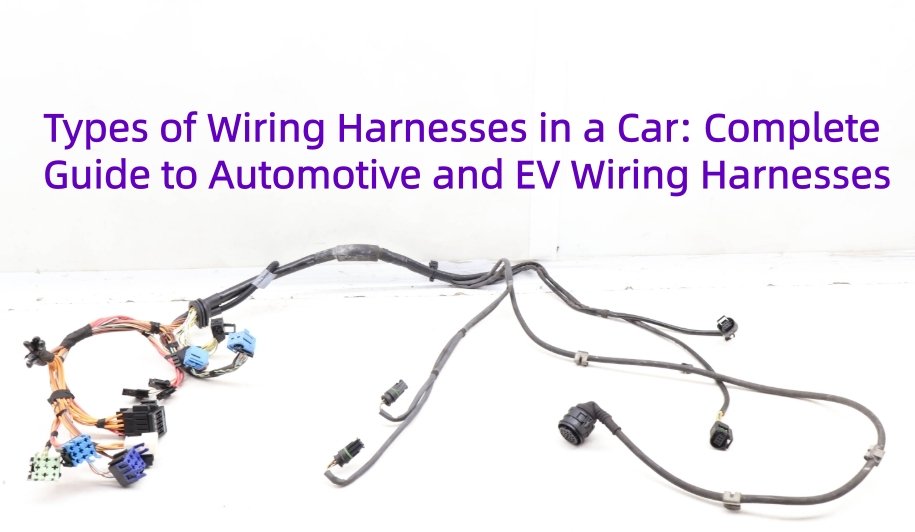
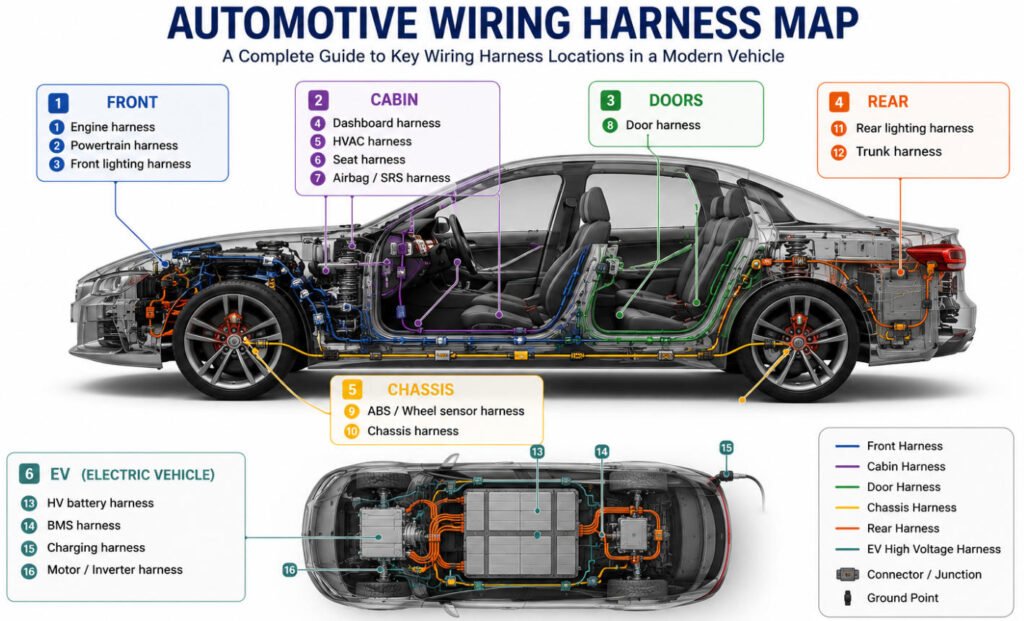
A car wiring harness is an organized network of wires, terminals, connectors, and protective components that distributes power, signals, and data throughout the vehicle electrical system. A modern wiring harness in car is not one single loom, but a combination of multiple regional and functional harnesses serving the engine, body, doors, dashboard, battery, sensors, lighting, and other systems.
The structure of an automotive wiring harness also differs significantly between ICE, hybrid, and EV platforms. This blog i will explains the main types of wiring harness in car, where they are located, what they do, and the key engineering and OEM manufacturing considerations.
From a manufacturing perspective, different harnesses require different wire gauges, connector systems, sealing levels, shielding, protective materials, and testing methods.
How Much Wiring Can Be Found in the Average Vehicle?
There is no single figure for how much wiring can be found in the average vehicle, because car wiring length varies significantly by vehicle size, trim level, electrical architecture, and whether the platform is ICE, hybrid, or electric.
According to Siemens, some modern vehicles contain close to 40 separate wiring harnesses, approximately 700 connectors, and more than 3,000 individual wires. If laid end to end, the wiring can exceed 2.5 miles (4 km) and weigh around 132 lb (60 kg).
| Typical Modern Vehicle Wiring | Approximate Figure |
|---|---|
| Separate wiring harnesses | Up to ~40 |
| Connectors | ~700 |
| Individual wires | 3,000+ |
| Total wiring length | 2.5+ miles / 4+ km |
| Automotive wiring weight | Up to ~60 kg |
So, when asking how many wires are in a car or how many wiring harnesses are in a car, the answer depends heavily on vehicle configuration.
Modern vehicles require more wiring because of increasing numbers of ECUs, ADAS systems, cameras, radar sensors, infotainment, connectivity, electrification, and high-speed data networks. Siemens also notes that modern vehicles can contain more than 70 specialty cables, including coaxial, USB, and high-speed data cables.
Manufacturer Insight: Greater electrical complexity does not only increase wire count; it also increases connector density, routing difficulty, branch-tolerance requirements, manufacturing complexity, and the number of circuits that must be electrically tested.
Is a Car Wiring Loom the Same as a Wiring Harness?
Yes. In most automotive applications, a car wiring loom and a wiring harness refer to the same general type of organized electrical assembly. The terminology varies mainly by region, industry, and manufacturer rather than by a strict technical difference.
| Term | Typical Usage |
|---|---|
| Wiring Harness | Most common engineering term for organized vehicle wiring assemblies |
| Wire Harness | Common OEM and manufacturing term |
| Wiring Loom | Common in the UK and automotive markets |
| Electrical Harness | Broader term for an electrical interconnection assembly |
For example, wiring looms for cars may include engine, dashboard, door, lighting, sensor, or body circuits in exactly the same way an automotive wiring harness does. Searches for automotive wiring loom, wiring loom car, or car electrical harness therefore often describe closely related products.
When comparing wire harness vs wiring loom, buyers should focus less on terminology and more on the actual construction, including wire specifications, connectors, terminals, branch dimensions, protection, sealing, and testing requirements.
Manufacturer Insight: Manufacturers normally rely on the drawing, BOM, connector specification, and customer requirements rather than the terminology alone.
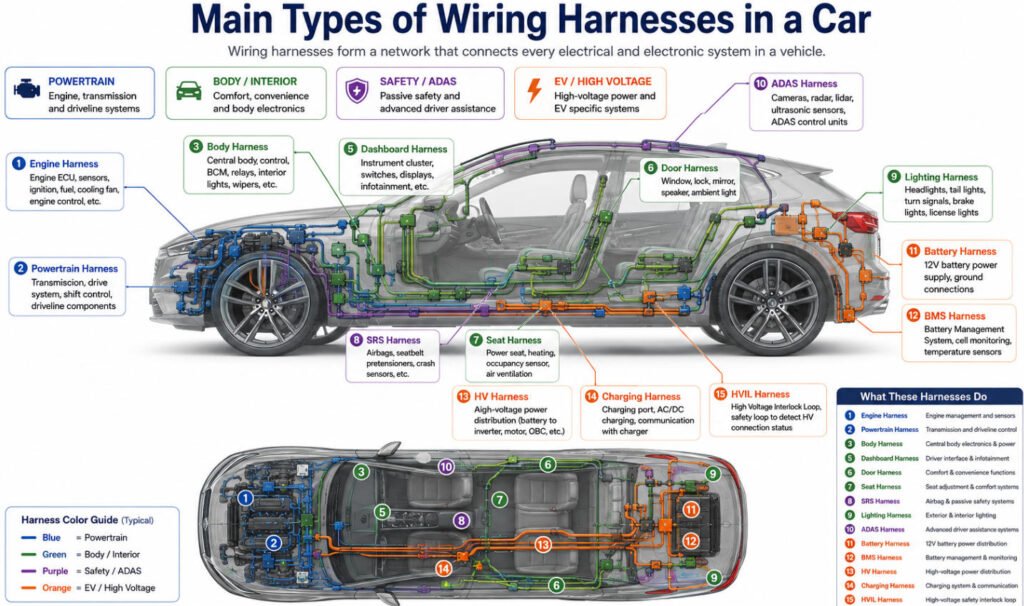
What Are the Main Types of Wiring Harnesses in a Car?
A modern vehicle uses multiple wiring harnesses rather than one single electrical bundle. Different types of wiring harnesses in a car are designed according to their location, electrical function, environmental exposure, movement, and safety requirements.
Different areas of a vehicle place very different demands on the wiring harness, so OEM engineers usually divide the electrical system into separate harnesses based on location, function, voltage level, and environmental exposure.
| Harness Type | Vehicle Location | Main Function | Typical Connections | Main Design Risk |
|---|---|---|---|---|
| Engine Harness | Engine bay | Power & signal | ECU, injectors, coils, sensors | Heat, vibration, oil |
| Powertrain Harness | Engine/transmission | Control & power | TCU, starter, alternator | Heat, vibration |
| Body Harness | Cabin/body | Power & signal | Locks, windows, lamps | Routing, abrasion |
| Chassis Harness | Underbody/frame | Power & signal | ABS, lights, sensors | Water, salt, stone impact |
| Dashboard Harness | Instrument panel | Signal & data | Cluster, HVAC, infotainment | High circuit density |
| Door Harness | Door hinge | Power & signal | Windows, locks, mirrors | Repeated flexing |
| Seat Harness | Seat assembly | Power & signal | Motors, heaters, sensors | Pinching, movement |
| Lighting Harness | Front/rear body | Power | LED modules, lamps | Moisture, heat |
| SRS Harness | Cabin | Safety signals | Airbags, pretensioners | Connection reliability |
| ADAS Harness | Vehicle perimeter | High-speed data | Cameras, radar, ECUs | EMI, data integrity |
| Battery Harness | Battery area | High current | Battery, fuse box | Voltage drop, temperature |
| BMS Harness | Battery pack | Measurement signal | Cells, sensors, BMS | Signal accuracy |
| HV Harness | EV powertrain | High-voltage power | Battery, inverter, motor | Insulation, EMI, safety |
| Charging Harness | Charge port | Power & communication | Port, OBC, battery | Water, heat |
| HVIL Harness | EV HV system | Safety interlock | HV connectors | Functional integrity |
The differences between these harnesses go beyond where they are installed. Each one must be designed around its specific electrical, mechanical and environmental demands.
1. Engine Wiring Harness
An engine wiring harness connects the ECU, injectors, ignition coils, sensors, starter, and alternator. It must withstand heat, vibration, oil, coolant, abrasion and moisture depending on location, 125°C class or higher temperature materials may be required.
2. Powertrain Wiring Harness
A powertrain wiring harness connects the engine, transmission, starter, alternator, TCU, sensors, and actuators. Key concerns include high temperature, vibration, current load, connector retention, and fluid exposure.
3. Body Wiring Harness
A body wiring harness supplies windows, locks, interior lighting, trunk systems, switches, and comfort electronics. Because it contains many branches, branch length, clip position, routing, and assembly tolerance are important manufacturing controls.
4. Chassis Wiring Harness
A chassis wiring harness connects ABS sensors, wheel-speed sensors, rear lighting, fuel-system components, and other underbody electronics. It requires strong protection against water, salt, road debris, abrasion, and vibration.
5. Dashboard / Instrument Panel Wiring Harness
A dashboard wiring harness or instrument panel wiring harness connects the cluster, HVAC, infotainment, switches, airbag modules, and gateway ECUs. The main challenges are high connector density, limited packaging space, and routing power, signal, and data circuits together.
6. Door Wiring Harness
A door wiring harness connects windows, locks, mirrors, speakers, and door sensors. Repeated bending at the door hinge makes flex life, bend radius, grommet design, and strain relief especially important.
7. Seat Wiring Harness
A seat wiring harness connects seat motors, heaters, ventilation, occupancy sensors, and seat-belt sensors. Routing must prevent pinching, stretching, and abrasion during repeated seat movement.
8. Lighting Wiring Harness
An automotive lighting harness powers headlights, tail lamps, DRLs, indicators, and LED modules. Important considerations include moisture protection, connector sealing, wire gauge, voltage drop, and heat near lighting components.
9. SRS / Airbag Wiring Harness
An SRS wiring harness connects airbags, crash sensors, pretensioners, and restraint-system control modules. Connector locking, pin position, traceability, and reliable electrical testing are especially important.
10. ADAS Wiring Harness
An ADAS wiring harness connects cameras, radar, sensors, and control units. High-speed data circuits may require shielding, controlled impedance, reliable grounding, and careful bend-radius control.
11. Battery Wiring Harness
A battery wiring harness carries high current between the battery, fuse box, starter, converters, and power-distribution units. Conductor size, crimp quality, resistance, voltage drop, and temperature rise are key engineering parameters.
12. BMS Wiring Harness
A BMS wiring harness connects battery cells, voltage-sensing points, temperature sensors, and the Battery Management System. Signal accuracy, pin position, small-wire crimping, and 100% circuit testing are critical.
13. High-Voltage Wiring Harness
A high-voltage wiring harness connects the EV battery, inverter, motor, DC/DC converter, and other HV components. It requires suitable insulation, shielding, sealing, high-current terminations, and safety features such as HVIL where specified.
14. Charging Wiring Harness
A charging wiring harness connects the charge port, on-board charger, battery system, and related communication circuits. Water sealing, current capacity, connector temperature, strain relief, and repeated mating must be considered.
15. HVIL Wiring Harness
An HVIL harness forms part of the High Voltage Interlock Loop used to monitor high-voltage connections. Correct routing, terminal retention, connector sequencing, and continuity are essential for reliable system monitoring.
What Wiring Harnesses Are Used in the Engine and Powertrain?
Engine and powertrain systems use several dedicated harnesses to carry power, control signals, and sensor data between the engine, transmission, starter, alternator, and electronic control units.
Engine Wiring Harness
An engine wiring harness, also called an engine harness, engine wire harness, or automotive engine harness, connects the ECU, injectors, ignition coils, temperature and pressure sensors, starter, alternator, and other engine components.
Because a car engine wiring harness operates close to heat, oil, coolant, vibration, moisture, and abrasion, it typically requires high-temperature wire, sealed connectors, protective sleeving, and secure routing.
Transmission Wiring Harness
A transmission wiring harness or automotive transmission harness connects the transmission control unit, solenoids, speed sensors, pressure sensors, and related actuators.
The main engineering risks are oil exposure, elevated temperature, vibration, and connector contamination, so a transmission wire harness often requires fluid-resistant insulation, sealed connectors, reliable terminal retention, and controlled routing.
Starter and Alternator Wiring Harness
A starter wiring harness and alternator wiring harness carry relatively high current between the battery, starter motor, alternator, fuse box, and power distribution system.
These assemblies may use a high current automotive cable or battery cable assembly with larger conductor cross-sections. Key manufacturing controls include terminal crimping, ultrasonic welding where applicable, low connection resistance, voltage-drop control, and temperature-rise validation.
What Wiring Harnesses Are Used in the Body and Interior?
Body and interior harnesses distribute power, signals, and data across the cabin, doors, dashboard, seats, HVAC system, lighting, and other comfort or control functions.
Body Wiring Harness
A body wiring harness, also called an automotive body harness or main body wiring harness, connects multiple body-control modules, switches, lamps, locks, windows, and convenience systems.
Because it is one of the more complex branching harnesses in a vehicle, key manufacturing controls include branch length, breakout position, clip location, connector orientation, and routing accuracy.
Dashboard Wiring Harness
A dashboard wiring harness, instrument panel wiring harness, or dash wiring harness connects the instrument cluster, switches, HVAC controls, infotainment, displays, airbags, and gateway modules.
The main engineering challenges are high connector density, limited packaging space, multiple signal types, and accurate branch dimensions.
Door Wiring Harness
A door wiring harness or car door wiring harness connects power windows, locks, mirrors, speakers, switches, and door sensors.
As a high flex automotive harness, it must withstand repeated movement at the door hinge, making flex life, bend radius, grommet design, and strain relief especially important.
Seat, HVAC and Interior Wiring Harnesses
A seat wiring harness connects motors, heaters, ventilation, and occupancy sensors, while an HVAC wiring harness supports blowers, actuators, sensors, and climate-control modules.
Other interior wiring harnesses and automotive lighting harnesses may connect ambient lighting, roof electronics, consoles, and other cabin systems where compact routing and reliable connector retention are important.
What Wiring Harnesses Are Used for Vehicle Safety and ADAS Systems?
Modern safety and ADAS systems rely on dedicated harnesses to carry safety signals, sensor data, and high-speed communication between airbags, wheel sensors, cameras, radar units, and electronic control modules.
Airbag / SRS Wiring Harness
An airbag wiring harness, SRS wiring harness, or automotive safety harness connects crash sensors, airbag control units, airbags, and seat-belt pretensioners.
Key requirements include reliable electrical connections, secure connector locking, controlled assembly, and complete traceability because these circuits are directly related to vehicle safety functions.
ABS and Wheel Sensor Wiring Harness
An ABS wiring harness, wheel speed sensor harness, or automotive sensor harness connects wheel-speed sensors and related chassis control systems.
Because these harnesses operate close to the wheels and underbody, they must withstand water, road debris, repeated flexing, vibration, and wide temperature changes.
Camera, Radar and ADAS Wiring Harness
An ADAS wiring harness connects cameras, radar sensors, ultrasonic sensors, and control modules used for driver-assistance and automated driving functions.
An automotive camera harness, automotive radar cable, or automotive sensor cable may require a shielded automotive cable, waterproof connectors, controlled impedance, and carefully managed routing to reduce EMI and maintain data integrity.
What Wiring Harnesses Carry Data and Connectivity Signals in a Car?
Modern vehicles use dedicated data and connectivity harnesses to transmit communication signals between ECUs, cameras, infotainment systems, antennas, sensors, and other electronic modules.
CAN and LIN Wiring Harnesses
A CAN bus wiring harness and LIN harness carry control and communication signals between vehicle ECUs, sensors, switches, and actuators. Reliable routing, connector quality, and noise control are important for stable network communication.
Automotive Ethernet and High-Speed Data Harnesses
An automotive Ethernet harness or high speed automotive cable supports high-bandwidth communication for ADAS, cameras, central computing, infotainment, and zonal vehicle architectures.
These assemblies may require twisted-pair construction, shielding, controlled impedance, and carefully selected connectors.
Coaxial, Camera and Infotainment Harnesses
An automotive coaxial cable is commonly used for camera data, RF signals, GPS, and antenna connections, while an infotainment wiring harness connects displays, audio systems, USB interfaces, and communication modules.
An antenna wiring harness may also connect radio, GPS, cellular, Wi-Fi, or other wireless systems.
What Wiring Harnesses Are Used for Automotive Data and ADAS Systems?
Modern vehicles rely on increasingly complex data networks in addition to traditional power and control circuits. Dedicated automotive data harnesses connect ECUs, cameras, radar sensors, infotainment systems, antennas, and other high-speed electronic modules.
CAN Bus Wiring Harness
A CAN bus wiring harness or automotive CAN harness connects ECUs, sensors, switches, and actuators across the vehicle communication network.
Key design considerations include twisted-pair construction, routing, grounding, connector quality, and protection against electromagnetic interference.
Automotive Ethernet Harness
An automotive Ethernet cable or automotive Ethernet wiring harness supports higher data rates for ADAS, infotainment, central computing, and zonal vehicle architectures.
These harnesses may require controlled impedance, precise cable geometry, shielding, and connectors designed for high-speed automotive communication.
Camera and ADAS Harness
An ADAS wiring harness or camera wiring harness automotive connects cameras, radar, ultrasonic sensors, and control units used for driver-assistance functions.
An automotive camera cable must maintain reliable signal transmission while withstanding vibration, temperature changes, moisture, and vehicle movement.
FAKRA and Coaxial Harness
A FAKRA cable assembly and automotive coaxial cable are commonly used for cameras, GPS, radio, cellular, antenna, and other RF or high-frequency connections.
Connector assembly, shielding continuity, cable bend radius, and termination quality can directly affect signal performance.
Why Do Different Car Wiring Harnesses Use Different Designs?
Different vehicle harnesses use different wire gauges, insulation materials, connectors, shielding, protection, and routing because each part of the vehicle sees a different electrical and mechanical environment. In our experience, a harness design that works well inside the cabin may fail quickly if the same design is used near the engine, underbody, or a moving door.
1.Current Load
Current requirement is one of the biggest design differences.
A battery or starter harness may carry high current and therefore needs larger conductors, low-resistance terminals, and careful temperature-rise control. A sensor harness, by contrast, may carry only small signal currents and can prioritize signal stability rather than conductor size.
2.Temperature
Temperature varies significantly throughout the vehicle.
An engine-bay harness may be exposed to elevated temperatures from the engine, exhaust, turbocharger, or cooling system, while a cabin harness normally operates in a less severe thermal environment.
This affects:
- Wire insulation material
- Connector temperature rating
- Tape and sleeve selection
- Terminal and seal materials
Some harnesses remain almost completely stationary, while others move thousands of times during vehicle use.
A door wiring harness must repeatedly flex at the hinge area, so bend radius, flexible conductor construction, grommet design, and strain relief are important.
A dashboard harness is mostly fixed, so packaging density and routing accuracy are usually more important than continuous flex life.
3.Moisture and Contamination
An underbody or chassis harness may be exposed to:
- Water
- Road salt
- Mud
- Dust
- Automotive fluids
- Stone impact
These applications often require sealed connectors, protective tubing, abrasion resistance, and stronger environmental protection.
Interior cabin harnesses usually require less sealing but may have tighter routing and packaging constraints.
4.EMI and EMC
Not every circuit handles the same type of electrical signal.
Lighting and basic power circuits are generally less sensitive to electromagnetic interference than:
- Sensors
- CAN bus
- LIN bus
- Automotive Ethernet
- Camera systems
- Radar systems
For sensitive or high-speed circuits, engineers may use twisted pairs, shielding, drain wires, controlled routing, or separation from high-current cables to maintain signal integrity and EMC performance.
5.Voltage Level
Modern vehicles may contain several voltage systems, including:
- 12 V
- 24 V
- 48 V
- EV high-voltage systems
A 12 V body harness and an EV high-voltage harness cannot use the same design approach.
High-voltage systems require additional consideration of:
- Insulation rating
- Creepage and clearance
- Shielding
- HV connectors
- Interlock circuits
- Electrical safety
- Hi-pot and insulation resistance testing
Installation Space
6.Vehicle packaging space is often very limited.
Dashboard and door areas can contain large numbers of connectors, clips, branches, electronic modules, and moving components within a small space.
This makes the following especially important:
- Branch length
- Connector orientation
- Bend radius
- Clip position
- Harness diameter
- Assembly sequence
A harness that is electrically correct can still cause production problems if it cannot be routed or installed efficiently.
Manufacturer Note
In our factory experience, wire harness design should always start from the actual vehicle zone and operating conditions. High-current battery cables, flexible door harnesses, sealed chassis harnesses, and shielded ADAS harnesses may all belong to the same vehicle, but they require very different materials, connector systems, routing strategies, and validation methods.
This is why automotive harness engineering is not simply about connecting point A to point B. The design must match the electrical load, temperature, movement, moisture, EMC environment, voltage level, and available installation space of each vehicle system.
What Types of Wiring Harnesses Are Used in Electric Vehicles?
An EV wiring harness is more complex than a conventional vehicle harness because an electric vehicle combines low-voltage control circuits, high-voltage power distribution, battery monitoring, charging, and thermal-management systems. A complete electric vehicle wiring harness architecture may therefore include several specialized harnesses rather than one single EV wire harness.
The most common EV wiring harness types can be grouped by their role in power distribution, charging, battery monitoring, control, and thermal management, as shown below.
1.High-Voltage Battery Harness
The high-voltage battery harness connects the battery pack to high-voltage distribution components and power electronics.
Main requirements: high-voltage insulation, large conductor size, secure terminals, shielding where required, and reliable connector locking.
2.Inverter-to-Motor Harness
This high voltage wiring harness carries power between the inverter and electric motor.
Main requirements: high current capacity, shielding, EMI control, temperature resistance, and vibration resistance.
3.Charging Port Harness
The charging port harness connects the vehicle inlet to the onboard charger and related control circuits.
Main requirements: sealing, temperature control, connector retention, electrical isolation, and resistance to repeated plugging cycles.
4.DC-DC Converter Harness
This harness connects the high-voltage system to the DC-DC converter, which supplies lower-voltage vehicle circuits.
Main requirements: correct voltage rating, conductor sizing, insulation, routing, and connector compatibility.
5.BMS Harness
The BMS harness connects battery cells, temperature sensors, voltage-sensing circuits, and the battery management system.
Main requirements: accurate signal transmission, stable terminals, compact routing, and clear circuit identification.
6.HVIL Harness
The HVIL harness forms part of the High Voltage Interlock Loop and monitors whether high-voltage connectors and covers are correctly connected.
Main requirements: reliable continuity, correct pin assignment, connector engagement, and traceability.
7.Low-Voltage EV Harness
The low-voltage harness supports systems such as ECUs, sensors, lighting, infotainment, pumps, and control modules.
Main requirements: compact routing, connector density, signal integrity, and standard automotive environmental protection.
8.Thermal Management Harness
This harness connects pumps, valves, heaters, fans, temperature sensors, and thermal-control modules used to manage battery and drivetrain temperature.
Main requirements: temperature resistance, moisture protection, connector sealing, and reliable operation around coolant systems.
Low Voltage vs High Voltage EV Harness
| Feature | Low Voltage Harness | High Voltage Harness |
|---|---|---|
| Voltage | 12V / 24V / 48V systems | Hundreds of volts depending on vehicle architecture |
| Cable Size | Generally smaller | Generally larger |
| Shielding | Sometimes required | Often required |
| Color | Various colors | Commonly orange |
| Testing | Continuity, resistance, pin verification | Hi-pot, insulation resistance, continuity, shielding checks |
| Applications | Lights, ECUs, sensors, infotainment | Battery, inverter, motor, charger |
ICE vs Hybrid vs EV Wiring Harnesses
The wiring architecture of an internal-combustion vehicle, hybrid, and EV differs significantly because each platform has different power sources, voltage levels, propulsion systems, and electronic-control requirements.
The table below highlights the key differences in wiring architecture between ICE, hybrid, and electric vehicles, especially in voltage level, propulsion-related harnesses, data requirements, and shielding needs.
| Feature | ICE Vehicle | Hybrid Vehicle | Electric Vehicle |
|---|---|---|---|
| Low-Voltage Harness | Yes | Yes | Yes |
| High-Voltage Harness | Limited / typically not part of propulsion | Yes | Yes |
| Engine Harness | Major system | Yes | No or greatly reduced |
| Battery HV Harness | No | Yes | Yes |
| Motor / Inverter Harness | No | Yes | Yes |
| BMS Harness | Limited | Yes | Yes |
| High-Speed Data | Increasing | High | High |
| Shielding Demand | Moderate | Higher | Higher |
An ICE vs EV wiring harness comparison shows that conventional vehicles rely heavily on engine, transmission, starter, alternator, and 12 V body harnesses. A hybrid vehicle wiring harness combines these traditional circuits with high-voltage battery, motor, inverter, and BMS connections.
An EV wiring harness is even more dependent on the electric vehicle wiring system, where battery, inverter, motor, charger, DC-DC converter, BMS, and thermal-management systems all require dedicated wiring.
Manufacturer Insight: EV harnesses do not simply replace engine wiring with thicker cables; automotive high voltage wiring introduces additional requirements for insulation, shielding, temperature rise, sealing, low-resistance terminations, and high-voltage interlock functions.
How Do OEM Engineers Choose the Right Automotive Wiring Harness?
Automotive wiring harness selection starts with the actual operating conditions of the vehicle system. OEM engineers should define the electrical load, routing path, connector interfaces, movement, environment, and testing requirements before choosing the final harness construction.
The table below provides a practical guide for common applications.
| Application | Main Requirement | Typical Harness |
|---|---|---|
| Engine Bay | Heat, oil, vibration | High-temperature sealed harness |
| Door | Repeated flexing | High-flex harness |
| Dashboard | Dense connections and limited space | Multi-branch low-voltage harness |
| ADAS Camera | High-speed data and signal integrity | Shielded data harness |
| Wheel Sensor | Water, debris, vibration | Sealed sensor harness |
| EV Battery | High voltage and high current | High-voltage harness |
| BMS | Small signals and measurement accuracy | Fine-wire signal harness |
For a custom automotive wiring harness, the final design should also consider wire gauge, connector sealing, shielding, branch geometry, protection materials, and service access.
Manufacturer Insight
In OEM projects, the correct vehicle wiring harness design is usually determined by the application rather than by selecting a standard harness type first. At Yihetai, we recommend defining current load, routing, connector interfaces, movement, environmental exposure, and test requirements before finalizing the OEM automotive wiring harness construction.
How Is Zonal Architecture Changing Automotive Wiring Harnesses?
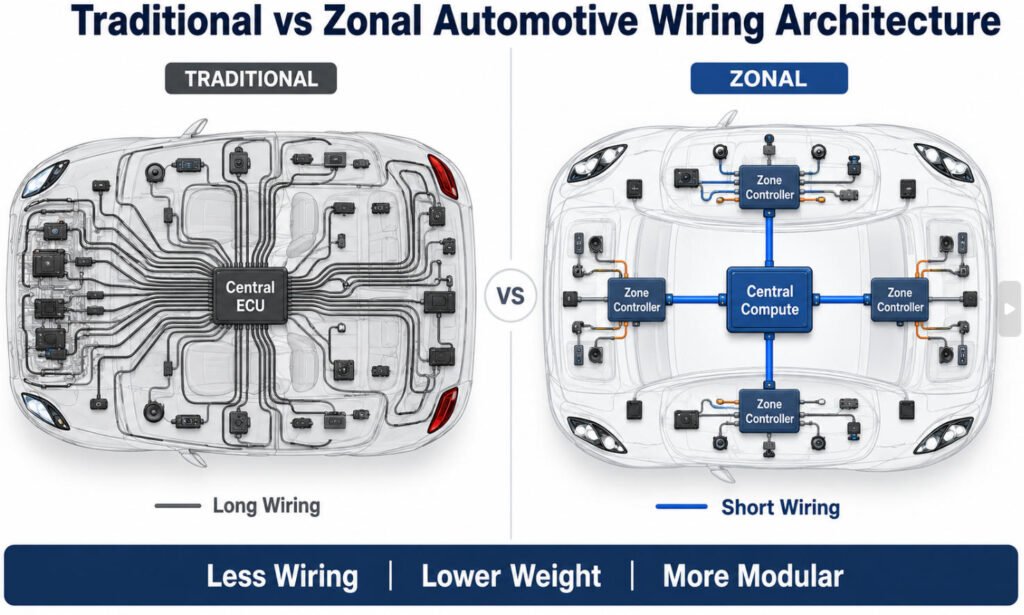
Traditional vehicle wiring architecture relies heavily on long point-to-point connections between central ECUs and individual devices. In a zonal vehicle architecture, the structure becomes more distributed:
Traditional: Central ECU → Long Point-to-Point Wiring
Zonal: Central Compute → Zone Controller → Local Devices
This change affects both the automotive E/E architecture and the physical zonal wiring harness design.
Key benefits include:
- Shorter cable runs and simpler routing
- Lower wiring weight
- More modular harness assemblies
- Greater use of automotive Ethernet
- Easier automation and vehicle assembly
- Increased use of 48V automotive wiring in some systems
- More standardized connector and zone-controller interfaces
For software-defined vehicles, this architecture also supports higher data bandwidth and more centralized computing while reducing the number of long individual circuits.
Manufacturer Insight
Automotive zonal architecture does not eliminate wiring harnesses. It changes where harnesses are concentrated and increases demand for modular, high-speed, and highly repeatable interconnect assemblies. From a manufacturing perspective, this places more emphasis on connector consistency, data-cable performance, branch accuracy, shielding, and scalable modular assembly.
Conclusion
A modern vehicle uses multiple car wiring harness systems to distribute power, signals, and data across different vehicle zones. The design of an automotive wiring harness varies significantly between ICE, hybrid, and EV platforms, so wire selection, connectors, crimping, sealing, routing, shielding, and testing must all match the application.
For OEM projects, a reliable custom automotive wiring harness should be engineered around the actual electrical architecture and operating environment. If you are developing a custom harness, send Yihetai your drawing, BOM, connector information, or sample for an engineering review and quotation from an experienced automotive wire harness manufacturer.
Read more: Types of Wiring Harnesses in a Car: Complete Guide to Automotive and EV Wiring HarnessesRelated Wire Harness Articles:
- What Is a Wiring Harness? A Complete OEM Guide to Types, Components, Manufacturing, Testing and Supplier Selection
- Automotive Wire Harness Protection Materials: Corrugated Tube, Tape, Sleeves and Foam Compared
- Top 24 Automotive Wire Harness Manufacturers for OEM Projects
- Wire Strain Relief Methods: Types, Design, Testing and How to Choose the Right Solution
- How to Design a Custom Wire Harness for Harsh Environments?