
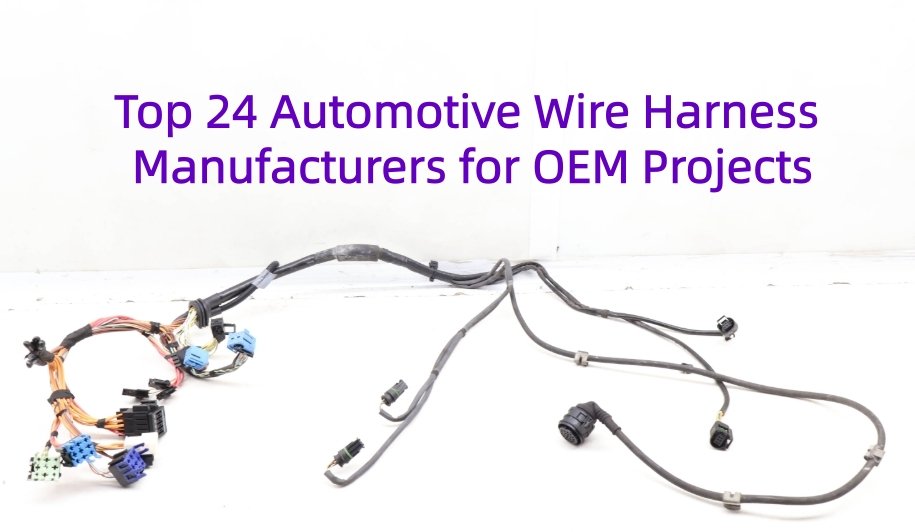
Modern automotive wire harnesses are becoming increasingly complex. The rapid growth of electric vehicles (EVs), ADAS, high-voltage systems, CAN bus, and Automotive Ethernet has significantly raised the technical requirements for wire harness design and manufacturing.
Today, success depends not only on cost, but on a supplier’s engineering expertise, quality control, and manufacturing capabilities. As a result, choosing the right supplier is now far more important than choosing the lowest price.
In this blog, we’ve selected some of the leading automotive wire harness manufacturers worldwide and provide practical tips to help you choose the right supplier for your project.
What Is an Automotive Wire Harness?
An automotive wire harness is an organized assembly of wires, connectors, and terminals that delivers power and transmits signals between a vehicle’s electrical and electronic systems. It ensures reliable, safe, and efficient operation of modern vehicles.
What Are The Types of Automotive Wire Harnesses?
Different vehicle systems require different types of wire harnesses, each designed for specific electrical, environmental, and mechanical requirements.
1. Engine Wire Harness
Connects the engine, sensors, fuel system, and ECU. It is designed to withstand high temperatures, vibration, and exposure to oil and chemicals.
2. Dashboard Wire Harness
Distributes power and signals to the instrument cluster, infotainment system, switches, climate controls, and other dashboard electronics.
3. Battery Wire Harness
Transfers power between the battery, starter, alternator, and other electrical systems. It is built to handle high current loads safely.
4. Lighting Wire Harness
Supplies power to headlights, taillights, fog lights, interior lighting, and signal lamps while ensuring reliable electrical connections.
5. Door Wire Harness
Connects power windows, door locks, mirrors, speakers, and other electronic components inside the vehicle doors.
6. Body Wire Harness
Links electrical systems throughout the vehicle body, including lighting, HVAC, seating, and other comfort and convenience features.
7. High-Voltage (HV) Wire Harness
Used in electric and hybrid vehicles to connect the battery pack, inverter, motor, and charging system. It requires high-voltage insulation and enhanced safety protection.
8. Charging Wire Harness
Transfers power between the charging port, onboard charger, and battery system in electric vehicles, supporting safe and efficient charging.
9. Trailer Wire Harness
Provides electrical connections between the vehicle and trailer for lighting, braking, and auxiliary power functions.
10. Sensor Wire Harness
Connects sensors for systems such as ABS, ADAS, engine management, and tire pressure monitoring, ensuring accurate signal transmission.
11. Infotainment Wire Harness
Supports multimedia, navigation, displays, cameras, USB ports, and communication systems, often requiring high-speed data transmission.
What Are the Key Components of an Automotive Wire Harness?
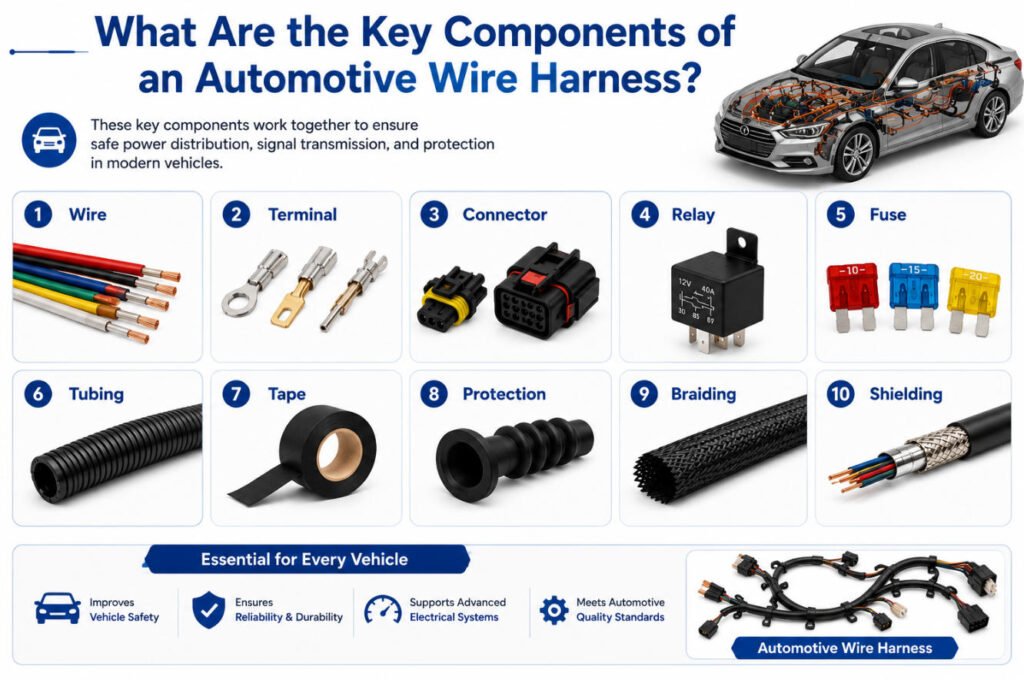
An automotive wire harness consists of several essential components that work together to ensure reliable power distribution, signal transmission, and long-term durability in demanding vehicle environments.
- Wire – Carries electrical power and signals between different vehicle systems.
- Terminal – Crimped or soldered onto wires to create secure electrical connections.
- Connector – Joins multiple circuits while allowing easy installation and maintenance.
- Relay – Controls high-current circuits using a low-current electrical signal.
- Fuse – Protects electrical circuits by interrupting the current during overloads or short circuits.
- Tubing – Provides insulation and mechanical protection for wires and cable bundles.
- Tape – Bundles wires together while reducing vibration, noise, and abrasion.
- Protective Sleeving – Shields the harness from heat, moisture, chemicals, and mechanical damage.
- Braiding – Adds extra abrasion resistance and improves the harness’s flexibility.
- Shielding – Minimizes electromagnetic interference (EMI) to ensure stable signal transmission, especially in ·CAN, Ethernet, and high-speed communication systems.
How Automotive Wire Harnesses Are Manufactured?
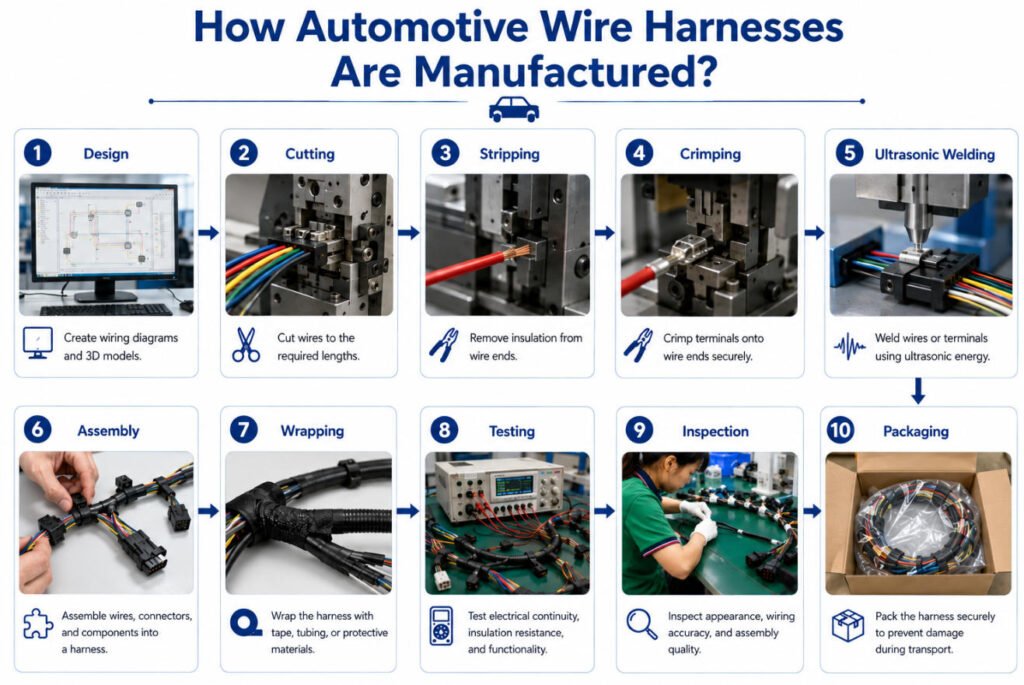
A reliable automotive wire harness depends not only on quality materials but also on a well-controlled manufacturing process. In our 25 years of manufacturing custom wire harnesses, we’ve found that consistent process control and 100% testing are essential to meeting the high reliability standards required by the automotive industry.
Manufacturing Process:
Design
Engineers review customer drawings, select suitable wires, terminals, and connectors, and optimize the harness design for manufacturing.
↓
Cutting
Wires are automatically cut to precise lengths according to production specifications.
↓
Stripping
The insulation is removed from wire ends without damaging the conductor.
↓
Crimping
Terminals are crimped onto the wires using calibrated equipment to ensure reliable electrical and mechanical connections.
↓
Ultrasonic Welding
Where required, multiple wires are joined using ultrasonic welding to create strong, low-resistance connections.
↓
Assembly
Connectors, terminals, clips, and protective components are assembled according to the wiring layout.
↓
Wrapping
Tape, tubing, braided sleeving, and protective materials are applied to improve durability and protect against vibration, heat, and abrasion.
↓
Testing
Each harness undergoes electrical testing, including continuity, wire sequence, and insulation verification to ensure correct performance.
↓
Inspection
Finished products are visually inspected to verify dimensions, workmanship, labeling, and overall quality.
↓
Packaging
Qualified wire harnesses are packaged according to customer requirements to ensure safe transportation and complete traceability.
How to Choose an Automotive Wire Harness Manufacturer
Selecting the right automotive wire harness manufacturer is about much more than comparing prices. In our experience manufacturing custom wire harnesses for OEM customers, many production issues result from weak engineering support, inconsistent processes, or inadequate quality control rather than the wire harness itself. Here are 12 keys factors to evaluate before choosing a supplier.
1. Automotive Program Experience
Choose a manufacturer with experience in automotive applications, including passenger vehicles, commercial vehicles, EVs, or specialty vehicles.
2. Engineering & DFM Support
A qualified supplier should review your drawings, BOM, and specifications, and provide Design for Manufacturability (DFM) suggestions before production.
3. IATF 16949 Quality System
IATF 16949 certification demonstrates that the manufacturer follows automotive quality management requirements and continuous improvement processes.
4. APQP & PPAP Capability
For OEM projects, verify that the supplier can support APQP planning, PPAP documentation, and engineering change management.
5. Connector Sourcing
Ensure the manufacturer can source genuine connectors and terminals from approved brands or qualified alternatives when required.
6. Crimp-Force Monitoring
Reliable crimping is critical for long-term performance. Automated crimp-force monitoring helps detect defective crimps during production.
7. Ultrasonic Welding
For high-current or wire-to-wire connections, ultrasonic welding provides consistent, low-resistance joints with excellent reliability.
8. High-Voltage Manufacturing Capability
If your project involves hybrid or electric vehicles, confirm the supplier has experience with high-voltage cables, shielding, insulation, and HV testing.
9. Electrical Testing
A professional manufacturer should perform 100% electrical testing, including continuity, short-circuit, pin assignment, and insulation verification where applicable.
10. Environmental Testing
Depending on the application, additional tests such as temperature cycling, vibration, waterproof, salt spray, or pull-force testing may be required.
11. Traceability
Good manufacturers maintain batch traceability for materials, production records, and test results to support quality control and after-sales service.
12. Production Capacity & Delivery
Finally, evaluate the supplier’s production capacity, lead time, inventory management, and ability to scale from prototypes to mass production without compromising quality.
Top 24 Automotive Wire Harness Manufacturers for OEM Projects
1. Yazaki Corporation
Founded: 1929
Website: www.yazaki-group.com
Headquarters: Tokyo, Japan
Main products: Automotive wire harnesses, connectors, terminals, meters, junction blocks, and high-voltage distribution systems.
Manufacturing capabilities: Global engineering, wire production, connector manufacturing, harness assembly, validation, and large-scale platform production.
Certifications: IATF 16949, ISO 9001, ISO 14001, and OEM-specific quality systems at applicable facilities.
Best for: Global passenger-car and commercial-vehicle platforms requiring multi-country production.
Buyer notes: Yazaki is highly suitable for large OEM programs requiring global engineering and supply-chain coordination. Smaller OEMs, prototypes, and low-volume programs may find its qualification process, commercial requirements, and minimum project scale less flexible than those of specialized custom manufacturers. Yazaki traces its wire-harness business to 1929 and remains one of the industry’s largest global suppliers.
2. Sumitomo Wiring Systems

Founded: 1917
Website: www.sws.co.jp
Headquarters: Yokkaichi, Japan
Main products: Low-voltage harnesses, aluminum harnesses, high-voltage motor cables, connectors, terminals, junction blocks, and electronic modules.
Manufacturing capabilities: Material development, component design, harness engineering, automated wire processing, global assembly, and vehicle-level validation.
Certifications: IATF 16949, ISO 9001, ISO 14001
Best for: Japanese and global OEM programs requiring lightweight wiring and stable worldwide supply.
Buyer notes: Sumitomo is particularly strong in large, long-term vehicle platforms and aluminum wiring technology. Its global structure benefits multinational OEMs, but smaller customers should confirm engineering access, development charges, nomination requirements, and regional production responsibility early. The group produces harnesses, high-voltage cables, connectors, and related automotive electronics across an extensive international network.
3. Aptiv PLC

Founded: 1994 as Delphi Automotive Systems; renamed Aptiv in 2017
Website: www.aptiv.com
Headquarters: Dublin, Ireland
Main products: Electrical distribution systems, high-voltage wiring, connectors, terminals, vehicle architecture, ADAS, and data-connectivity solutions.
Manufacturing capabilities: Vehicle electrical architecture design, connector development, harness production, high-voltage systems, software integration, and global program management.
Certifications: IATF 16949, ISO 9001, ISO 14001, ISO 26262-related development processes
Best for: Complex EV, ADAS, connected-vehicle, and zonal-architecture programs.
Buyer notes: Aptiv is best suited to OEMs requiring system-level electrical architecture rather than build-to-print harness assembly alone. Its engineering value is high, but development costs, program qualification, and commercial entry requirements may be excessive for basic or low-volume harness projects.
4. Lear Corporation

Founded: 1917
Website: www.lear.com
Headquarters: Southfield, Michigan, USA
Main products: Low-voltage and high-voltage wire harnesses, terminals, connectors, battery connection systems, electronic modules, and power-distribution products.
Manufacturing capabilities: Complete E-Systems engineering, harness architecture, connector design, automated assembly, high-voltage production, and global vehicle-platform support.
Certifications: IATF 16949, ISO 9001, ISO 14001
Best for: Global EV and conventional vehicle platforms requiring integrated electrical distribution systems.
Buyer notes: Lear offers strong vehicle-level engineering and global launch support. It is more appropriate for strategic OEM programs than simple quotation-driven sourcing, and buyers should clarify whether Lear will supply a complete electrical system or an individual build-to-print harness. Lear supports both 12–48 V systems and high-voltage electrified powertrains.
5. CelLink Corporation

Founded: 2011
Website: cellinktechnologies.com
Headquarters: San Carlos, California, USA
Main products: Flexible automotive wiring harnesses, battery interconnects, power and signal circuits, lightweight electrical distribution systems, and flexible circuit assemblies.
Manufacturing capabilities: Flexible-circuit design, automated production, battery and module interconnection, integrated power and data transmission, lightweight harness manufacturing, and high-volume automotive production.
Certifications: IATF 16949, ISO 9001, ISO 14001
Best for:EV battery packs, lightweight vehicle electrical systems, automated harness production, sensors, modules, and advanced automotive architectures.
Buyer notes: CelLink is not a traditional round-wire harness manufacturer. It is valuable because it represents a newer flexible-harness technology that can reduce weight and automate production. Its Texas expansion has been designed to support high-volume EV applications.
6. Motherson

Founded: 1986
Website: www.motherson.com
Headquarters: Noida, India
Main products: Automotive wiring harnesses, high-voltage systems, connectors, electrical distribution units, cockpit modules, and vehicle components.
Manufacturing capabilities: Global harness engineering, vertically integrated component sourcing, low- and high-voltage assembly, testing, and multi-region production.
Certifications: IATF 16949, ISO 9001, ISO 14001, ISO 45001
Best for: OEMs seeking large-scale global production with a strong presence in Asia and emerging markets.
Buyer notes: Motherson offers broad geographic coverage and competitive large-volume manufacturing. Buyers should identify the exact business division and production plant because engineering capability, vertical integration, and customer focus may differ across its extensive group structure.
7. Technical Cable Applications
Founded: 2002
Website: www.technicalcable.com
Headquarters: Auburn, Washington, USA
Main products: Custom automotive wire harnesses, transportation harnesses, battery cables, molded cable assemblies, EV cable assemblies, and industrial cable assemblies.
Manufacturing capabilities: Custom wire cutting, crimping, cable assembly, molding, prototype manufacturing, electrical inspection, component tracking, and domestic US production.
Certifications: ISO 9001:2015, UL, ITAR
Best for: North American OEMs, specialty vehicles, transport equipment, prototypes, low-to-medium volumes, and customers seeking US-based manufacturing.
Buyer notes: Technical Cable smaller than global Tier 1 suppliers but may be more relevant to buyers seeking flexible production, engineering communication and domestic supply.
8. AQ Wiring Systems

Founded: 1985
Website:www.aqgroup.com
Headquarters: Västerås, Sweden
Main products: Automotive wiring harnesses, commercial-vehicle harnesses, power cables, cable assemblies, and electromechanical modules.
Manufacturing capabilities: Manufacturing-documentation development, prototype production, harness assembly, electromechanical integration, series manufacturing, testing, and global production support.
Certifications: AQ,UL
Best for:Commercial vehicles, buses, trucks, industrial vehicles, railway equipment, agricultural machinery, and complex electromechanical assemblies.
Buyer notes: Commercial vehicles, buses, trucks, industrial vehicles, railway equipment, agricultural machinery, and complex electromechanical assemblies.
9. DRÄXLMAIER Group

Founded: 1958
Website: www.draexlmaier.com
Headquarters: Vilsbiburg, Germany
Main products: Complete vehicle wiring systems, high-voltage battery systems, electrical components, interiors, and premium-vehicle electronics.
Manufacturing capabilities: Full electrical-system development, high-voltage engineering, battery-system integration, harness production, testing, and global launch management.
Certifications: IATF 16949, ISO 9001, ISO 14001, ISO 45001
Best for: Premium and luxury vehicle platforms with complex electrical architectures.
Buyer notes: DRÄXLMAIER is well matched to premium OEMs requiring deep co-development and platform integration. It is generally not the first choice for small aftermarket runs, simple replacement harnesses, or customers without formal automotive development processes.
10. Yura Corporation

Founded: 1993
Website: www.yuracorp.co.kr
Headquarters: Seongnam, South Korea
Main products: Automotive wiring harnesses, junction blocks, connectors, high-voltage distribution systems, and vehicle electronic components.
Manufacturing capabilities: Harness design, connector engineering, low- and high-voltage assembly, injection molding, testing, and international production.
Certifications: IATF 16949, ISO 9001, ISO 14001
Best for: Korean OEM platforms and international projects requiring Asian and Eastern European production.
Buyer notes: Yura has strong experience with Korean vehicle manufacturers and international expansion. New buyers should assess available engineering resources outside its core customer base and confirm whether the proposed factory has the required localization and PPAP experience.
11. Kyungshin Corporation

Founded: 1974
Website: www.kyungshin.co.kr
Headquarters: Incheon, South Korea
Main products: Automotive wiring harnesses, battery cables, high-voltage systems, connectors, junction boxes, and electronic control products.
Manufacturing capabilities: Electrical-system design, harness assembly, injection molding, high-voltage manufacturing, electrical testing, and global production.
Certifications: IATF 16949, ISO 9001, ISO 14001
Best for: Korean OEMs, EV programs, and high-volume vehicle platforms.
Buyer notes: Kyungshin is a capable high-volume supplier with strong EV development experience. Buyers outside its established OEM relationships should confirm project priority, nomination procedures, tooling policies, and engineering communication arrangements.
12. Kab-lem S.p.A.

Founded: 1980
Website: www.kablem.com
Headquarters: Cambiano, Turin, Italy
Main products: Wiring harnesses for automotive lighting, climate-control modules, vehicle components, electrical subsystems, and customized automotive applications.
Manufacturing capabilities: Automotive harness development, wire processing, terminal assembly, manufacturing-system development, testing, technical support, design-to-cost assistance, and international production.
Certifications: IATF 16949, ISO 14001
Best for: European passenger vehicles, lighting systems, HVAC modules, premium vehicles, and component-level automotive harness programs.
Buyer notes: Kab-lem began by producing harnesses for Fiat-related automotive suppliers and now supplies products directly or indirectly to numerous international vehicle brands. It is more focused on automotive component harnesses than complete vehicle-level body wiring systems.
13. Hypermotive

Founded: 2016
Website: www.hyper-motive.com
Headquarters: Lutterworth, United Kingdom
Low-voltage automotive harnesses, high-voltage EV cable assemblies, complete vehicle electrical systems, power-distribution modules, motorsport harnesses, and specialist high-temperature harnesses.
Manufacturing capabilities: Electrical-system design, schematic development, 3D routing, prototype builds, high- and low-voltage harness production, vehicle integration, Cirris electrical testing, PPAP support, and series production.
Certifications: IATF 16949, ISO 14001
Best for: Start-up vehicle manufacturers, hypercars, motorsport, Formula E, specialty vehicles, commercial vehicles, EV conversions, and low-to-medium-volume production.
Buyer notes: Hypermotive is especially relevant as a flexible alternative to global Tier 1 manufacturers. It supports production quantities from individual prototypes to thousands of units per year and provides PPAP, IMDS, engineering, and vehicle-integration support.
14. Coroplast Group

Founded: 1928
Website: www.coroplast-group.com
Headquarters: Wuppertal, Germany
Main products: Automotive wire harnesses, technical adhesive tapes, flexible printed circuits, and cable-protection products.
Manufacturing capabilities: Harness engineering, adhesive-material production, flexible circuit development, assembly, testing, and international manufacturing.
Certifications: IATF 16949, ISO 9001, ISO 14001
Best for: European OEM projects requiring harnesses, specialized wrapping materials, or flexible circuit solutions.
Buyer notes: Coroplast’s material expertise can be valuable for noise reduction, abrasion resistance, and lightweight routing. Buyers sourcing only conventional harness assembly should compare total cost against suppliers without the same integrated material portfolio.
15. Precision Cable Assemblies(PCA)
Founded: 1980
Website:www.pca-llc.com
Headquarters: Brookfield, Wisconsin, USA
Main products: Custom wire harnesses, engine harnesses, battery cables, power-distribution cables, connector overmoldings, and complex multi-circuit assemblies.
Manufacturing capabilities: Harness design, prototype production, wire processing, battery-cable manufacturing, injection molding, connector overmolding, testing, limited production, and international volume production.
Certifications: ISO 9001
Best for: Utility vehicles, recreational vehicles, trailers, emergency vehicles, construction equipment, agricultural machinery, golf carts, marine vehicles, and small-engine applications.
Buyer notes:PCA manufactures harnesses ranging from simple single circuits to assemblies containing more than 300 circuits. Its in-house molding, overmolding, battery-cable, and harness capabilities make it suitable for specialized transportation OEMs rather than only mass-market passenger-car programs.
16. Spark Minda

Founded: 1958
Website: www.sparkminda.com
Headquarters: Gurugram, India
Main products: Automotive wiring harnesses, connectors, terminals, switches, sensors, electronic controllers, and EV components.
Manufacturing capabilities: Harness design, component manufacturing, molding, stamping, assembly, validation, and regional mass production.
Certifications: IATF 16949, ISO 9001, ISO 14001
Best for: Indian OEMs, two-wheelers, commercial vehicles, and cost-sensitive regional vehicle programs.
Buyer notes: Spark Minda has strong access to India’s automotive supply chain and cost structure. brands.
17. Hesto Harnesses

Founded: 1989
Website: www.hesto.co.za
Headquarters: KwaDukuza, South Africa
Main products: Automotive wiring harnesses and related electrical distribution assemblies.
Manufacturing capabilities: Wire cutting, crimping, manual assembly, in-process quality control, electrical testing, and high-volume vehicle-program production.
Certifications: IATF 16949, ISO 9001, ISO 14001
Best for: OEMs requiring regional production in Southern Africa.
Buyer notes: Hesto can provide valuable localization for South African vehicle assembly. Its suitability depends heavily on regional content rules, logistics, customer nomination, and whether sufficient engineering and component-sourcing support is available locally.
18. Brascabos

Founded: 1993
Website: www.brascabos.com.br
Headquarters: Rio Claro, São Paulo, Brazil
Main products: Automotive wire harnesses, battery cables, power cables, and electromechanical assemblies.
Manufacturing capabilities: Wire processing, crimping, assembly, electrical testing, component integration, and localized serial production.
Certifications: IATF 16949, ISO 9001, ISO 14001
Best for: South American automotive and commercial-vehicle programs requiring regional supply.
Buyer notes: Brascabos may reduce logistics and localization risks for production in Brazil and nearby markets. Global buyers should compare local tax advantages against component import exposure, currency risk, and the availability of approved connector brands.
19.Coficab Group

Founded: 1992
Website: coficab.com
Headquarters: Tunis, Tunisia
Main products: Automotive wires and cables, battery cables, high-voltage cables, data cables, and charging cables.
Manufacturing capabilities: Conductor processing, extrusion, shielding, high-temperature cable production, and international manufacturing.
Certifications: IATF 16949, ISO 9001, ISO 14001
Best for: OEMs and harness manufacturers sourcing automotive cable rather than complete assembled harness systems.
Buyer notes: Coficab is primarily recognized as an automotive cable specialist. Buyers seeking a complete harness should confirm assembly capability or expect to combine Coficab cable with a separate harness integrator.
20.MD Elektronik

Founded: 1974
Website: md-elektronik.com
Headquarters: Waldkraiburg, Germany
Main products: Automotive data cables, coaxial assemblies, H-MTD, Ethernet, camera, infotainment, and autonomous-driving connections.
Manufacturing capabilities: High-frequency cable assembly, automated production, impedance-controlled testing, and international manufacturing.
Certifications: IATF 16949 ,ISO 9001,
Best for: ADAS, cameras, Automotive Ethernet, infotainment, and high-speed data systems.
Buyer notes: MD Elektronik is a strong specialist for data connectivity but is not necessarily the best single-source option for an entire vehicle body harness or battery distribution system.
21.Auto-Kabel Group

Founded:1930
Website: www.autokabel.com
Headquarters: Hausen im Wiesental, Germany
Main products: Battery cables, starter cables, ground cables, high-voltage power-distribution harnesses, aluminum conductors, battery terminals, busbars, and vehicle energy-management components.
Power-distribution-system development, aluminum and copper conductor processing, battery-cable manufacturing, terminal production, harness assembly, product design, laboratory validation, and international automotive manufacturing.
Certifications: IATF 16949, ISO 14001, ISO 50001
Best for: EV power distribution, battery-to-starter connections, grounding systems, high-current cables, aluminum wiring, and automotive energy-management applications..
Auto-Kabel is not a conventional full body-harness supplier. It is a strong specialist for high-current power distribution, battery and starter cables, grounding cables, and vehicle energy-management systems.
22.KOSTAL Kontakt Systeme

Founded: 1912.
Website: kostal-kontakt-systeme.com
Headquarters: Lüdenscheid, Germany
Main products: Automotive connectors, terminals, high-voltage connections, and customized connection systems.
Manufacturing capabilities: Connector engineering, tooling, stamping, moulding, validation, and cable-assembly support.
Certifications: IATF 16949, ISO 9001, ISO 14001
Best for: Custom automotive connectors, EV power connections, and engineered interconnection systems.
Buyer notes: KOSTAL is a connection-system specialist rather than a universal full-harness supplier. Buyers may need a separate harness assembler to integrate its components into finished vehicle harnesses.
23.Gebauer & Griller
Founded: 1940
Website: www.gg-group.com
Headquarters: Vienna, Austria
Main products:
Automotive cables, high-voltage cables, data cables, charging cables, cable assemblies, and harness-related connection products.
Manufacturing capabilities:
Conductor processing, cable extrusion, shielding, high-voltage cable manufacturing, cable assembly, and international automotive production.
Certifications:
IATF 16949, ISO 9001, ISO 14001
Best for:
EV powertrain, battery, charging, high-temperature, and automotive data-cable applications.
Buyer notes:
Gebauer & Griller is particularly relevant to specialized automotive cables and cable assemblies. Buyers looking for complete vehicle-level body harness integration should confirm whether that service is available at the selected regional facility.
24.Xiamen Yihetai Cable Co., Ltd.

Founded: 2001
Website: www.yihetai-cable.com
Headquarters: Xiamen, Fujian, China
Main products: Custom automotive wire harnesses, EV and energy-storage harnesses, high-voltage cables, battery-system harnesses, machinery harnesses, terminal cables, and customized cable assemblies.
Manufacturing capabilities: In-house wire and cable extrusion, cutting, stripping, terminal crimping, soldering, ultrasonic welding, injection moulding, assembly, continuity testing, high-voltage testing, and final inspection. Yihetai supports both low-volume and mass-production requirements.
Certifications: ISO 9001, IATF 16949, ISO 13485, UL, and CCC
Best for: Start-up EV manufacturers, specialty vehicles, Tier 2 suppliers, aftermarket programs, prototypes, and OEMs requiring flexible custom production.
Buyer notes: Yihetai offers greater flexibility for custom designs, lower volumes, engineering changes, and mixed production than many global Tier 1 suppliers. Yihetai is most competitive where buyers need one factory to control wire production, wire processing, crimping, soldering, molding, assembly, and electrical inspection.
How Automotive Wire Harnesses Are Manufactured In Yihetai?
After the design and material specifications are confirmed, the automotive wire harness moves through a controlled production process. Each step must be verified carefully because even a small assembly error can cause electrical failure, signal instability, or field-service problems. At Yihetai, we will must be definitely follow 16 steps to manufactured automotive wiring harnesses.
1. Drawing and BOM Review
Engineers review the drawing, pinout, wire specifications, connector part numbers, dimensions, and customer requirements before production starts.
2. Wire and Connector Verification
Wires, terminals, seals, and connectors are checked against the approved BOM to prevent incorrect material use or unapproved substitutions.
3. Wire Cutting and Stripping
Wires are cut to the required length and stripped without damaging the conductor strands.
4. Terminal Crimping
Terminals are crimped onto the wires using controlled tooling and defined process parameters.
5. Crimp-Height Measurement
Crimp height is measured to confirm that the terminal is compressed within the approved specification.
6. Pull-Force Testing
Sample crimps are tested to verify the mechanical strength of the wire-to-terminal connection.
7. Seal Insertion
Waterproof seals are inserted in the correct direction and position for sealed automotive connectors.
8. Connector Assembly
Crimped terminals are inserted into the connector housing and checked for complete locking and correct cavity position.
9. Sub-Assembly Preparation
Small branches, splices, fuse sections, and connector groups are prepared before final harness assembly.
10. Harness Board Routing
The wires are routed on an assembly board to control branch length, connector position, and overall harness dimensions.
11. Taping and Protective Covering
Automotive tape, corrugated tubing, braided sleeving, or heat-resistant protection is applied according to the operating environment.
12. Clip and Label Installation
Clips, fasteners, labels, and identification marks are installed in the specified locations.
13. Overmolding or Sealing
Overmolding, heat-shrink tubing, adhesive, or sealant may be added where extra waterproofing, strain relief, or mechanical protection is required.
14. Electrical Testing
The completed harness is tested for continuity, short circuits, incorrect wiring, terminal position, and other specified electrical requirements.
15. Visual Inspection
Inspectors check dimensions, connector orientation, tape coverage, labeling, workmanship, and overall appearance.
16. Packaging and Traceability
Each harness is packed to prevent damage during transport, while batch numbers, material records, and test results are retained for traceability.
In our factory, many early-stage automotive wire harness failures can be traced back to incorrect crimp height, damaged conductor strands, incomplete terminal insertion, or poor strain relief rather than the wire itself. For this reason, we pay particular attention to crimp measurement, pull-force verification, terminal locking, and 100% electrical testing before shipment.
Which Tests Are Required for Automotive Wire Harnesses?
Automotive wire harness testing should cover more than basic continuity. The required test plan must match the circuit function, voltage level, connector type, installation environment, and customer specification.
1. 100% Production Tests
These tests are normally performed on every finished harness before shipment:
- Continuity: Confirms that each circuit is electrically connected.
- Short-circuit testing: Checks for unintended connections between circuits.
- Open-circuit testing: Identifies broken wires, poor crimps, or incomplete terminal insertion.
- Miswiring detection: Verifies that every wire is connected to the correct connector cavity.
- Connector pin-position check: Confirms pin arrangement and terminal placement.
- Resistance testing: Measures circuit resistance where low-resistance or high-current performance is critical.
2. Process Validation Tests
These tests confirm that key manufacturing processes remain stable:
- Crimp-height inspection: Verifies that conductor and insulation crimps are within approved limits.
- Pull-force testing: Confirms the mechanical strength of the wire-to-terminal connection.
- Cross-section analysis: Examines strand compression, terminal deformation, and conductor position inside the crimp.
- Terminal insertion check: Ensures that terminals are fully seated and properly locked inside the connector.
3. Reliability Tests
Depending on the vehicle application and customer requirements, additional validation may include:
- Insulation resistance
- Hi-pot testing
- Voltage-drop testing
- Contact-resistance testing
- Temperature-rise testing
- Vibration testing
- Thermal cycling
- Salt-spray testing
- Water-ingress testing
- Flexing tests
- Abrasion testing
- Chemical-resistance testing
- Terminal and connector retention-force testing
In our factory experience, a harness can pass a basic continuity test and still fail in service because of unstable crimping, excessive voltage drop, incomplete terminal locking, or inadequate strain relief. For this reason, production testing should be combined with process validation, calibrated equipment, approved limits, and traceable test records.
Buyer Note:
“100% tested” should not be accepted as a complete answer. Buyers should ask which parameters are tested, what acceptance limits are used, whether the test program is locked against unauthorized changes, and how each result is linked to the production batch or individual harness.
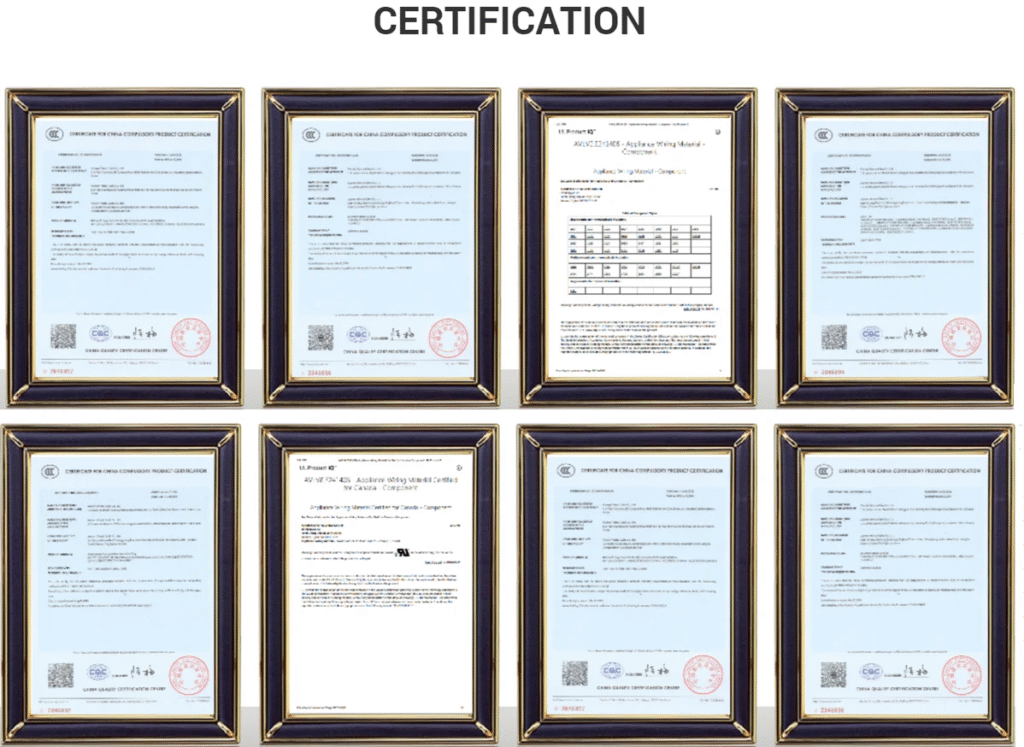
Which Are Important Automotive Certifications and Standards?
Automotive wire harnesses must comply with various quality systems, product standards, and customer-specific requirements. Many OEM buyers focus only on whether a supplier has IATF 16949, but in practice, different projects may require additional standards depending on the vehicle platform, market, and application.
IATF 16949
The global quality management standard for the automotive industry. It defines requirements for manufacturing processes, risk management, traceability, continuous improvement, and defect prevention.
ISO 9001
An international quality management standard that establishes consistent production and quality control processes. While widely adopted, it is generally considered a basic requirement rather than sufficient for automotive OEM projects.
ISO 14001
An environmental management standard that demonstrates the manufacturer’s commitment to environmental compliance, waste reduction, and sustainable production.
ISO 26262
ISO 26262 is a functional safety standard for automotive electrical and electronic systems, not a certification for wire harness products. Although harness manufacturers are rarely certified to ISO 26262 themselves, they may be required to support OEM functional safety processes through documentation, traceability, and controlled manufacturing.
IPC/WHMA-A-620
The industry’s most widely recognized workmanship standard for cable and wire harness assemblies. It defines acceptance criteria for crimping, soldering, insulation, routing, labeling, and overall assembly quality.
USCAR Standards
A series of automotive performance specifications developed by major North American automakers. USCAR standards cover connectors, terminals, sealing, electrical performance, vibration, durability, and environmental testing.
LV 214
A German automotive connector qualification standard widely adopted by European vehicle manufacturers, especially for connector reliability and environmental performance.
ISO 6722
Specifies the performance requirements for single-core automotive cables, including conductor construction, insulation, temperature rating, and electrical characteristics.
ISO 19642
An international standard covering automotive cables used in road vehicles, including low-voltage cable design, construction, performance, and testing requirements.
SAE Standards
The Society of Automotive Engineers (SAE) publishes numerous standards covering automotive electrical systems, wiring, connectors, testing methods, and vehicle communication technologies.
RoHS and REACH
These environmental regulations restrict hazardous substances and regulate chemical compliance for materials used in automotive components. They are commonly required for global supply chains, particularly in Europe.
OEM-Specific Requirements
In addition to international standards, most automotive manufacturers establish their own engineering specifications, validation procedures, approved component lists, PPAP requirements, and testing protocols that suppliers must follow.
Buyer Note:
Certifications alone do not guarantee product quality. Buyers should verify that the certificates are valid, issued to the actual manufacturing site, and applicable to the products being supplied. It is equally important to confirm the supplier’s testing capability, process controls, traceability system, and experience with your target OEM or vehicle platform.
20 Questions to Ask Before Selecting a Supplier
Here are 20 essential questions every buyer should ask:
- Is the manufacturing site IATF 16949 certified?
- Does the certificate cover the actual factory producing my harness?
- Which automotive wire standards can you process?
- Can you source genuine TE, Molex, Yazaki or Sumitomo components?
- How do you control connector substitutions?
- Do you perform crimp-force monitoring?
- How is crimp height checked?
- Can you provide pull-force records?
- Do you support terminal cross-section analysis?
- What electrical tests are performed on every unit?
- Can test programs be password-controlled?
- How are wire, terminal and connector lots traced?
- Can you support PPAP documentation?
- How are engineering changes controlled?
- Can you build prototypes before tooling is completed?
- What is the MOQ?
- Can you support pilot production?
- Do you have overmolding capability?
- Can you process shielded and high-voltage cables?
- What is your contingency plan for connector shortages?
Buyer Tip:
Don’t stop at asking whether a supplier has a capability—ask how it is implemented. For example, instead of asking whether every harness is tested, ask which parameters are tested, what the acceptance limits are, how test records are stored, and whether they can be traced back to each production lot.
Manufacturing Experience:
Over the years, we’ve found that the most successful automotive sourcing projects begin with thorough technical discussions rather than price negotiations. Buyers who evaluate engineering support, process control, testing capability, and traceability early in the supplier selection process are far less likely to encounter PPAP delays, field failures, or production disruptions after SOP.
What Factors Affect Automotive Wire Harness Pricing?
Automotive wire harness pricing depends on far more than the total wire length. In our experience, two harnesses with similar dimensions can have significantly different costs due to connector selection, testing requirements, and assembly complexity. Understanding these cost drivers helps buyers compare quotations more accurately.
1. Wire Type
The type of automotive wire, such as PVC, XLPE, silicone, or high-voltage shielded cable, has a major impact on material cost.
2. Copper Content
Higher-purity copper and larger conductor cross-sections increase both electrical performance and material cost.
3. Wire Gauge
Thicker wires require more copper and are generally more expensive than smaller-gauge conductors.
4. Harness Length
Longer harnesses consume more wire, protective materials, and assembly time.
5. Number of Circuits
More circuits mean additional wires, terminals, connectors, routing, and electrical testing, increasing manufacturing complexity.
6. Connector Brand
Original connectors from brands such as TE Connectivity, Aptiv, Yazaki, or Sumitomo typically cost more than generic alternatives specified for less demanding applications.
7. Terminal Plating
Tin-, gold-, or silver-plated terminals vary in price depending on corrosion resistance, conductivity, and application requirements.
8. Seals
Waterproof seals, grommets, and cavity plugs add both material cost and assembly time.
9. Protective Tubing
Corrugated tubing, braided sleeving, heat-shrink tubing, and other protective materials increase durability but also affect the total cost.
10. Taping
Different automotive tapes provide varying levels of abrasion resistance, noise reduction, and heat resistance, resulting in different material and labor costs.
11. Shielding
Foil or braided shielding is commonly required for high-voltage cables, CAN communication, and automotive Ethernet, adding both material and processing costs.
12. Assembly Complexity
Multiple branches, splices, overmolding, ultrasonic welding, and special routing increase labor time and manufacturing difficulty.
13. Testing Requirements
Projects requiring Hi-pot, insulation resistance, pull-force, environmental, or 100% electrical testing generally have higher manufacturing costs than those requiring only basic continuity testing.
14. Production Volume
Higher production volumes usually reduce the unit cost through automation, tooling utilization, and purchasing efficiency. Prototype builds and low-volume production usually have higher unit costs because tooling, setup, and engineering expenses are spread across fewer parts.
Buyer Note :
The lowest quotation may use unapproved wire, equivalent connectors, reduced copper content, incomplete electrical testing, or limited traceability. Always compare quotations against the same drawing, BOM, component brands, test requirements, and quality documentation.
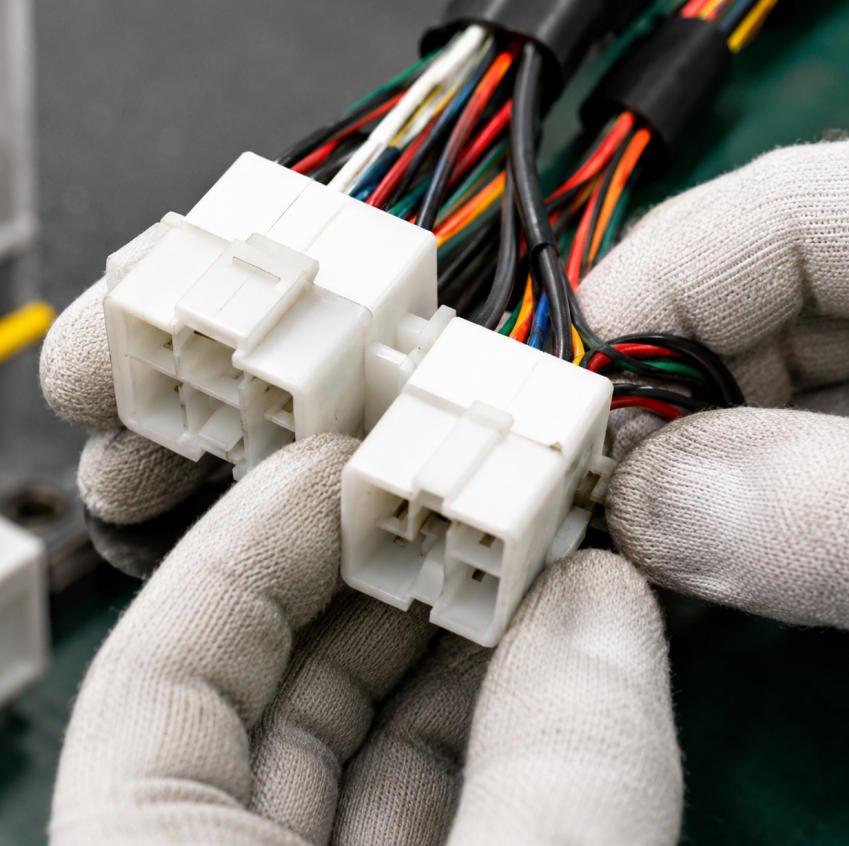
How to Find an OEM Automotive Wire Harness Manufacturer
Finding an automotive wire harness manufacturer is easier than ever thanks to search engines, B2B platforms, and industry exhibitions. The real challenge is identifying a supplier that can consistently meet your technical requirements, quality expectations, and production schedule throughout the entire product lifecycle. In our experience, manufacturers that become long-term OEM partners usually stand out because of their engineering support, process control, and ability to solve problems before mass production begins.
The following 6 methods can help you quickly find an OEM Automotive Wire Harness Manufacturer:
Method1: Search on Google
Google is still one of the most effective ways to identify OEM manufacturers. Instead of searching only for “automotive wire harness manufacturer,” try more specific keywords, such as:
- “Automotive wire harness manufacturer”
- “Automotive wiring harness supplier”
- “OEM automotive wire harness manufacturer”
- “Custom automotive wire harness manufacturer”
- “EV wire harness manufacturer”
- “High-voltage wire harness supplier”
- “Automotive cable assembly manufacturer”
- “IATF 16949 wire harness manufacturer”
- “Automotive wire harness manufacturer China”
- “Automotive wiring harness factory”
Review the supplier’s website carefully. Look for manufacturing capabilities, certifications, production equipment, testing facilities, case studies, and engineering support rather than attractive marketing claims alone.
Method2: Use B2B Sourcing Platforms
Platforms such as Alibaba, Made-in-China, and Global Sources can help buyers identify manufacturers that export internationally. These platforms often provide factory profiles, product catalogs, certifications, and customer reviews.
However, always verify whether the company is the actual manufacturer or simply a trading company before requesting quotations.
Below their websit for your check:
- Alibaba – https://www.alibaba.com
- Made-in-China – https://www.made-in-china.com
- Global Sources – https://www.globalsources.com
Method3:Search on LinkedIn
LinkedIn is an effective platform for identifying automotive wire harness manufacturers and connecting directly with sales managers, engineers, or business development teams. Search keywords such as “Automotive Wire Harness Manufacturer,” “Wire Harness Factory,” “Automotive Cable Assembly,” or “EV Wire Harness” to find relevant companies.
LinkedIn is useful for identifying automotive suppliers, engineering teams, and business development managers. It also allows buyers to understand a company’s manufacturing experience, recent projects, and industry focus.
Method4:Visit Industry Trade Shows
Trade shows remain one of the best ways to compare suppliers face-to-face. Major exhibitions include:
- Electronica
- Productronica
- Wire China
- Automotive World
- The Battery Show
- CES (Automotive Technology)
Meeting engineers directly often provides more useful information than exchanging dozens of emails.
Below their official exhibition website for your check:
Electronica
https://electronica.de
Productronica
https://productronica.com
Wire China
https://www.wirechina.net
Automotive World
https://www.automotiveworld.jp
The Battery Show
https://www.thebatteryshow.com
CES (Consumer Electronics Show)
https://www.ces.tech
Method5: Check Automotive Supplier Directories
Industry directories and automotive associations can help identify qualified manufacturers serving OEM and Tier 1 customers. Many directories also list certifications, manufacturing locations, and core product categories.
Below are some of the most widely used automotive supplier directories and industry resources for finding qualified automotive wire harness manufacturers and other automotive component suppliers.
| Directory | Website | Description |
|---|---|---|
| MarkLines | https://www.marklines.com | One of the leading automotive industry databases, providing supplier profiles, OEM relationships, manufacturing locations, and product categories. |
| Automotive News Supplier Directory | https://www.autonews.com | A trusted source for researching global automotive suppliers, industry rankings, and company profiles. |
| S&P Global Mobility | https://www.spglobal.com/mobility | Provides automotive market intelligence, supplier analysis, and OEM supply chain information. |
| AIAG (Automotive Industry Action Group) | https://www.aiag.org | Offers automotive quality standards, industry resources, and information for OEMs and automotive suppliers. |
| OESA (Original Equipment Suppliers Association) | https://www.oesa.org | Represents North American automotive suppliers and provides industry insights, member resources, and networking opportunities. |
| CLEPA | https://www.clepa.eu | The European Association of Automotive Suppliers, offering information on leading European automotive manufacturers and suppliers. |
| CATARC (China Automotive Technology & Research Center) | https://www.catarc.ac.cn | A leading Chinese automotive organization providing industry standards, technology research, and supplier information. |
| SAE International | https://www.sae.org | Publishes automotive engineering standards, technical papers, and industry resources used by manufacturers worldwide. |
| Thomasnet | https://www.thomasnet.com | A comprehensive directory for locating automotive wire harness manufacturers and contract manufacturers in North America. |
| Kompass | https://www.kompass.com | An international B2B directory that enables buyers to search manufacturers by product category, country, certification, and industry. |
Method6: Ask Connector Manufacturers for Recommendations
Global connector suppliers such as TE Connectivity, Aptiv, Molex, Yazaki, and Sumitomo often work with qualified wire harness manufacturers. If your project specifies a particular connector system, their local sales or distribution partners may recommend experienced harness assemblers.
Evaluate the Factory Before Shortlisting
Before selecting a supplier, request information such as:
- Factory certifications (IATF 16949, ISO 9001, etc.)
- Manufacturing equipment
- Electrical testing capability
- PPAP and APQP support
- Prototype experience
- Annual production capacity
- Typical lead time
- Customer references
- Quality control process
Buyer Tip: In our experience, the best automotive wire harness suppliers are not always the largest companies. Global Tier 1 manufacturers are ideal for high-volume vehicle platforms, while many specialized OEM manufacturers provide faster engineering support, lower MOQs, and greater flexibility for prototypes, EV equipment, commercial vehicles, and low-to-medium-volume production programs.
Why Choose Yihetai As Your Automotive Wire Harness Manufacturers for OEM Projects?
Not every OEM project requires a global Tier 1 supplier. For custom development, faster engineering support, and flexible production, Yihetai provides an efficient alternative for automotive wire harness manufacturing.
- More than 25 years of experience designing and manufacturing custom wire harnesses and cable assemblies.
- Operates under IATF 16949, ISO 9001, and ISO 13485 quality management systems.
- Manufactures custom automotive wire harnesses according to customer drawings, BOMs, and technical specifications.
- Produces cable assemblies for EVs, battery systems, energy storage, and charging applications.
- Provides overmolding and integrated cable assembly to improve sealing, strain relief, and durability.
- Supports projects from prototype samples and pilot runs through stable volume production.
- Every finished harness undergoes electrical testing and final inspection before shipment.
- Assists customers with DFM, connector selection, drawing review, and manufacturing optimization during development.
Buyer Note: Yihetai is best suited to OEMs needing customized automotive wire harnesses, EV cable assemblies, and low-to-medium volume development before scaling to production.
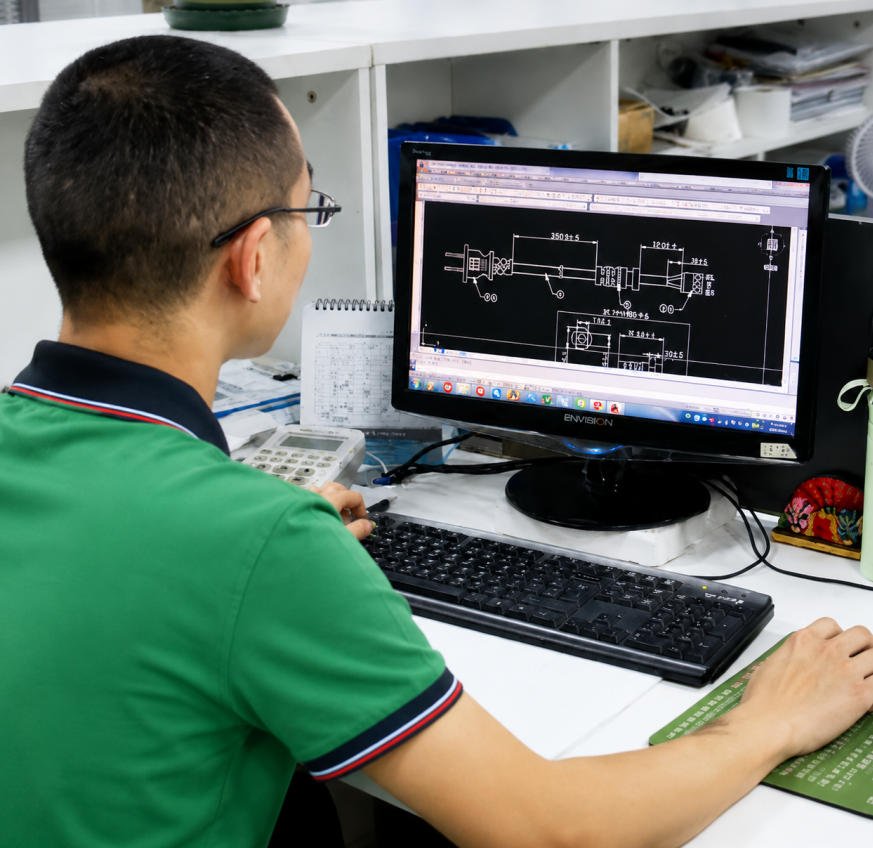
FAQ
1. How do I choose the right automotive wire harness manufacturer?
Look for automotive project experience, engineering support, IATF 16949 certification, manufacturing capability, testing procedures, traceability, and reliable delivery performance.
2 What certifications should an automotive wire harness supplier have?
Most automotive OEM projects require suppliers operating under IATF 16949 and ISO 9001. Depending on the application, additional standards such as IPC/WHMA-A-620, USCAR, or customer-specific requirements may also apply.
3. Does every automotive wire harness need 100% electrical testing?
For most OEM programs, yes. Production testing typically includes continuity, open-circuit, short-circuit, miswiring, and connector verification before shipment.
4. What factors affect automotive wire harness pricing?
The main cost drivers include wire type, copper content, wire gauge, harness complexity, connector brand, protective materials, testing requirements, and production volume.
5. What information is required to request a quotation?
Providing drawings or samples, wiring schematics, BOMs, connector part numbers, wire specifications, annual quantities, and testing requirements helps manufacturers prepare an accurate quotation.
6. Can automotive wire harnesses be fully customized?
Yes. Most OEM wire harnesses are manufactured according to customer drawings, connector selections, wire specifications, branch layouts, and application requirements.
7 Can Yihetai manufacture automotive wire harnesses based on my drawings or samples?
Yes. Yihetai manufactures custom automotive wire harnesses according to customer drawings, BOMs, wiring diagrams, connector specifications, or physical samples.
8. Does Yihetai support prototype and low-volume OEM projects?
Yes. We support prototype development, pilot production, and low-to-medium volume manufacturing before scaling to mass production.
9. What types of automotive wire harnesses can Yihetai manufacture?
Yihetai manufactures custom automotive wire harnesses, EV cable assemblies, high-voltage battery cables, overmolded cable assemblies, and other customized wiring solutions for automotive and industrial applications.
10. What quality certifications does Yihetai have?
Yihetai operates under IATF 16949, ISO 9001, and ISO 13485 quality management systems and can also support UL-recognized wire products as well as RoHS and REACH compliance where required.
11. Why choose Yihetai for OEM automotive wire harness projects?
Yihetai is best suited for OEM customers requiring customized automotive wire harnesses, responsive engineering support, and flexible low-to-medium volume development before scaling to mass production.
Conclusion
Choosing the right automotive wire harness manufacturer is about more than comparing prices. OEM buyers should evaluate engineering expertise, manufacturing capability, quality systems, testing standards, certifications, supply chain stability, and long-term production support.
The manufacturers featured in this guide each have different strengths, from global Tier 1 automotive suppliers to specialized custom harness manufacturers. The best choice depends on your project requirements, production volume, technical specifications, and quality expectations.
If you’re looking for a reliable partner for custom automotive wire harnesses, EV cable assemblies, overmolded cable solutions, or prototype-to-production manufacturing, Yihetai combines more than 25 years of manufacturing experience with in-house engineering, certified quality systems, and comprehensive production capabilities. We work closely with OEM customers to deliver reliable, high-quality wiring solutions tailored to their specific applications.
Read more: Top 24 Automotive Wire Harness Manufacturers for OEM ProjectsRelated Wire Harness Articles:
- Automotive Wire Harness Protection Materials: Corrugated Tube, Tape, Sleeves and Foam Compared
- Top 20 Custom Cable Assembly Manufacturers in China
- Top 25 Wire Harness Manufacturers in China: The Ultimate Buyer’s Guide
- Top 25 Global Ethernet & RJ45 Cable Manufacturers
- 18 Best LVDS Cable Assemblies Manufacturers Worldwide