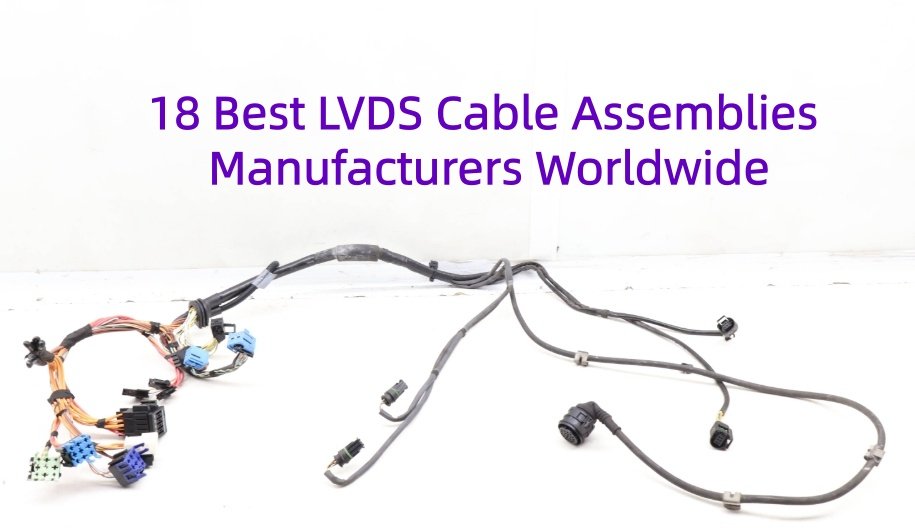
Many OEM buyers focus mainly on the connector model, pin count, and cable length when sourcing LVDS cable assemblies. These details are important, but in real display projects, they are rarely the only factors that decide whether the cable will work reliably.
In our experience manufacturing custom wire harnesses and cable assemblies, many LCD display failures are caused by details that are easy to overlook during the RFQ stage. A cable may look correct on the drawing, but if the differential pairs are not twisted consistently, the shielding is not properly grounded, the connector exit direction is wrong, or the crimping quality is unstable, the final product may suffer from screen flicker, image noise, intermittent black screen, EMI test failure, or loose connector contact after vibration.
LVDS cable assemblies are not ordinary signal wires. They are high-speed differential signal paths used in LCD displays, industrial HMI panels, medical imaging systems, automotive displays, robotics, cameras, and embedded electronic devices. For these applications, cable structure, impedance control, pair layout, shielding design, connector selection, strain relief, electrical testing, and mass production consistency all matter.
This guide compares 15 LVDS cable assembly manufacturers worldwide and explains how OEM buyers should evaluate suppliers from an engineering and manufacturing perspective. Instead of only listing company names, we will look at what each type of supplier is best suited for, what technical capabilities you should check, and what questions you should ask before choosing a long-term LVDS cable assembly partner.
What Is an LVDS Cable Assembly?
An LVDS cable assembly is a cable solution designed for Low Voltage Differential Signaling, a high-speed data transmission method widely used in display and electronic systems. LVDS is commonly selected because it can transmit data at high speed with low power consumption and strong noise resistance, especially when compared with many single-ended signal transmission methods.
A typical LVDS cable assembly may include twisted pair wires, shielding layer, drain wire, ground wire, connector housing, terminals, labels, tape wrapping, protective sleeve, heat shrink tubing, and strain relief design. Depending on the application, the cable may also include power wires, backlight wires, touch signal wires, or additional grounding branches.
LVDS Cable Assembly Is Not Just a Display Cable
Many buyers simply call an LVDS cable a “display cable” or “screen cable.” That description is understandable, but it does not fully explain the engineering requirements behind the product. From a cable assembly manufacturing perspective, an LVDS cable is a high-speed differential signal harness, not just a group of wires connected between two connectors.
In our factory experience, the problems in LVDS cable projects are often caused by details that are not visible at first glance. For example, if the differential pair is opened too far near the connector, the cable may become more sensitive to noise. If the shielding is not terminated correctly, the product may fail EMI testing after installation. If the crimp height is unstable, the display may work during sample testing but show intermittent failure after vibration or repeated movement.
The wire structure, impedance control, twist pitch, shielding coverage, drain wire treatment, connector assembly, terminal crimping, and strain relief all influence the final performance of the cable. This is why OEM buyers should evaluate not only the connector model and cable length, but also the supplier’s engineering understanding and production control capability.
What Are Common Types of LVDS Cable Assemblies?
LVDS cable assemblies are available in many connector styles and wiring structures. In most OEM projects, the connector series is the first specification engineers confirm, but the complete cable design also depends on cable length, pin assignment, shielding method, wire gauge, bending direction, installation space, and testing requirements.
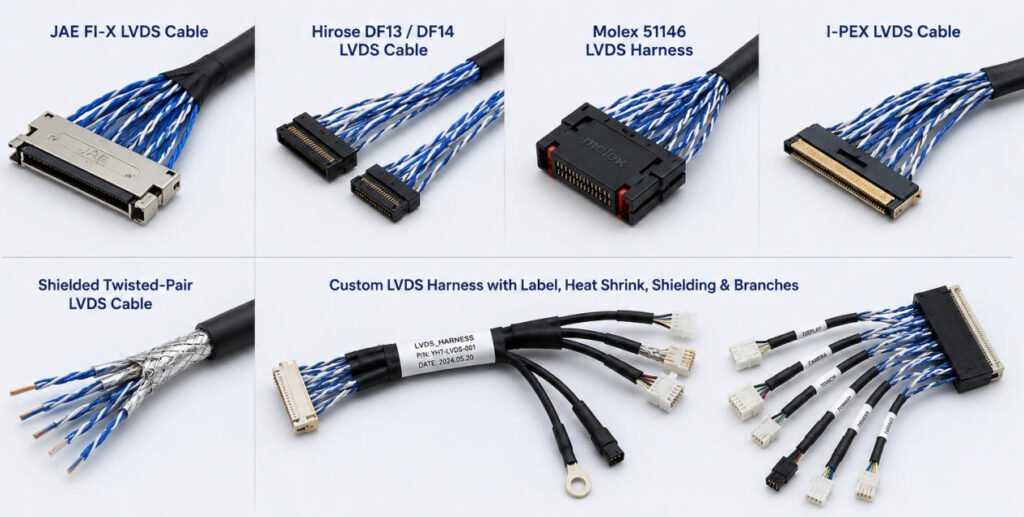
At Yihetai, our LCD monitor LVDS and I-PEX wire harness product range covers many commonly used LVDS cable types, including JAE FI, JAE FI-X, JAE FI-RE, HRS DF13, HRS DF14, HRS DF19, Molex 51146, I-PEX 20142, I-PEX 20453, Dupont 2.0mm, Dupont 2.54mm, shielded LVDS cables, and customized LCD monitor LVDS cable assemblies.
The table below summarizes common LVDS cable assembly types and where they are typically used.
| LVDS Cable Assembly Type | Common Applications | Key Points to Confirm |
|---|---|---|
| JAE FI LVDS Cable | LCD panels, display modules, embedded displays | Connector model, pin count, cable direction |
| JAE FI-X LVDS Cable | LCD monitors, industrial displays, control boards | Pin assignment, terminal crimping, mating connector |
| JAE FI-RE LVDS Cable | Compact LCD modules, space-limited devices | Fine-pitch assembly, connector orientation |
| Hirose (HRS) DF13 LVDS Cable | Industrial displays, compact electronics, display panels | Crimping stability, terminal insertion, wire sequence |
| HRS DF14 LVDS Cable | Small display modules, electronic devices | Cable exit direction, bending radius, connector fit |
| HRS DF19 LVDS Cable | LCD modules, embedded equipment, industrial devices | Pinout accuracy, small terminal handling |
| Molex 51146 LVDS Cable | Display boards, control systems, OEM electronics | Original connector part number, terminal compatibility |
| I-PEX 20142 LVDS Cable | Compact LCD displays, camera modules, thin devices | Fine-pitch connector handling, cable routing |
| I-PEX 20453 LVDS Cable | LCD monitors, embedded displays, compact electronics | Connector series, mating height, cable direction |
| Dupont 2.0mm / 2.54mm LVDS Cable | Prototypes, testing, low-cost display connections | Contact stability, suitability for final production |
| Shielded LVDS Cable | EMI-sensitive devices, industrial equipment, automotive displays | Foil shield, braid shield, drain wire, grounding method |
| Custom LCD Monitor LVDS Cable | LCD monitors, display systems, OEM equipment | Custom pinout, length, label, tape, sleeve, routing |
| LVDS + Backlight Cable Assembly | Display systems with backlight control | Signal and backlight wire separation, current rating |
| LVDS + Power Cable Assembly | Integrated display cable systems | Power wire gauge, noise control, insulation |
| Custom LVDS Cable Assembly | OEM/ODM display, medical, automotive, industrial projects | Drawing, sample approval, testing, traceability |
Although these cable types may look similar, they are not always interchangeable. Similar connectors can have different pitch, locking structures, terminal designs, mating heights, or pin arrangements. Before mass production, OEM buyers should confirm the connector brand, exact part number, cable drawing, pinout, shielding structure, and testing standard with the manufacturer.
For custom LVDS cable assemblies, the goal is not only to make the cable fit mechanically. The cable must also provide stable signal transmission, reliable connector mating, consistent crimping quality, and repeatable performance during mass production.
What Are Common LVDS Connector Types Used in Cable Assemblies?
Connector selection is one of the first technical decisions in an LVDS cable assembly project. The connector affects cable routing, board layout, mating reliability, locking strength, assembly space, and long-term signal stability.
In many OEM projects, the LVDS connector is already defined by the LCD panel or main board. However, when customers are developing a new product, replacing an old cable, or looking for an equivalent connector, the connector should be reviewed carefully before sample production. Some connectors may look similar, but they can have different pitch sizes, pin counts, terminal structures, mating heights, latch designs, and cable exit directions.
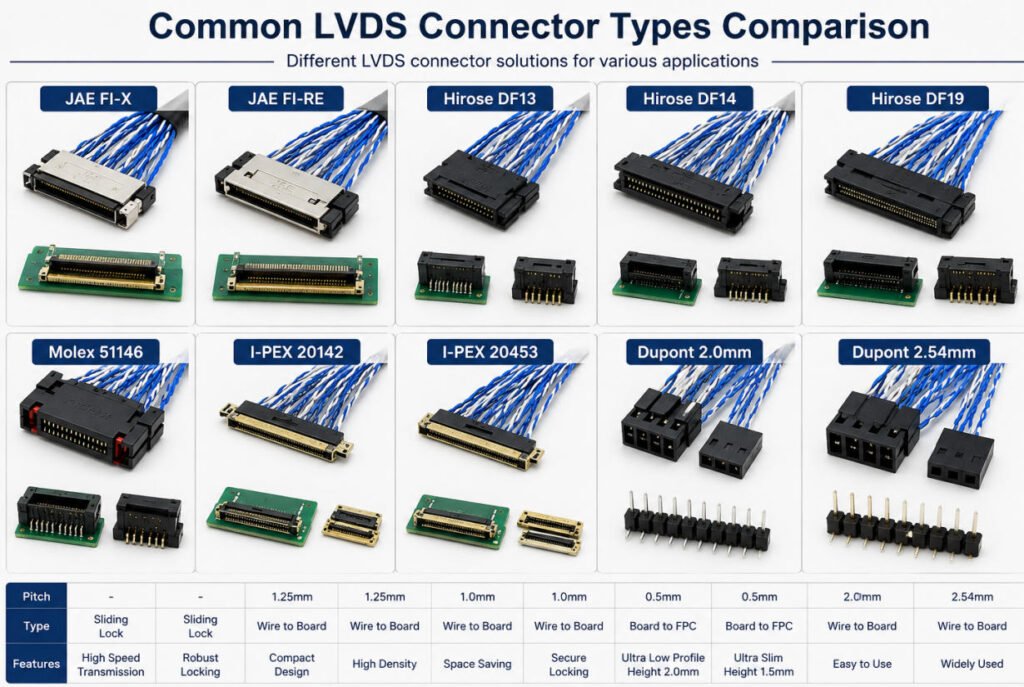
Common LVDS connector types used in cable assemblies include:
- JAE FI series: JAE FI, JAE FI-X, JAE FI-RE, JAE FI-X with lock
- Hirose / HRS series: DF13, DF14, DF19
- Molex connectors: Molex 51146 and other wire-to-board display connectors
- I-PEX connectors: I-PEX 20142, I-PEX 20453, I-PEX 20474
- Dupont and JST alternatives: Dupont 2.0mm, Dupont 2.54mm, JST PH, JST SH, JST PHD
JAE FI series connectors are commonly used for LCD panels, industrial displays, and thin display modules. Hirose DF13, DF14, and DF19 connectors are often selected for compact display interfaces and small-pitch wire-to-board applications. Molex 51146 and other Molex wire-to-board connectors are frequently used in industrial displays, embedded systems, and OEM display modules. I-PEX connectors are suitable for thin display modules, notebooks, compact electronics, and camera or display transmission applications. Dupont and JST alternatives are more often used for low-speed signals, auxiliary wires, backlight power wires, test fixtures, or cost-sensitive equipment projects.
When choosing an LVDS connector, OEM engineers should review pitch size, pin count, locking structure, mating cycles, current rating, vibration requirement, board layout, available installation space, cable exit direction, and connector availability. It is also important to confirm whether the project requires original brand connectors or approved equivalent connectors.
In our factory experience, connector confirmation is one of the most important steps before sampling. We usually recommend that customers provide the display panel model, PCB mating connector information, connector part number, drawing, or an approved sample. This helps prevent wrong mating, reversed pinout, unstable locking, and repeated sample revisions.
A good LVDS cable assembly manufacturer should not only source the connector, but also understand how connector selection affects crimping, assembly, cable routing, shielding, testing, and long-term reliability.
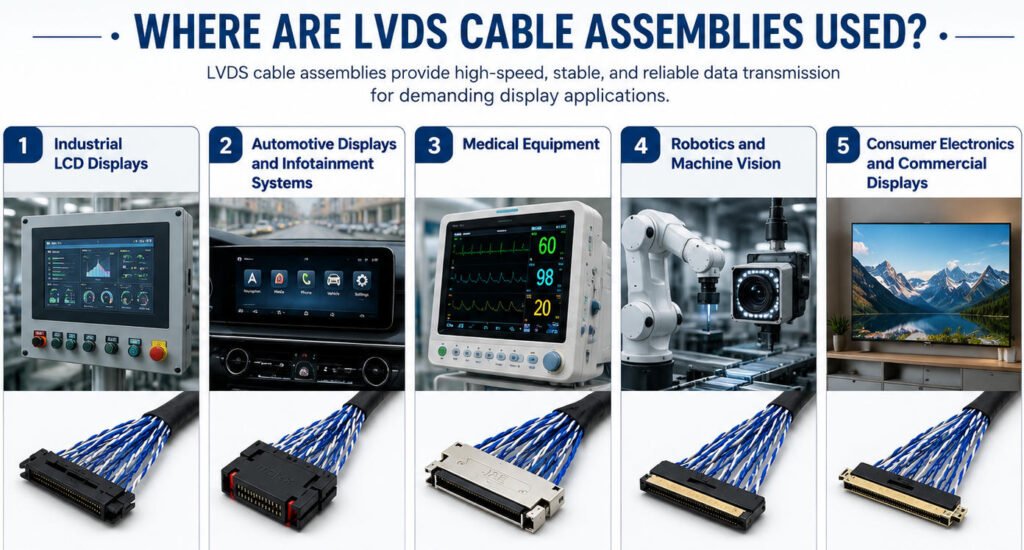
Where Are LVDS Cable Assemblies Used?
LVDS cable assemblies are widely used in display, imaging, and control systems where stable high-speed signal transmission is required. Different applications have different requirements for shielding, connector reliability, flexibility, material selection, and production consistency.
1. Industrial LCD Displays
LVDS cable assemblies are commonly used in HMI panels, CNC control panels, automation equipment, industrial computers, and testing instruments.
Industrial environments often involve vibration, dust, electromagnetic interference, long operating hours, and limited installation space. For these projects, the cable design should focus on shielding, grounding, connector stability, cable routing, and strain relief.
2. Automotive Displays and Infotainment Systems
In automotive applications, LVDS cables are used for dashboard displays, center console displays, rear-seat entertainment systems, camera display modules, and ADAS display interfaces.
Automotive LVDS cable assemblies must withstand vibration, temperature changes, and long-term use. Connector locking, stable crimping, material consistency, and IATF 16949 quality system support are important factors for supplier evaluation.
3. Medical Equipment
LVDS cable assemblies are used in patient monitors, ultrasound devices, imaging systems, diagnostic displays, and portable medical devices.
Medical applications require stable signal transmission, clean production control, material safety, and traceability. For portable devices, flexibility and bending resistance should also be considered.
4. Robotics and Machine Vision
Robotics and machine vision systems use LVDS cable assemblies in machine vision cameras, robot control displays, inspection equipment, and motion control systems.
These applications often need flexible cable routing, EMI control, and repeated bending resistance. The cable should be designed with proper shielding, bend radius, and strain relief to avoid signal interruption during movement.
5. Consumer Electronics and Commercial Displays
LVDS cable assemblies are also used in POS terminals, digital signage, vending machines, gaming displays, smart home panels, kiosks, and other commercial display products.
These projects usually require compact design, stable quality, cost control, and efficient mass production. OEM buyers should check whether the supplier can maintain consistent pinout, cable length, connector quality, labeling, packaging, and electrical testing.
Why LVDS Cable Assemblies Are More Difficult to Manufacture Than Ordinary Signal Cables
LVDS cable assemblies may look similar to ordinary signal cables, but the manufacturing requirements are much more demanding. In our 25 years of building custom wire harnesses, we have seen many display-related failures caused not by a completely broken cable, but by small details in signal transmission, shielding, connector termination, or assembly process control.
For LCD monitors, industrial HMI panels, medical display equipment, automotive displays, and embedded display modules, an LVDS cable must transmit low-voltage differential signals with stable pair matching and low noise interference. If the cable structure is not controlled properly, the final device may show display flicker, black screen, noise lines, intermittent signal loss, or unstable image output.
1. Differential Pair Consistency
LVDS uses differential signaling, which means the signal is transmitted through paired conductors. These pairs must stay as consistent as possible in length, spacing, twist, and routing. If one conductor in the pair is stretched, untwisted, routed differently, or terminated poorly, the signal balance can be affected.
In actual production, this is one of the areas where low-cost cable assembly suppliers often make mistakes. The cable may pass a simple continuity test, but still fail during real display operation because the differential pair structure has not been maintained correctly.
2. Cable Length and Routing Control
For LVDS cable assemblies, cable length is not only a mechanical dimension. It can also affect signal stability. Long cables, sharp bends, tight routing spaces, and inconsistent branch layout may increase signal loss or noise sensitivity.
Before making samples, a professional manufacturer should confirm the total cable length, tolerance, connector exit direction, folding direction, bending radius, and installation space. This is especially important for automotive displays, industrial control panels, robotics, and medical equipment, where vibration, movement, or limited internal space can create extra stress on the cable.
3. Shielding and Grounding Design
LVDS cables are often used near power circuits, motors, display backlights, wireless modules, or control boards. These environments can create electromagnetic interference. For this reason, shielding is not just an optional feature; it can be critical to signal reliability.
Depending on the application, the cable may use aluminum foil shielding, braided shielding, drain wire, or a combined shielding structure. The grounding method also needs to be confirmed. In some designs, the shield is grounded at one end. In other designs, both-end grounding or a specific drain wire connection may be required.
A good LVDS cable assembly manufacturer should not guess the shielding structure. It should be reviewed according to the customer’s device design, EMC requirement, cable length, and installation environment.
4. Connector Selection and Pinout Accuracy
Many LVDS cable failures come from connector mismatch or pinout mistakes. Common LVDS connector options include JAE FI, JAE FI-RE, JAE FI-X, Hirose DF13, Hirose DF14, Hirose DF19, Molex 51146, I-PEX 20142, I-PEX 20453, and customized connector solutions.
Some connectors look very similar but have different pitch, locking structure, mating height, terminal design, or pin arrangement. If a replacement connector is used without engineering approval, the cable may fit mechanically but fail electrically or become unreliable after vibration.
At Yihetai, we support many LCD monitor LVDS and I-PEX wire harness types, including JAE FI, JAE FI-RE, JAE FI-X, HRS DF13, HRS DF14, HRS DF19, Molex 51146, I-PEX 20142, and I-PEX 20453 cable assemblies. This gives OEM customers more flexibility when choosing between original connectors, equivalent options, and fully customized LVDS cable designs.
5. Crimping Quality and Terminal Stability
For LVDS cable assemblies, terminal crimping quality is a hidden but critical factor. A poor crimp may not fail immediately. It may pass basic electrical testing in the factory, but later fail under vibration, bending, temperature change, or repeated assembly.
Important crimping control points include crimp height, crimp width, conductor position, insulation support, terminal deformation, pull force, and applicator wear. If the terminal is over-crimped, the conductor may be damaged. If it is under-crimped, the contact resistance may become unstable.
This is why LVDS cable assembly manufacturing requires both proper tooling and experienced process control. The goal is not only to make the cable conductive, but to make it stable during long-term use.
How Professional Manufacturers Test and Control LVDS Cable Assembly Quality
A qualified LVDS cable assembly should not be judged only by appearance. Because LVDS cables carry high-speed differential signals, the manufacturer must control electrical performance, mechanical reliability, connector quality, and production traceability.
In our factory, we treat testing as part of the manufacturing process, not as a final formality. A cable that looks clean and well assembled may still have wrong pin assignment, poor insulation, weak crimping, unstable shielding, or hidden intermittent contact. That is why each critical process must be checked before shipment.
1. Incoming Material Inspection
Quality control starts before production. The manufacturer should check incoming wires, connectors, terminals, shielding materials, heat shrink tubes, labels, and other components.
For LVDS cable assemblies, connector authenticity and terminal compatibility are especially important. The supplier should confirm connector model, pitch, plating, housing material, terminal type, and mating compatibility. If equivalent connectors are used, they should be approved by the customer before production.
2. Wire Cutting and Stripping Control
During cutting and stripping, the factory must control cable length, stripping length, conductor damage, insulation damage, and shield preparation. For shielded LVDS cables, improper stripping can damage the foil, braid, drain wire, or differential pair structure.
A small cutting or stripping mistake may not be obvious after assembly, but it can affect shielding performance, insulation reliability, or mechanical strength near the connector.
3. Terminal Crimping Inspection
Crimping is one of the most important quality points in LVDS cable assembly manufacturing. A professional factory should control crimp height, crimp width, terminal position, conductor brush, insulation support, and pull force.
For critical projects, crimping quality should be checked with proper tools such as a crimp height micrometer, terminal cross-section analyzer, tensile tester, or terminal interface analyzer. Stable crimping helps reduce contact resistance changes and intermittent failures.
4. Continuity, Open and Short Testing
Every LVDS cable assembly should go through electrical testing to confirm correct pin-to-pin connection. Continuity testing verifies that each wire is connected to the correct terminal. Open and short testing helps detect broken wires, wrong wiring, short circuits, and pin assignment mistakes.
This is the minimum test requirement for most LVDS wire harnesses. Without this step, even a cable with perfect appearance may be unusable.
5. Insulation Resistance and Withstand Voltage Testing
For applications with safety or reliability requirements, insulation resistance and withstand voltage testing may be required. Insulation resistance testing checks whether the insulation material can prevent leakage current. Withstand voltage testing helps confirm that the cable can tolerate the required voltage without breakdown.
These tests are especially important for automotive electronics, medical equipment, industrial control systems, and other applications where reliability matters.
6. Impedance and Signal Integrity Considerations
For some LVDS applications, especially longer cable runs or high-resolution displays, impedance control may need to be reviewed. Not every LVDS cable project requires full impedance testing in mass production, but the manufacturer should understand how wire structure, twisted pair consistency, shielding, cable length, and connector termination affect signal performance.
A responsible supplier should be able to discuss whether impedance testing, display validation, EMI checking, or customer-side signal integrity testing is necessary for the project.
7. Appearance and Dimension Inspection
Final appearance inspection should check connector orientation, terminal insertion, wire sequence, label position, heat shrink tube position, jacket damage, shield exposure, branch length, and overall cable dimensions.
For LVDS cables used inside compact display modules, even a small dimension error may cause assembly interference, sharp bending, or connector stress. This is why dimensional control should not be treated as a minor issue.
8. Traceability and Final Inspection Records
For OEM projects, traceability is very important. A reliable LVDS cable assembly manufacturer should be able to trace material batches, connector lots, terminal lots, production dates, operators, inspection records, and test results.
At Yihetai, our wire harness process covers incoming inspection, cutting, crimping, assembly, bundling, electrical testing, appearance inspection, packaging, and final inspection. Key quality checks include insulation resistance, withstand voltage, conducting test, appearance inspection, and dimensional inspection. This process helps customers reduce risk from sample development to mass production.
How We Selected the Best LVDS Cable Assembly Manufacturers
For OEM buyers, the “best” LVDS cable assembly manufacturer is not always the largest company or the most famous connector brand. The right supplier should match your project requirements, including connector type, cable structure, signal performance, shielding design, testing standard, sample flexibility, and long-term production stability.
From a manufacturing point of view, we looked at whether each supplier can support real custom LVDS cable assembly projects, not just standard catalog parts.
Here are 10 key factors to consider:
- LVDS cable assembly experience
- Connector sourcing capability for JAE, Hirose, Molex, I-PEX, JST, TE, or approved equivalents
- Custom engineering support for drawings, samples, BOMs, and pinouts
- Understanding of signal integrity, differential pairs, impedance, and cable routing
- Shielding and grounding design capability
- Crimping, terminal insertion, and assembly process control
- Electrical testing capability, including continuity, short/open, insulation, hi-pot, and impedance testing when required
- Certifications and quality systems, such as ISO 9001, IATF 16949, UL, RoHS, and REACH
- Flexibility from prototype samples to mass production
- Communication speed and OEM project support
These factors can help identify suppliers that do more than provide a connector or a standard cable. A qualified LVDS cable assembly manufacturer should be able to turn a customer’s design requirements into a stable, testable, and repeatable production part.
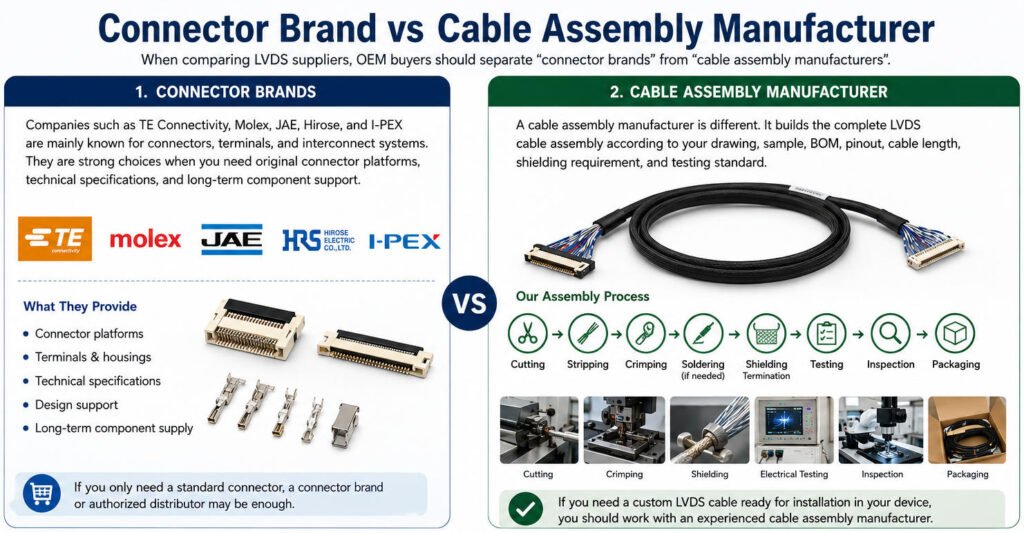
Connector Brand vs Cable Assembly Manufacturer
When comparing LVDS suppliers, OEM buyers should separate “connector brands” from “cable assembly manufacturers”.
Companies such as TE Connectivity, Molex, JAE, Hirose, and I-PEX are mainly known for connectors, terminals, and interconnect systems. They are strong choices when you need original connector platforms, technical specifications, and long-term component support.
A cable assembly manufacturer is different. It builds the complete LVDS cable assembly according to your drawing, sample, BOM, pinout, cable length, shielding requirement, and testing standard. This includes cutting, stripping, crimping, soldering if needed, shielding termination, assembly, labeling, electrical testing, inspection, and packaging.
If you only need a standard connector, a connector brand or authorized distributor may be enough. If you need a custom LVDS cable ready for installation in your device, you should work with an experienced cable assembly manufacturer.
18 Best LVDS Cable Assembly Manufacturers Worldwide
Choosing the right LVDS cable assembly manufacturer depends on your project requirements, connector type, cable structure, signal performance, shielding design, testing standards, and production volume. Some companies on this list are global connector brands, while others are custom cable assembly manufacturers that can build complete LVDS wire harnesses according to customer drawings, samples, BOMs, and pinouts.
1. Xiamen Yihetai Cable Co., Ltd.
Established: 2001
Location: Xiamen, China
Website: www.yihetai-cable.com
Company overview:
Yihetai is a custom wire harness and cable assembly manufacturer with 25+ years of wire and cable processing experience. The company supports LVDS & I-PEX wire harnesses, including JAE FI, FI-X, FI-RE, Hirose DF13/DF14/DF19, Molex 51146, I-PEX 20142/20453, and custom LCD monitor LVDS cables.
Best for:
Custom LVDS wire harness and OEM cable assembly manufacturing.
Key strengths:
ISO 9001, IATF 16949, ISO 13485, UL, CCC, engineering support, prototyping, small-batch and mass production, 100% electrical testing, and traceability.
What OEM buyers should consider:
Yihetai is suitable for buyers who need finished custom LVDS cable assemblies, not only standard connectors. If you already have a drawing, sample, connector model, BOM, or pinout, Yihetai can support custom production according to your project requirements.
2. TE Connectivity
Established: 2007 as an independent company
Location: Global
Website: www.te.com
Company overview:
TE Connectivity is a global interconnect company offering connectors, sensors, cable assemblies, and high-reliability electronic components for automotive, industrial, medical, energy, and communication applications.
Best for:
Global interconnect solutions and large OEM programs.
Key strengths:
Strong connector portfolio, automotive-grade interconnects, global supply chain, and mature engineering support.
What OEM buyers should consider:
TE is excellent for connector platforms and large projects, but small-batch custom LVDS harness production may require a specialized cable assembly manufacturer.
3. Molex
Established: 1938
Location: USA
Website: www.molex.com
Company overview:
Molex is a global connector and cable assembly supplier serving display, automotive, industrial, medical, data, and consumer electronics markets. Its wire-to-board connector systems are commonly used in LVDS display cable projects.
Best for:
Display and wire-to-board connector platforms.
Key strengths:
Broad connector portfolio, stable supply chain, mature interconnect design, and strong OEM support.
What OEM buyers should consider:
Molex is ideal when your design specifies Molex connectors. For custom pinout, shielding, labeling, and testing, work with a cable assembly manufacturer using Molex parts.
4. JAE
Established: 1953
Location: Tokyo, Japan
Website: www.jae.com
Company overview:
Japan Aviation Electronics Industry, Ltd. is a Japanese connector manufacturer known for precision connectors used in display, automotive, industrial, and electronic equipment.
Best for:
FI series LCD display connectors.
Key strengths:
JAE FI, FI-X, and FI-RE series connectors are widely used in LCD panels, thin display modules, and compact electronic devices.
What OEM buyers should consider:
JAE is mainly a connector manufacturer. OEM buyers still need a qualified cable assembly supplier to control wire sequence, crimping, shielding, cable length, and testing.
5. Hirose Electric
Established: 1937
Location: Japan
Website: www.hirose.com
Company overview:
Hirose Electric is a global connector manufacturer offering board-to-board, wire-to-board, FPC/FFC, coaxial, circular, and high-speed connector solutions.
Best for:
Compact board-to-wire display connections.
Key strengths:
DF13, DF14, and DF19 connectors are widely used in compact LCD display, embedded system, and small-pitch wire-to-board applications.
What OEM buyers should consider:
For Hirose LVDS cables, confirm the exact series, pin count, mating header, latch direction, wire size range, and connector orientation before sampling.
6. I-PEX
Established: 1963
Location: Kyoto, Japan
Website: www.i-pex.com
Company overview:
I-PEX is a precision connector manufacturer known for micro-coaxial, twinaxial, FPC/FFC, board-to-board, and compact high-speed connector solutions.
Best for:
Thin display modules, notebooks, compact electronics, camera modules, and micro-coax LVDS connections.
Key strengths:
I-PEX 20142, 20453, 20474, and similar series are suitable for compact high-speed display and camera transmission.
What OEM buyers should consider:
I-PEX cable assemblies require precise fine-pitch assembly, bend radius control, connector protection, and careful visual inspection.
7. Amphenol

Established: 1932
Location: USA
Website: www.amphenol.com
Company overview:
Amphenol is a global interconnect manufacturer offering connectors, cable assemblies, antennas, sensors, and high-speed interconnect solutions.
Best for:
Rugged and high-reliability applications.
Key strengths:
Strong in automotive, industrial, aerospace, telecom, medical, RF, fiber optic, and harsh-environment interconnect systems.
What OEM buyers should consider:
Amphenol is a strong interconnect platform supplier. For a custom LVDS wire harness, confirm whether the complete cable assembly service is available directly or through an assembly partner.
8. Samtec
Established: 1976
Location: USA
Website: www.samtec.com
Company overview:
Samtec is a high-speed interconnect supplier offering connectors, cable assemblies, optics, RF systems, and signal integrity support.
Best for:
High-speed interconnect engineering.
Key strengths:
High-speed cable systems, twinax assemblies, Flyover technology, signal integrity expertise, and engineering support for demanding electronic systems.
What OEM buyers should consider:
Samtec is best for high-speed and high-density interconnect platforms. For cost-sensitive LVDS display cables, compare performance needs against budget and customization requirements.
9. 3M Interconnect
Established: 1902
Location: USA
Website: www.3m.com
Company overview:
3M Interconnect provides flat cable, ribbon cable, connectors, MDR cable assemblies, twin axial cable assemblies, and industrial interconnect products.
Best for:
Flat cable, ribbon cable, and EMI-related interconnect solutions.
Key strengths:
Strong material technology, shielding-related products, flat cable systems, and industrial connectivity experience.
What OEM buyers should consider:
3M is useful for standard or legacy display interfaces. For fully customized LVDS wire harnesses, confirm assembly capability or work with a harness manufacturer using 3M components.
10. Sumitomo Electric
Established: 1897
Location: Osaka, Japan
Website: www.sumitomoelectric.com
Company overview:
Sumitomo Electric is a global manufacturer with strong automotive wiring harness, cable, electronics, energy, and industrial material businesses.
Best for:
Automotive and advanced cable technologies.
Key strengths:
Automotive wiring harness expertise, global manufacturing, advanced cable technology, and strong support for vehicle electronics.
What OEM buyers should consider:
Sumitomo is best for large automotive programs. Smaller OEMs or low-volume LVDS projects may need a more flexible custom cable assembly supplier.
11. Luxshare Precision
Established: 2004
Location: China
Website: www.luxshare-ict.com
Company overview:
Luxshare Precision is a large electronics and interconnect manufacturer known for cable assemblies, connectors, consumer electronics manufacturing, and large-scale OEM supply chain support.
Best for:
High-volume consumer electronics cable assemblies.
Key strengths:
Large-scale production capacity, strong manufacturing systems, connector and cable assembly experience, and global OEM project support.
What OEM buyers should consider:
Luxshare is more suitable for high-volume programs. Small-batch custom LVDS projects may require a more flexible manufacturer.
12. Axon’ Cable
Established: 1965
Location: France
Website: www.axon-cable.com
Company overview:
Axon’ Cable manufactures high-performance wires, composite cables, flat flexible cables, cable assemblies, connectors, and mini-systems.
Best for:
High-performance custom cable assemblies.
Key strengths:
Strong experience in aerospace, medical, defense, robotics, industrial automation, miniature cables, and high-reliability interconnects.
What OEM buyers should consider:
Axon’ is suitable for demanding projects, but may be higher-cost than standard LVDS cable suppliers.
13. Yamaichi Electronics
Established: 1956
Location: Japan
Website: www.yamaichi.co.jp
Company overview:
Yamaichi Electronics is a precision connector and electronic interface manufacturer serving semiconductor, telecom, automotive, industrial, and medical markets.
Best for:
Precision connectors and test interfaces.
Key strengths:
Strong in test sockets, precision connectors, high-speed interfaces, and specialized electronic connection systems.
What OEM buyers should consider:
Yamaichi is useful when precision connector technology matters. For complete LVDS cable assemblies, buyers may need a qualified cable assembly partner.
14. L-com
Established: 1982
Location: USA
Website: www.l-com.com
Company overview:
L-com is an industrial connectivity supplier offering cable assemblies, connectors, adapters, antennas, enclosures, and custom cable solutions.
Best for:
Standard and industrial cable assemblies.
Key strengths:
Fast procurement, wide catalog, configurable cable options, and support for low-volume industrial connectivity needs.
What OEM buyers should consider:
L-com is strong for standard or semi-standard cables. Highly customized LVDS display harnesses may require a more specialized manufacturer.
15. Fullglory Technology

Established: To be confirmed with company
Location: Taiwan
Website: www.fullglorygroup.com
Company overview:
Fullglory Technology is a Taiwan-based OEM/ODM cable and electronic component manufacturer offering wire harnesses, cable assemblies, connectors, and customized electronic parts.
Best for:
Taiwan custom LVDS and wire harness manufacturing.
Key strengths:
LVDS cable products, OEM/ODM design support, wire harness production, and customized cable assembly capability.
What OEM buyers should consider:
Confirm connector series, shielding structure, testing process, production location, certification status, and mass production support before ordering.
16. Compatible Cable Inc.

Established: 2009
Location: United States
Website: www.compatiblecable.com
Company overview:
Compatible Cable Inc. manufactures custom cable and wire harness assemblies for OEM and industrial applications, including custom LVDS cable assemblies.
Best for:
Custom LVDS cable assemblies in North America.
Key strengths:
Supports original or equivalent connectors from Hirose, JST, JAE, TE Connectivity, and other brands. Good for customer-specific LVDS cable requirements.
What OEM buyers should consider:
Confirm shielding design, impedance expectations, testing requirements, sample lead time, and production scalability.
17. Quadrangle Products

Established: 30+ years of experience
Location: New Jersey, USA
Website: www.quadrangleproducts.com
Company overview:
Quadrangle Products manufactures custom wire harnesses and cable assemblies, including LVDS cables for LCD, controller, SBC, and embedded motherboard interfaces.
Best for:
Custom LVDS display cable assemblies.
Key strengths:
Custom lengths, shielding options, prototype support, low-volume manufacturing, mass production capability, and ISO 9001:2015 support.
What OEM buyers should consider:
A good option for North American OEMs needing custom display cables. Confirm connector brands, shielding design, and testing requirements.
18. Autech Technology Co., Ltd.
Established: 2004
Location: Taiwan
Website: www.autech.com.tw
Company overview:
Autech Technology is a Taiwan-based supplier focused on industrial PCs, power supply solutions, integration services, and cable assembly products, including LVDS/LCD cable assemblies.
Best for:
Industrial LVDS/LCD cable assembly and small-batch integration support.
Key strengths:
LVDS/LCD cable assemblies, wire-to-board cable assemblies, industrial automation applications, ISO 9001 support, and small-batch integration services.
What OEM buyers should consider:
Confirm whether the LVDS cable is manufactured in-house or through partners, and check pinout control, shielding options, testing, and mass production support.
China vs Global LVDS Cable Assembly Manufacturers
When sourcing LVDS cable assemblies, OEM buyers often compare global interconnect brands with China-based custom cable assembly manufacturers. Both options can be good choices, but they serve different project needs.
Global brands such as TE, Molex, Hirose, JAE, Amphenol, and Samtec are usually better for large OEM programs, standardized connector platforms, long lifecycle projects, and applications requiring global engineering support.
China custom manufacturers are often more suitable for custom pinouts, quick samples, small and medium batch production, cost-sensitive OEM/ODM projects, and flexible connector alternatives. For example, Yihetai is a practical choice when buyers need a finished custom LVDS wire harness based on drawings, samples, connector models, BOM, or pinout requirements.
LVDS Cable Assembly Manufacturer Comparison Table
| Comparison Point | Global Interconnect Brands | China Custom Cable Assembly Manufacturers |
|---|---|---|
| Best for | Large OEM programs, regulated projects, standard connector systems | Custom LVDS cable assemblies, OEM/ODM projects, small and medium batches |
| Main advantage | Brand recognition, global support, mature connector platforms | Fast response, flexibility, competitive cost, custom production |
| Custom pinout | Usually less flexible | More flexible for drawings, samples, and special pinout designs |
| Prototype speed | May take longer depending on project process | Faster sample iteration and easier design changes |
| MOQ | Better for larger programs | Better for prototypes and small-to-medium orders |
| Cost | Usually higher | More cost-effective for custom assembly |
| Engineering support | Strong connector-level support | Strong hands-on support for wire harness design, crimping, testing, and assembly |
| Best purchasing scenario | When you need standard connectors and global support | When you need a complete custom LVDS cable assembly solution |
In short, choose global brands when you need mature standard connector platforms and global engineering resources. Choose a China custom manufacturer when you need flexible customization, fast communication, competitive cost, and a complete LVDS cable assembly ready for production.
How to Choose the Right LVDS Cable Assembly Manufacturer
Choosing the right LVDS cable assembly manufacturer is not only about price. For OEM projects, the supplier must understand connector selection, cable structure, signal stability, shielding, crimping, testing, and long-term production consistency.
Before placing an order, buyers and engineers should evaluate the supplier from the following 10 dimensions.
| No. | Evaluation Point | What to Check | Why It Matters |
|---|---|---|---|
| 1 | Engineering support | Can the supplier review drawings, samples, BOM, pinout, cable routing, and application requirements? | Early engineering review helps prevent display flicker, EMI issues, connector mismatch, and assembly problems. |
| 2 | Custom pinout capability | Can the supplier build cables according to your exact pin assignment and provide drawings for confirmation? | Wrong pinout is one of the most common causes of LVDS cable failure. |
| 3 | Connector sourcing ability | Can they support JAE, Hirose, Molex, I-PEX, JST, TE, original connectors, or approved equivalents? | Connector availability affects lead time, cost, mating reliability, and long-term supply stability. |
| 4 | Impedance control | Does the supplier understand how wire structure, twisted pairs, cable length, and connector termination affect signal performance? | LVDS is a high-speed differential signal, so poor structure control may cause unstable image output. |
| 5 | EMI shielding design | Can they recommend foil shield, braid shield, drain wire, grounding method, or combined shielding structures? | Proper shielding helps reduce EMI failure, display noise, and signal interference. |
| 6 | Prototype lead time | How fast can they provide samples after drawing and material confirmation? | Fast prototyping helps OEM teams shorten design validation and product development cycles. |
| 7 | MOQ flexibility | Can they support small-batch trial orders and later mass production? | Many OEM projects start with prototypes or pilot runs before moving to volume production. |
| 8 | Testing capability | Do they perform continuity, open/short, insulation resistance, withstand voltage, appearance, and dimension inspection? | Testing helps catch wrong wiring, short circuits, poor insulation, and assembly defects before shipment. |
| 9 | Certifications | Do they have ISO 9001, IATF 16949, UL, RoHS, REACH, ISO 13485, or other required quality systems? | Certifications show stronger process control and are important for automotive, medical, industrial, and export projects. |
| 10 | Long-term production stability | Can they keep material traceability, process consistency, drawing revision control, and stable quality across batches? | LVDS cable assemblies must perform consistently from sample approval to mass production. |
A professional LVDS cable assembly manufacturer should not only ask for your connector model and cable length. They should also confirm your application, display panel, mating connector, pinout, shielding requirement, bending direction, installation space, testing standard, and production volume.
In our experience, the best supplier is not always the one with the lowest quotation. The right supplier is the one that can help you reduce engineering risk, avoid hidden quality problems, and keep the cable stable during long-term production.
What Are Common LVDS Cable Assembly Failures and How to Avoid Them?
LVDS cable assemblies may look simple, but small design or manufacturing mistakes can cause display failure, EMI problems, or unstable signal transmission. In our factory experience, the most common LVDS cable problems usually come from pinout errors, poor crimping, weak shielding, loose connectors, cable damage, or inconsistent production control.
Failure 1: Wrong Pinout
Cause:
Wrong pinout usually happens because of an outdated drawing version, unclear connector direction, reverse copying from a sample, or misunderstanding of the Pin 1 position. In custom LVDS cable projects, even one wrong wire position can cause the display to fail.
Yihetai Solution:
Confirm the pinout drawing before sample production. Use first article inspection, wire sequence testing, and golden sample control. For custom LVDS cable assemblies, every cable should be tested against the approved pinout before shipment.
Failure 2: Screen Flickering or Intermittent Display
Cause:
Screen flickering, black screen, unstable image, or intermittent display may be caused by unstable crimping, loose terminals, excessive cable length, inconsistent differential pair structure, or poor connector contact.
Yihetai Solution:
Control the crimping process carefully. Check crimp height, terminal insertion, conductor damage, and pull force. For sensitive LVDS projects, pair length and cable routing should also be reviewed. When needed, test the sample with the customer’s actual display module or final device.
Failure 3: EMI Test Failure
Cause:
EMI failure often comes from insufficient shield coverage, poor drain wire handling, unclear grounding method, or inconsistent shielding material between sample and mass production.
Yihetai Solution:
Review the shielding structure before production. Choose foil shield, braid shield, combined shield, drain wire, or ground wire based on the application environment. Define the grounding method clearly, and keep the shielding material and assembly process consistent during mass production.
Failure 4: Connector Loosening Under Vibration
Cause:
Connector loosening usually happens when the connector has no locking structure, the terminal retention force is weak, or the cable has no proper fixing point near the connector. This is common in automotive, industrial, and robotics applications.
Yihetai Solution:
Use connectors with latch or locking features when vibration is expected. Add strain relief, tape, clips, cable ties, protective sleeves, or molded structures to reduce stress near the connector. Review vibration requirements before confirming the connector and cable routing.
Failure 5: Cable Damage Near the Hinge or Moving Area
Cause:
LVDS cables used near hinges, moving displays, robot arms, or drag chains may fail if the wire is too stiff, the bending radius is too small, or the cable lacks protection. Repeated movement can damage the conductor, insulation, shield, or terminal connection.
Yihetai Solution:
Use flexible wire and review the bending radius during design. Add protective sleeves, proper fixing points, and strain relief. For moving applications, swing or bending tests should be considered before mass production.
Failure 6: Prototype Works, but Mass Production Fails
Cause:
A handmade prototype may work well, but mass production can fail if there is no standard process, no fixture, no CTQ control, no approved material control, or no clear inspection method.
Yihetai Solution:
Transfer the approved sample into production through SOPs, CTQ definitions, production fixtures, 100% electrical testing, inspection records, and traceability labels. A reliable LVDS cable assembly manufacturer should make sure mass production follows the same structure, material, and process as the approved sample.
What Questions Should You Ask Before Choosing an LVDS Cable Assembly Manufacturer?
Before buying LVDS cable assemblies, OEM buyers should ask more than just the price and lead time. LVDS cables are used for high-speed differential signal transmission, so small details in connector selection, pinout, shielding, crimping, and testing can affect the final display performance.
In our factory experience, many LVDS cable issues happen because the technical requirements were not confirmed clearly before sample production. A cable may look simple on the outside, but if the pin sequence, shield termination, wire length, or connector direction is wrong, the final equipment may have screen flickering, intermittent display, EMI failure, or assembly problems.
Below are the key questions we recommend asking before choosing an LVDS cable assembly manufacturer.
- Can you make the LVDS cable assembly according to my drawing, sample, or pinout?
- Can you help review the connector selection before sampling?
- Can I specify original connector brands or approved substitutes?
- What wire type, wire gauge, and insulation material do you recommend?
- How do you control twisted pairs and differential signal routing?
- What shielding and grounding structure do you recommend?
- How do you control crimping quality?
- What electrical tests are performed before shipment?
- Can you provide samples before mass production?
- What is your lead time for samples and bulk production?
- What is your MOQ for custom LVDS cable assemblies?
- Can the materials, labels, colors, length, and branch structure be customized?
- Do you have the required certifications and material compliance?
- Can you provide inspection reports and traceability records?
- Can your engineering team support design improvement before production?
These questions help you identify whether the supplier is only quoting a cable, or actually understands custom LVDS cable assembly manufacturing. A reliable manufacturer should be able to discuss drawings, connectors, pinout, shielding, crimping, testing, and production control before mass production starts.
Final Recommendation
The best LVDS cable assembly manufacturer depends on your project requirements, production volume, technical risk, and sourcing strategy.
If your project needs global connector brands, mature standard interconnect platforms, and long-term component support, TE Connectivity, Molex, Hirose, JAE, and Amphenol are strong choices.
If your project needs a cost-effective custom LVDS wire harness, flexible MOQ, fast sample response, engineering support, and stable production from prototype to mass production, Yihetai is a practical option for OEM buyers.
For projects with drawings, samples, connector part numbers, BOMs, or pinout tables, Yihetai can manufacture custom LVDS cable assemblies according to your requirements, including cable length, connector type, wire sequence, shielding structure, labels, and testing standards.
In short, choose a global connector brand when you need standard interconnect components. Choose an experienced cable assembly manufacturer when you need a finished custom LVDS cable assembly ready for installation in your device.