
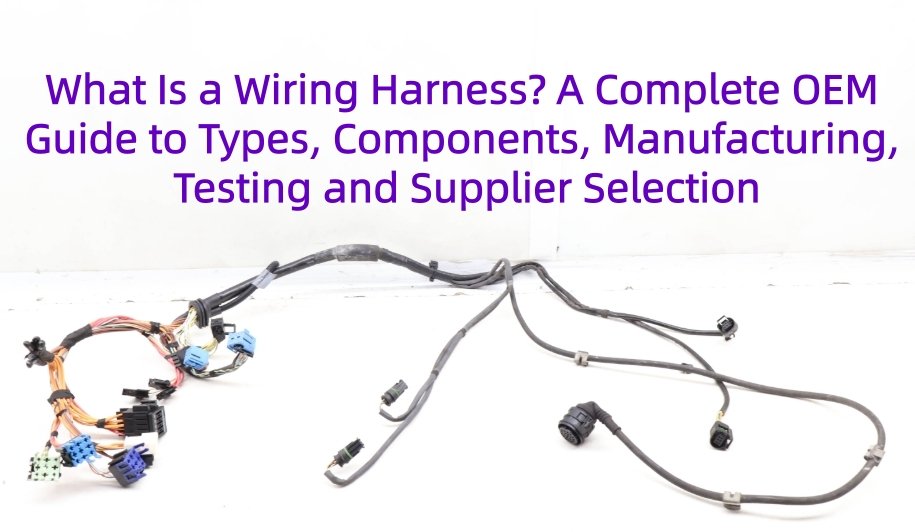
A wiring harness is an organized assembly of wires, cables, terminals, connectors, and protective materials designed to transmit electrical power, signals, or data between components in a vehicle, machine, or electronic system. A wiring harness helps simplify complex electrical connections by arranging multiple circuits into a reliable and easy-to-install system.
A typical wire harness includes wires, terminals, connectors, sleeves, tubing, tapes, clips, and other protection components. Depending on the application, it may also be called an electrical harness, cable harness, or wiring loom.
In this blog, we will explain what a wiring harness is, its main components, common types, design considerations, manufacturing process, testing methods, and how OEM buyers can select the right wiring harness supplier.
What Is a Wiring Harness?
A wiring harness is not simply a group of wires bundled together. It is a designed wire harness assembly manufactured according to specific electrical and mechanical requirements, including circuit layout, wire length, branch locations, terminal types, connector specifications, and protection methods.
A complete wiring harness integrates multiple components such as wires, terminals, connectors, sleeves, tapes, clips, shielding, and other protective materials into one organized assembly. This structure allows complex electrical connections to be installed faster, more safely, and more consistently compared with individual wires.
In an electrical wiring system, the harness acts as the connection platform between different components, ensuring reliable power delivery, signal transmission, and communication. It is widely used in automotive, industrial equipment, medical devices, robotics, energy systems, and electronic products.
How Does a Wiring Harness Work?
The main wiring harness function is to connect different electrical components through an organized network of circuits. Instead of installing separate wires one by one, manufacturers combine multiple circuits into a single assembly that improves reliability and simplifies installation.
A wiring harness usually performs three basic functions:
1. Power Distribution
A wiring harness transfers electrical power from a power source to different components such as motors, lights, controllers, and electronic modules.
Example:
Power Source → Harness → Controller → Motors / Loads
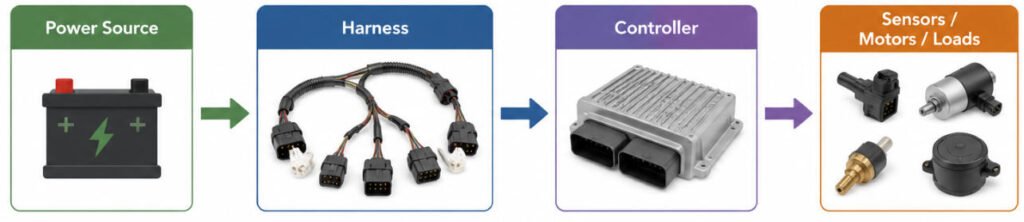
In automotive and industrial applications, wire size, terminal selection, and protection design must match the required current load to prevent overheating or voltage drop.
2. Signal Transmission
The harness carries control signals between sensors, switches, and controllers. These low-voltage circuits allow different components to communicate and operate correctly.
Example:
Sensors → Wiring Harness → Controller
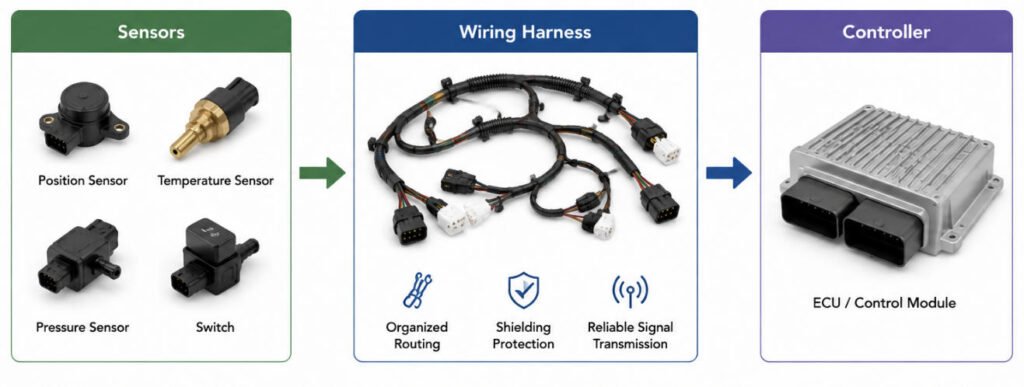
Proper routing and shielding may be required to prevent interference in sensitive signal applications.
3. Data Communication
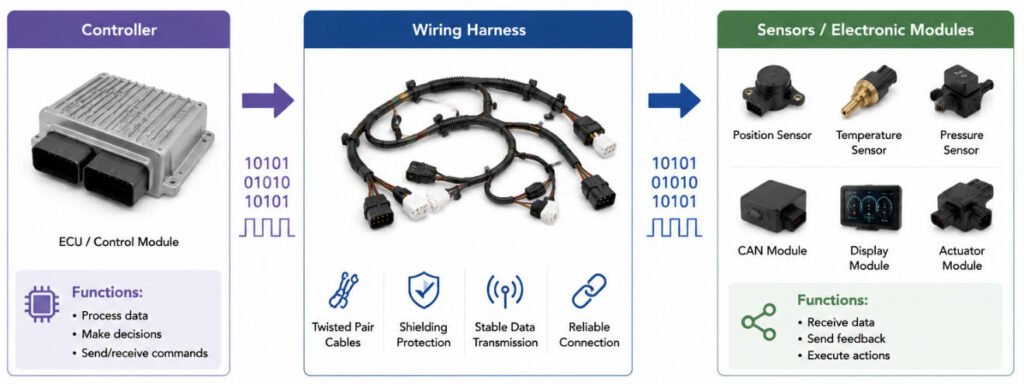
Modern systems increasingly rely on wiring harnesses to transmit digital data between electronic modules. Applications may include CAN communication, automotive Ethernet, industrial networks, and smart control systems.
Example:
Controller → Harness → Sensors / Electronic Modules
Are Wire Harnesses, Electrical Harnesses, Cable Harnesses and Wiring Looms the Same?
In the wire and cable industry, terms such as wire harness, electrical harness, cable harness, and wiring loom are often used interchangeably. However, depending on the industry and application, each term may describe slightly different structures or usage scenarios.
For OEM buyers, understanding these terms helps avoid confusion when communicating with suppliers and defining product requirements.
| Term | Meaning | Common Applications |
|---|---|---|
| Wiring Harness | An organized assembly of wires, terminals, connectors, and protective components designed for electrical connections | Automotive, industrial equipment, medical devices, appliances |
| Wire Harness | A common alternative term for wiring harness, usually referring to multiple wires assembled together | Machinery, vehicles, electronic equipment |
| Electrical Harness | A term focusing on the electrical function of the assembly, including power and signal connections | Vehicles, control systems, automation equipment |
| Cable Harness | Often used interchangeably with wire harness, but may include jacketed cables or more complex cable assemblies | Industrial systems, communication equipment |
| Harness Cable | A general expression describing cables used as part of a harness system | Custom cable assemblies and equipment wiring |
| Wiring Loom | A traditional term commonly used in the UK and automotive industries for a wiring harness | Cars, trucks, motorcycles, vehicle systems |
What Is an Electrical Harness?
An electrical harness is not usually a completely different product from a wiring harness. It refers to the same type of organized electrical connection assembly, with more emphasis on its function—transmitting power, control signals, or electrical data between components.
For example, an automotive electrical harness connects the battery, ECU, sensors, motors, lighting systems, and other electronic modules through properly routed circuits.
The main difference is terminology rather than structure. In engineering documents, suppliers may use “wiring harness” or “electrical harness” depending on the industry and customer preference.
What Is a Cable Harness?
A cable harness is another commonly used term that overlaps with wire harness. In many applications, both terms describe multiple conductors grouped together with connectors and protective materials.
However, the structure may be different depending on the application. A wire harness usually contains individual wires with terminals and connectors, while a cable harness may include jacketed cables, shielded cables, or heavier-duty cable assemblies designed for mechanical protection.
For example:
- Automotive body wiring often uses wire harness structures.
- Industrial equipment may use cable harnesses containing shielded or jacketed cables.
What Is a Wiring Loom?
A wiring loom is a traditional term mainly used in the UK and automotive industries. It describes the same basic concept as a wiring harness: multiple wires organized together into a complete electrical connection system.
The term is still commonly found in automotive discussions, especially when referring to engine harnesses, vehicle wiring systems, and replacement wiring assemblies.
From our manufacturing experience, customers may use different names for the same product. When developing a custom harness, the most important information is not the terminology but the actual requirements, including circuit design, wire specification, connector type, environmental conditions, testing requirements, and production quantity.
What Is the Difference Between a Wire Harness and a Cable Assembly?
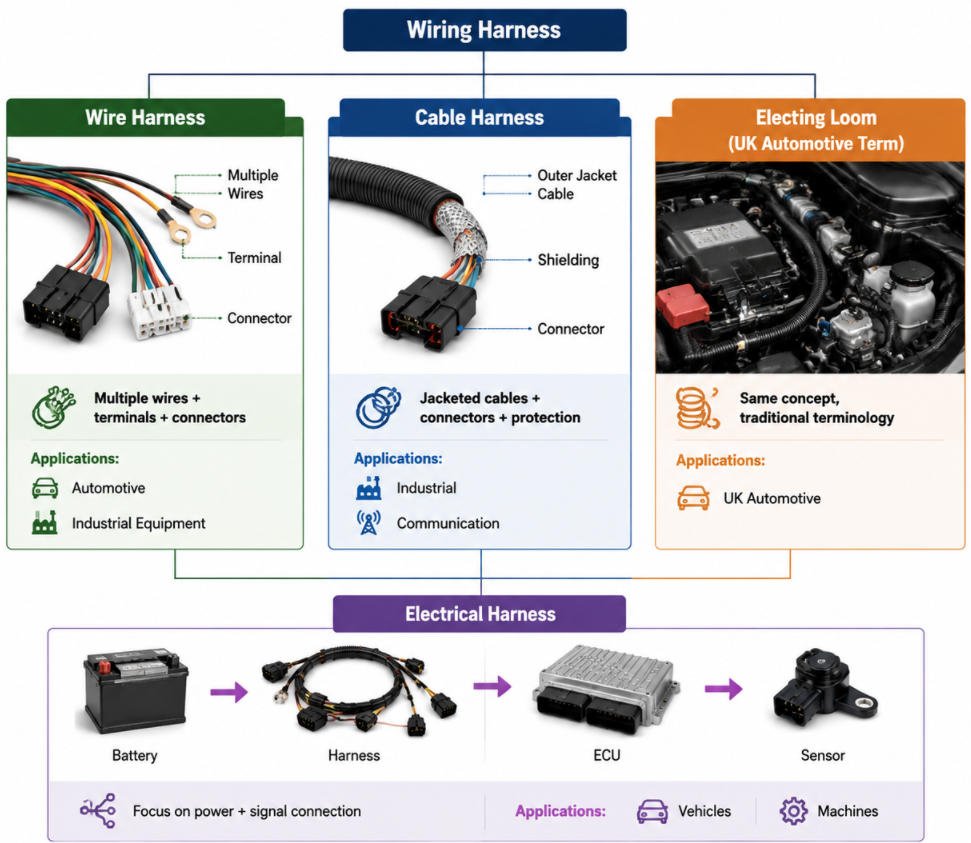
The terms wire harness and cable assembly are sometimes used interchangeably in the industry, but they usually describe different types of electrical connection solutions. The main difference is related to construction, application, protection requirements, and how the assembly is integrated into a system. Below comparison table for your check:
| Comparison | Wire Harness | Cable Assembly |
|---|---|---|
| Construction | Multiple individual wires combined with terminals, connectors, splices, and protective components | One or more cables assembled with connectors, jackets, or shielding |
| Branching | Often includes multiple branches and complex routing paths | Usually has simpler point-to-point connections |
| Protection | Commonly uses tape, tubing, conduit, clips, and protective coverings | Often relies on cable jackets, shielding, and molded protection |
| Flexibility | Designed for complex routing inside vehicles or equipment | Designed for specific connection paths or external connections |
| Application | Automotive systems, machinery, EVs, industrial equipment | Power cables, communication cables, sensors, electronic devices |
| Customization | Highly customized according to circuit layout, installation space, and vehicle design | Customized mainly around cable type, length, connector, and environmental requirements |
When to Use a Wire Harness
A wire harness assembly is typically preferred when a system requires:
- Multiple electrical circuits
- Complex routing paths
- Branch connections
- Space optimization
- Organized installation
Examples include:
- Automotive engine harnesses
- EV battery harnesses
- Industrial machine wiring
- Control panel assemblies
When to Use a Cable Assembly
An electrical cable assembly is commonly used when the application requires:
- A dedicated power connection
- High-speed data transmission
- Shielded communication
- Simple plug-and-play installation
Examples include:
- USB cable assemblies
- Sensor cables
- Ethernet cable assemblies
- High-voltage EV cables
Manufacturer Insight
Yihetai Insight
From a manufacturing perspective, the difference between a wire harness and a cable assembly depends on more than the number of wires. Factors such as application requirements, connector selection, protection design, testing methods, installation conditions, and production volume determine the most suitable solution.
What Are the Main Components of a Wiring Harness?
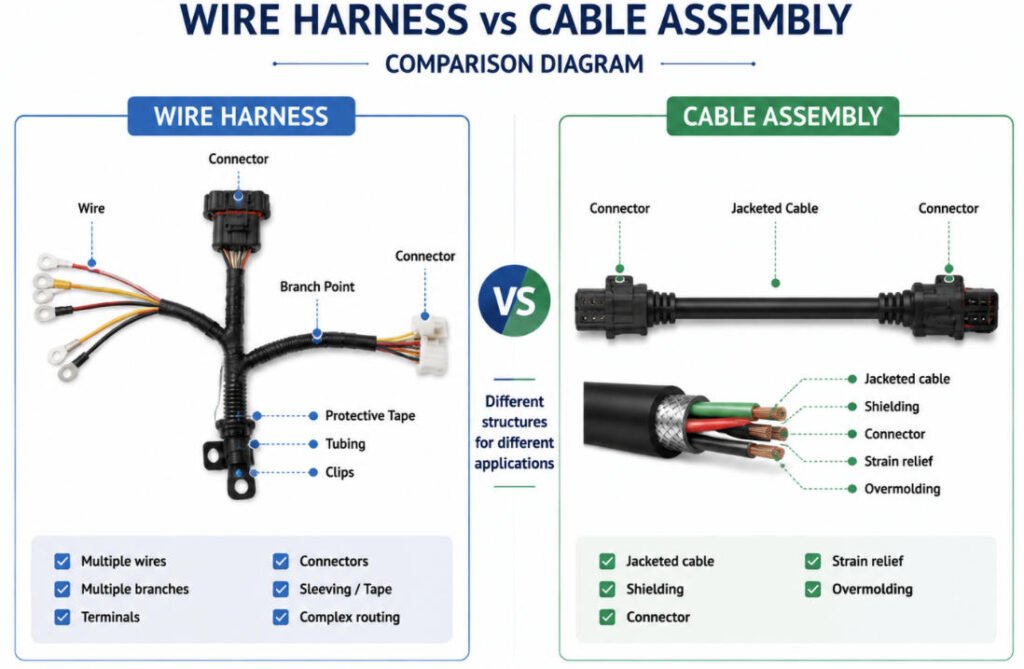
A wiring harness is only as reliable as the components used to build it. From the conductor and terminal to the connector, protection materials, and strain relief structure, every part affects electrical performance, durability, and long-term reliability. Understanding these key components helps OEM engineers make better decisions during harness design and supplier selection.
1. Wires and Cables
Function:
Carry electrical power, signals, or data between connected components.
Selection considerations:
Wire gauge (AWG), conductor material, insulation type, voltage rating, temperature resistance, flexibility, and application environment.
Potential problems if selected incorrectly:
Undersized wires may cause overheating or voltage drop, while unsuitable insulation may lead to cracking, aging, or insulation failure.
2. Terminals
Function:
Create the electrical and mechanical connection between the wire and connector housing.
Selection considerations:
Terminal material, plating, crimp compatibility, current rating, and required pull-force performance.
Potential problems if selected incorrectly:
Poor terminal selection or incorrect crimping can increase contact resistance, cause intermittent connections, or lead to circuit failure.
3. Connector Housings
Function:
Provide secure connections between harness circuits and electrical components.
Selection considerations:
Connector brand, pin count, locking structure, sealing requirements, temperature rating, and application environment.
Potential problems if selected incorrectly:
Wrong connectors may cause poor fitting, terminal loosening, water ingress, or unreliable electrical connections.
4. Seals and Cavity Plugs
Function:
Protect connectors from moisture, dust, and environmental contamination.
Selection considerations:
IP protection requirements, material compatibility, connector design, and operating environment.
Potential problems if selected incorrectly:
Poor sealing can result in corrosion, short circuits, and reduced service life.
5. Splices
Function:
Connect multiple wires together within the harness to distribute power or signals.
Selection considerations:
Current capacity, connection method, insulation protection, and reliability requirements.
Potential problems if selected incorrectly:
Weak splice connections may create resistance, heat generation, or intermittent electrical faults.
6. Sleeving and Conduit
Function:
Protect wires from abrasion, heat, chemicals, vibration, and mechanical damage.
Selection considerations:
Temperature range, flexibility, abrasion resistance, installation space, and environmental exposure.
Potential problems if selected incorrectly:
Insufficient protection may cause wire damage, insulation wear, or premature failure.
7. Tape
Function:
Bundle wires, control branch routing, reduce noise, and provide additional protection.
Selection considerations:
Temperature resistance, adhesion strength, abrasion resistance, and application environment.
Potential problems if selected incorrectly:
Poor tape performance may result in loose bundling, noise issues, or reduced harness durability.
8. Heat-Shrink Tubing
Function:
Provide insulation, sealing, strain relief, and mechanical protection.
Selection considerations:
Shrink ratio, temperature rating, waterproof requirements, and compatibility with cable materials.
Potential problems if selected incorrectly:
Improper heat-shrink selection can lead to poor sealing, exposed conductors, or mechanical damage.
9. Clips and Fasteners
Function:
Secure the harness to the vehicle, machine, or equipment structure.
Selection considerations:
Mounting location, vibration level, material strength, and installation method.
Potential problems if selected incorrectly:
Incorrect clips may cause harness movement, rubbing, noise, or damage during operation.
10. Labels
Function:
Provide identification, assembly information, and production traceability.
Selection considerations:
Label material, printing durability, environmental resistance, and customer requirements.
Potential problems if selected incorrectly:
Poor labeling can create installation errors, maintenance difficulties, or traceability issues.
11. Overmolded Strain Relief
Function:
Protect cable exits and connector areas from bending stress, pulling force, and environmental exposure.
Selection considerations:
Material compatibility, flexibility, sealing requirements, and mechanical stress conditions.
Potential problems if selected incorrectly:
Weak strain relief can cause conductor breakage, connector damage, or failures near cable exits.
In our 25 years of wire harness manufacturing, we have learned that reliability is often decided by small details. Problems such as incorrect terminal selection, poor crimping, or insufficient protection can lead to failures even when the wire meets specifications.
At Yihetai, we focus on controlling every stage of the harness manufacturing process, from component selection and assembly to testing and final inspection, to ensure consistent quality for every project.
What Are the Main Types of Wiring Harnesses?
Wiring harnesses can be classified by electrical function, construction, operating environment, and end-use application, and many custom assemblies combine several of these characteristics. Wiring harnesses can be classified by electrical function, application, protection requirements, and physical construction, although one custom harness may belong to several categories at the same time.
Types of Wiring Harnesses by Electrical Function
Electrical-function classification focuses on what the harness carries between components: power, signals, or data.
1. Power Distribution Harnesses
A power distribution harness carries electrical power from batteries, power supplies, fuse boxes, or distribution units to motors, controllers, lighting, and other electrical loads.
2. Signal and Sensor Harnesses
A signal harness connects sensors, switches, control modules, and monitoring devices using circuits designed for accurate, low-interference signal transmission.
3. Data Communication Harnesses
A data harness uses twisted-pair, shielded, coaxial, Ethernet, CAN, or other communication cables to transmit digital information between electronic systems.
Types of Wiring Harnesses by Application
Application-based classification identifies the equipment or system in which the wiring harness will operate.
4. Automotive Wiring Harnesses
An automotive wiring harness connects vehicle systems such as the engine, dashboard, lighting, doors, battery, sensors, infotainment equipment, and electronic control units.
5. Engine Wiring Harnesses
An engine harness connects the ECU with injectors, ignition coils, sensors, the starter, alternator, and other engine components while resisting heat, oil, vibration, and moisture.
6. High-Voltage Wiring Harnesses
High-voltage harnesses are used in electric vehicles, energy-storage systems, charging equipment, and other high-power applications requiring suitable insulation, shielding, identification, and connector protection.
Types of Wiring Harnesses by Protection
Protection-based classification focuses on how the harness resists moisture, electromagnetic interference, mechanical stress, and harsh operating conditions.
7. Waterproof Wiring Harnesses
A waterproof wiring harness uses sealed connectors, wire seals, cavity plugs, heat-shrink tubing, or overmolding to prevent moisture and contaminants from entering electrical connections.
8. Shielded Wiring Harnesses
A shielded harness uses foil, braid, twisted conductors, or controlled grounding to reduce electromagnetic interference in sensitive signal, data, and control circuits.
9. Overmolded Wiring Harnesses
An overmolded wire harness includes molded protection around connectors, splices, or cable exits to improve sealing, strain relief, durability, and resistance to repeated handling.
Types of Wiring Harnesses by Construction
Construction-based classification describes how the conductors are arranged and how the harness responds to routing, space, and movement requirements.
10. Flat and Ribbon Cable Harnesses
Flat and ribbon harnesses arrange multiple conductors in a parallel format, making them suitable for compact electronic equipment, control panels, appliances, and internal device connections.
11. High-Flex Wiring Harnesses
High-flex harnesses use flexible conductors, insulation, and protective materials designed for robotic equipment, moving machinery, doors, articulated systems, and repeated bending applications.
12. Custom Wiring Harnesses
A custom wiring harness is manufactured according to customer drawings, BOMs, circuit requirements, connector selections, branch dimensions, testing standards, and installation conditions.
In our experience, the correct harness type is determined by the application requirements rather than the product name. Before manufacturing, OEM customers usually need to confirm voltage, current, environment, installation space, flexibility requirements, and production volume.
Where Are Wiring Harnesses Used?
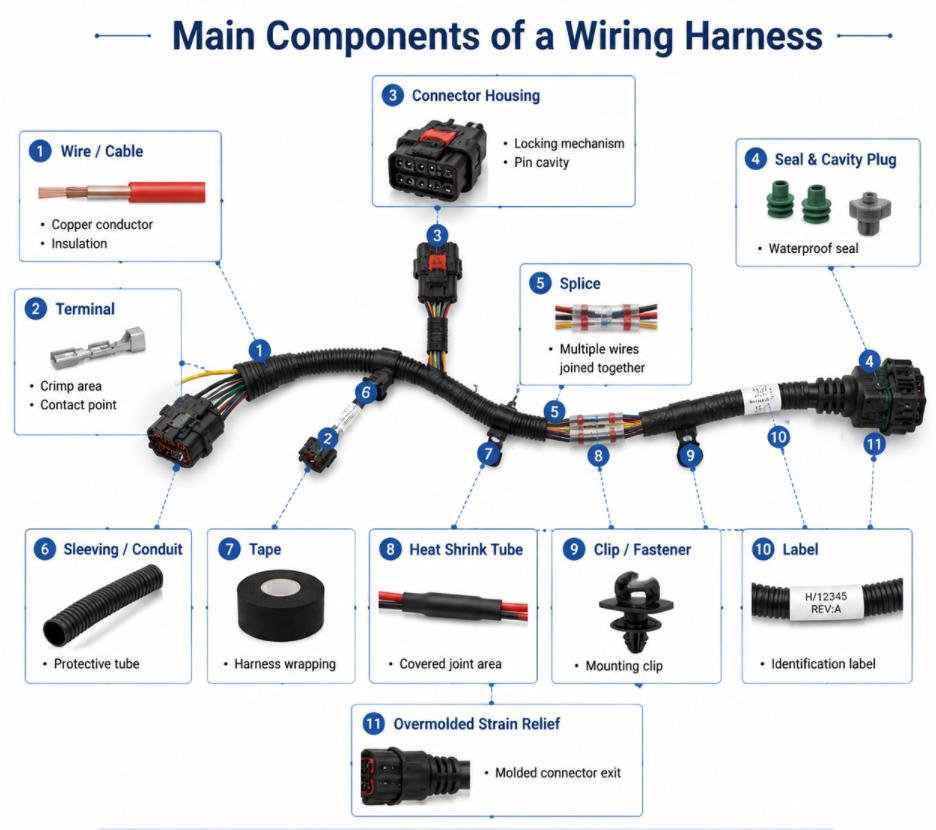
Wiring harnesses are essential components used across many industries to organize electrical connections, transmit power and signals, and improve system reliability. From modern vehicles and electric vehicles to industrial equipment, medical devices, and renewable energy systems, customized wiring harness solutions help ensure safe and efficient operation in complex electrical environments.
Common applications include automotive and electric vehicles, industrial automation, medical equipment, renewable energy and energy storage systems, household appliances, building automation and HVAC systems, aerospace equipment, lighting systems, telecommunications, and engineering machinery. Each application requires different wire specifications, connector designs, protection methods, and testing requirements based on operating conditions.
At Yihetai, we provide customized wire harness and cable assembly solutions for various industries, supporting projects from prototype development to mass production.
How Are Wiring Harnesses Manufactured?
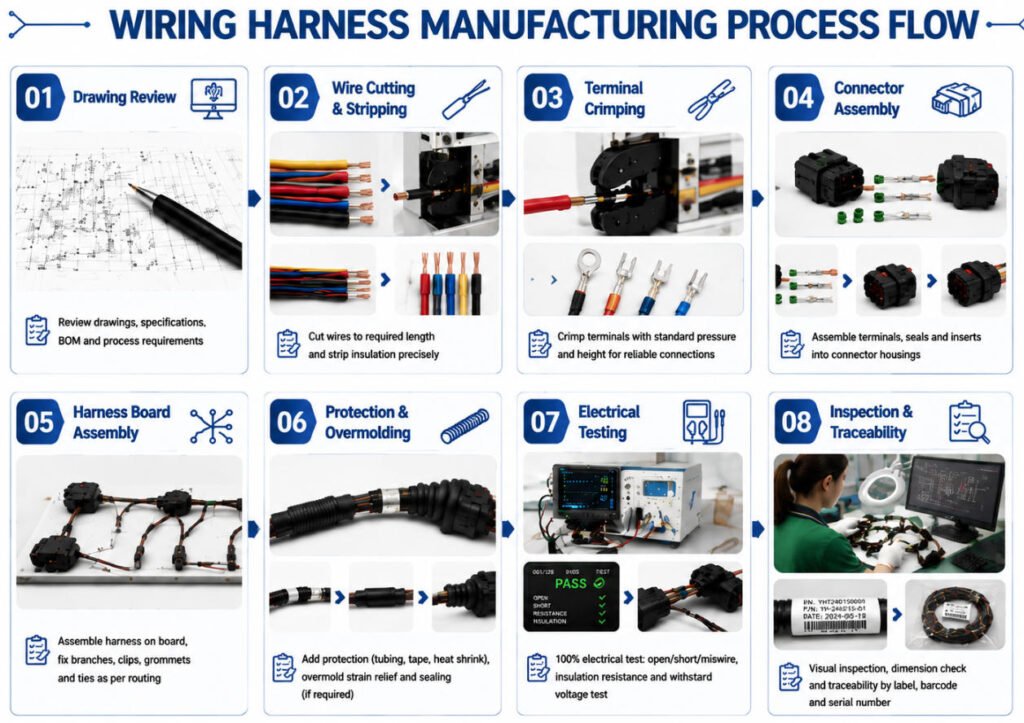
A professional wiring harness manufacturing process involves much more than simply connecting wires together. Each harness is produced according to approved drawings, BOM requirements, connector specifications, and application conditions. A controlled wire harness manufacturing process ensures that every circuit, terminal, and protective component meets the required electrical and mechanical performance.
The following steps explain how wiring harnesses are made in a typical OEM production environment.
1.Drawing and BOM Review
Before production begins, engineers review the wiring diagram, 3D routing requirements, BOM, connector part numbers, wire specifications, and customer requirements to confirm the design is manufacturable.
2.Wire and Connector Verification
All incoming wires, terminals, connectors, seals, and accessories are checked against approved specifications to prevent incorrect materials from entering production.
3. Wire Cutting and Stripping
During wire cutting and stripping, the main parameters include finished wire length, stripping length, insulation pull-off quality, conductor exposure, blade depth, and the number of damaged strands.
Strip length must match the terminal barrel so that the conductor is correctly positioned without insulation entering the conductor crimp; for example, one TE terminal specification requires a stripping length of 2.0 ±0.3 mm, while other terminals may require significantly different values.
The conductor cut should be square and even, with no nicked or cut strands.
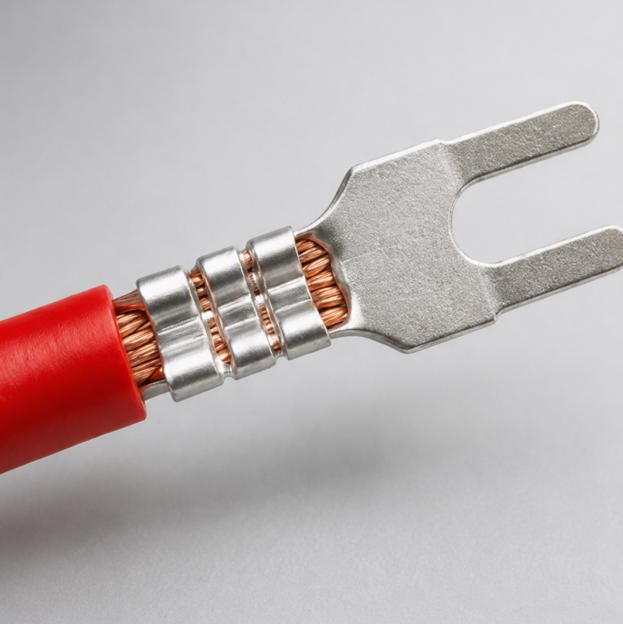
4. Terminal Crimping
During terminal crimping, engineers control:
- Conductor crimp height
- Conductor crimp width
- Insulation crimp height and width
- Front and rear bellmouth
- Conductor brush
- Cut-off tab
- Wire insertion position
- Insulation position
- Terminal bend, twist, and roll
These parameters interact with each other, so changing strip length, terminal position, or applicator setup may also change pull force and crimp geometry.
5. Crimp-Height Measurement
Crimp height is normally measured with a dedicated crimp micrometer at the most compressed part of the conductor barrel.
As a real terminal-specific example, a Molex application tooling specification gives the following conductor crimp-height ranges:
| Wire Size | Conductor Cross-Section | Example Crimp-Height Range |
|---|---|---|
| 24 AWG | 0.20 mm² | 0.79–0.87 mm |
| 22 AWG | 0.35 mm² | 0.85–0.94 mm |
| 20 AWG | 0.50 mm² | 0.95–1.04 mm |
| 18 AWG | 0.80 mm² | 0.97–1.07 mm |
Some TE terminal application specifications use a crimp-height tolerance of approximately ±0.05 mm, while tighter asymmetric tolerances may apply to specific small-wire combinations.
6. Pull-Force Testing
Pull-force testing verifies the mechanical strength of the conductor-to-terminal connection, normally without allowing the insulation crimp to influence the result.
For one Molex terminal family, the specified minimum pull forces are:
| Wire Size | Example Minimum Pull Force |
|---|---|
| 24 AWG / 0.20 mm² | 29.3 N |
| 22 AWG / 0.35 mm² | 39.1 N |
| 20 AWG / 0.50 mm² | 58.7 N |
| 18 AWG / 0.80mm² | 88.0 N |
The correct acceptance value must always be taken from the applicable terminal specification, customer standard, or validated internal process document.
7.Seal Insertion
Wire seals are installed in the correct direction and position, particularly for waterproof connectors used in automotive, outdoor, and harsh-environment applications.
8. Connector Assembly
Crimped terminals are inserted into connector housings according to the approved pin assignment.
The process includes checking:
- Terminal locking position
- Connector orientation
- Secondary locks
- Cavity position
Incorrect terminal insertion is one of the common causes of field failures.
9. Sub-Assembly Preparation
Complex harnesses are usually divided into smaller sections before final assembly.
Sub-assemblies may include:
- Branch circuits
- Battery cables
- Sensor cables
- Connector groups
- Splice sections
This improves assembly efficiency and reduces production errors.
10. Harness Board Routing
During harness board assembly, wires are arranged on a production board according to the final harness layout.
Operators verify:
- Wire routing
- Branch positions
- Connector locations
- Overall dimensions
This step ensures the finished harness matches the customer drawing.
11. Taping and Protective Covering
After routing, protective materials are applied according to application requirements.
Common protection methods include:
- Automotive tape
- Corrugated tubing
- Braided sleeves
- Heat-shrink tubing
- Protective conduits
The correct protection method depends on vibration, abrasion, temperature, and environmental conditions.
12. Clip and Label Installation
Clips, fasteners, labels, and identification markers are installed to support vehicle or equipment installation.
Labels also provide production information and traceability during manufacturing and after-sales service.
13.Overmolding or Sealing
Connectors, joints, and cable exits may be overmolded or sealed to improve water resistance, strain relief, insulation, and mechanical durability.
14. Electrical Testing
Every finished harness should undergo electrical testing before shipment.
Typical tests include:
- Continuity testing
- Open circuit detection
- Short circuit testing
- Miswiring detection
- Resistance measurement where required
Additional tests may be performed depending on customer requirements.
15. Visual Inspection
Final inspection verifies:
- Connector locking
- Wire routing
- Protection materials
- Labels
- Dimensions
- Overall workmanship
Visual inspection helps identify assembly issues that may not be detected by electrical testing alone.
16. Packaging and Traceability
Finished harnesses are packaged according to customer requirements to prevent damage during transportation.
Production records typically include:
- Material information
- Production batch
- Test results
- Inspection records
Complete traceability helps OEM customers manage quality control and future product support.
In our engineering reviews, connector availability, terminal-to-wire compatibility, branch tolerances, and insufficient strain relief are among the issues most often identified before prototype production.
From our manufacturing experience, many harness problems are not caused by the wire itself, but by incorrect component matching, unstable crimping processes, poor routing design, or insufficient protection. Early engineering review and controlled manufacturing processes are essential for achieving reliable wire harness performance.
Which Tests Are Required for Wiring Harnesses?
Wire harness testing is a critical step to ensure electrical performance, mechanical reliability, and long-term durability. A professional manufacturer does not rely on a single final check. Instead, wiring harness electrical testing usually combines production testing, process validation, and reliability testing to verify the harness meets design requirements.
The exact test program depends on the application, such as automotive, EV, industrial equipment, or other safety-critical systems.
Wiring harness testing can generally be divided into three main categories: 100% production tests, process validation tests, and reliability tests.
1. 100% Production Tests
These tests are normally performed on every finished wiring harness before shipment.
- Continuity Test: Confirms that every required circuit is electrically connected from the correct input pin to the correct output pin.
- Open-Circuit Test: Detects broken wires, incomplete crimps, loose terminals, or other interruptions in the intended circuit.
- Short-Circuit Test: Checks for unintended electrical connections between separate circuits.
- Miswiring Test: Verifies that each wire is installed in the correct connector cavity according to the approved pinout.
- Connector Pin-Position Test: Confirms the electrical sequence and, where supported by the fixture, helps identify incorrectly positioned terminals.
- Resistance Test: Measures circuit resistance where low-resistance connections, long cable runs, high-current circuits, or customer-defined limits apply.
A complete wiring harness electrical testing program should use an approved circuit map, defined acceptance limits, controlled fixtures, and a locked test program to prevent unauthorized changes.
2. Process Validation Tests
Process validation tests confirm that critical manufacturing operations remain within the approved process window.
- Crimp-Height Inspection: Uses a dedicated micrometer to verify that the conductor crimp remains within the specified dimensional range.
- Pull-Force Testing: A wire harness pull test measures the mechanical strength of the wire-to-terminal connection and records the failure mode.
- Crimp Cross-Section Analysis: A cut, polished, and magnified crimp cross section is examined for conductor compression, strand distribution, voids, symmetry, and terminal deformation.
- Terminal Insertion Check: Confirms that the terminal is fully seated, correctly oriented, and locked inside the connector housing.
- Seal-Position Verification: Checks that wire seals and cavity plugs match the wire diameter and are installed without twisting, cutting, or incorrect insertion depth.
The required inspection frequency should be defined in the control plan and may include first-piece approval, setup verification, periodic sampling, tooling-change checks, and end-of-run validation.
3. Reliability Tests
Reliability testing is selected according to the application environment, electrical load, customer specification, and expected service life.
| Reliability Test | What It Evaluates |
|---|---|
| Insulation Resistance | Leakage between conductors or between conductors and shielding |
| Hi-Pot Test | Ability of the insulation system to withstand a specified test voltage |
| Voltage-Drop Test | Electrical loss across wires, terminals, splices, and connectors |
| Contact-Resistance Test | Resistance at terminal, connector, or splice interfaces |
| Temperature-Rise Test | Heating under specified electrical current and ambient conditions |
| Vibration Test | Resistance to loosening, intermittent contact, abrasion, and mechanical fatigue |
| Thermal-Cycling Test | Performance after repeated exposure to high and low temperatures |
| Salt-Spray Test | Corrosion resistance of terminals, plating, connectors, and exposed metallic parts |
| Water-Ingress Test | Sealing performance against water, moisture, or pressure exposure |
| Flexing Test | Durability under repeated bending or movement |
| Abrasion Test | Resistance of insulation, tape, conduit, and sleeving to mechanical wear |
| Chemical-Resistance Test | Resistance to oils, fuels, cleaners, coolants, and other specified chemicals |
| Retention-Force Test | Mechanical retention of terminals, connectors, seals, clips, or overmolded joints |
Not every harness requires every reliability test. For example, an internal appliance harness may not require salt-spray testing, while an engine, EV, outdoor, or industrial harness may require vibration, temperature, chemical, and water-ingress validation.
Which Standards Apply to Wiring Harnesses?
Different applications require different wire harness standards and wiring harness certifications. There is no single standard that applies to every harness project. The required standards depend on the industry, application environment, target market, and customer specifications.
For OEM buyers, it is important to understand whether a standard is related to quality management systems, product workmanship requirements, or application-specific requirements.
The following standards are commonly referenced in wiring harness certification and automotive wiring harness standards.
IPC/WHMA-A-620
What it covers:
IPC/WHMA-A-620 defines workmanship requirements and acceptance criteria for cable and wire harness assemblies. It covers processes such as crimping, soldering, insulation, terminals, connectors, shielding, and assembly quality.
Type of standard:
Product workmanship and acceptance standard.
Common applications:
- Automotive wire harnesses
- Industrial cable assemblies
- Medical cables
- Aerospace and defense-related cable assemblies
Depends on customer requirements:
Yes. Many OEM customers specify IPC/WHMA-A-620 as a manufacturing quality reference, but the required revision and class level depend on the project.
ISO 9001
What it covers:
ISO 9001 defines a general quality management system, including document control, process management, corrective actions, supplier management, and continuous improvement.
Type of standard:
Quality management system certification.
Common applications:
Almost all industries requiring controlled manufacturing processes.
Depends on customer requirements:
Usually yes. Many OEM customers expect suppliers to maintain ISO 9001 as a basic quality system requirement.
IATF 16949
What it covers:
IATF 16949 is the primary automotive quality management system standard. It focuses on defect prevention, process control, risk management, traceability, and continuous improvement throughout the automotive supply chain.
Type of standard:
Automotive quality management system.
Common applications:
- Automotive wiring harnesses
- EV cable assemblies
- Vehicle electrical systems
- Automotive components
Depends on customer requirements:
Yes. For automotive OEM projects, IATF 16949 wire harness manufacturing capability is often a key supplier qualification requirement.
Important note:
IATF 16949 is a quality management system standard, not a product certification for a specific wire harness.
ISO 13485
What it covers:
ISO 13485 defines quality management requirements for medical device manufacturing, including risk control, documentation, traceability, and process validation.
Type of standard:
Medical device quality management system.
Common applications:
- Medical cable assemblies
- Patient monitoring equipment
- Diagnostic devices
- Medical instruments
Depends on customer requirements:
Yes. It is generally required when the wiring harness or cable assembly is part of a regulated medical device.
ISO 14001
What it covers:
ISO 14001 focuses on environmental management systems, including waste control, resource management, environmental risks, and regulatory compliance.
Type of standard:
Environmental management system.
Common applications:
Manufacturers supplying global OEM customers with environmental compliance requirements.
Depends on customer requirements:
Yes. Many multinational companies include environmental management requirements in supplier qualification.
ISO 26262
What it covers:
ISO 26262 addresses functional safety for road vehicle electrical and electronic systems. It defines processes for managing safety risks during product development.
Type of standard:
Functional safety development framework.
Common applications:
- ADAS systems
- Safety-related vehicle electronics
- Autonomous driving systems
- Critical electrical systems
Depends on customer requirements:
Yes.
Important note:
ISO 26262 is not a certification for ordinary wiring harness products. It is a functional safety framework applied to vehicle electrical and electronic systems. A standard wire harness manufacturer may need to support ISO 26262-related processes when supplying safety-critical vehicle systems.
ISO 19642
What it covers:
ISO 19642 specifies requirements for automotive cables, including conductor construction, insulation performance, mechanical properties, and environmental resistance.
Type of standard:
Automotive cable product standard.
Common applications:
- Low-voltage automotive cables
- High-performance vehicle cable systems
- EV-related cable applications
Depends on customer requirements:
Yes. The required cable specification depends on vehicle design, voltage level, temperature requirements, and OEM specifications.
USCAR Requirements
What it covers:
USCAR standards define automotive component performance requirements, especially for connectors, terminals, electrical connections, and validation testing.
Type of standard:
Automotive product performance standard.
Common applications:
- North American automotive programs
- Connector systems
- Terminal validation
- Electrical performance testing
Depends on customer requirements:
Yes. USCAR requirements are commonly specified by certain automotive OEMs and suppliers.
LV 214
What it covers:
LV 214 is a German automotive connector testing standard covering mechanical, electrical, and environmental performance requirements for low-voltage connector systems.
Type of standard:
Automotive component performance standard.
Common applications:
- European automotive connectors
- Vehicle wiring systems
- Connector validation
Depends on customer requirements:
Yes. It is commonly referenced in European automotive projects.
SAE Standards
What it covers:
SAE standards cover various automotive engineering requirements, including electrical systems, connectors, cables, testing methods, and vehicle components.
Type of standard:
Industry technical standards.
Common applications:
- Automotive electrical systems
- Commercial vehicles
- Vehicle component development
Depends on customer requirements:
Yes. The applicable SAE standard depends on vehicle type, region, and OEM specification.
UL Requirements
What it covers:
UL standards define safety requirements for electrical products, materials, wires, and cable assemblies, including flame resistance, insulation performance, and electrical safety.
Type of standard:
Product safety certification.
Common applications:
- Industrial equipment
- Consumer electronics
- Medical equipment
- North American markets
Depends on customer requirements:
Yes. Some projects require UL-recognized wire or UL-certified components.
RoHS and REACH
What they cover:
RoHS restricts hazardous substances in electrical and electronic products, while REACH regulates chemical substances used in products supplied to global markets.
Type of standard:
Material and environmental compliance requirements.
Common applications:
- Electronic equipment
- Automotive components
- Industrial products
Depends on customer requirements:
Many global customers require compliance documentation.
OEM-Specific Requirements
What they cover:
Many automotive and industrial customers have their own supplier specifications beyond international standards.
These may include:
- Approved connector brands
- Specific wire suppliers
- PPAP documentation
- Testing procedures
- Traceability requirements
- Packaging standards
- Change-control procedures
Type of requirement:
Customer-specific manufacturing and quality requirements.
Depends on customer requirements:
Always. OEM specifications often become the most important requirements for a specific project.
Standard vs Custom Wiring Harnesses: Which Is Better?
Neither a standard wiring harness nor a custom wiring harness is automatically better for every project. The right choice depends on connector compatibility, installation space, production volume, testing requirements, development budget, and how much design flexibility the OEM needs.
| Factor | Standard or Pre-Made Wiring Harness | Custom Wiring Harness |
|---|---|---|
| Availability | Usually available quickly if the specification is already established | Requires design review, material sourcing, and sample approval |
| Initial engineering cost | Lower because little or no new design work is required | Higher because drawings, BOMs, tooling, and validation may be needed |
| Connector options | Limited to existing connector and terminal combinations | Can use specified TE, Molex, JST, Hirose, Yazaki, Sumitomo, or custom connectors |
| Routing geometry | Fixed lengths and branch positions may not fit every installation | Branch lengths, breakouts, clips, and connector positions can match the equipment |
| MOQ | Often suitable for small quantities when stocked | MOQ depends on material, tooling, and production complexity |
| Tooling | Usually no dedicated tooling is required | Custom fixtures, molds, test boards, or applicators may be required |
| Testing | Usually based on the supplier’s standard test plan | Can include project-specific electrical, mechanical, and environmental testing |
| Traceability | May be limited to general production batches | Can be linked to material lots, production records, and test results |
| Modification flexibility | Changes are limited because the design is fixed | Wire gauge, connector, pinout, length, shielding, and protection can be modified |
| Volume suitability | Suitable for standard equipment, repairs, and low-complexity applications | Suitable for OEM development, specialized equipment, and scalable production |
A pre-made wiring harness is often the better choice when the connector interfaces, circuit layout, and installation dimensions are already standardized. It can reduce lead time, engineering effort, and initial cost.
A custom electrical harness or custom cable harness is more appropriate when the project requires unique pinouts, branch geometry, environmental protection, shielding, overmolding, traceability, or OEM-specific testing. A custom OEM wire harness can also reduce installation time by matching the exact mechanical layout of the final product.
In our manufacturing experience, customization adds the most value when it solves a defined engineering problem. If an existing harness already meets the electrical, mechanical, and environmental requirements, redesigning it may add unnecessary cost and validation work.
How Do You Choose a Wiring Harness Manufacturer?
Choosing the right wiring harness manufacturer is not only about comparing unit prices. Many OEM customers focus on price first, but supplier capability, quality control, and engineering support usually have a greater impact on total project cost, delivery stability, and long-term product reliability.
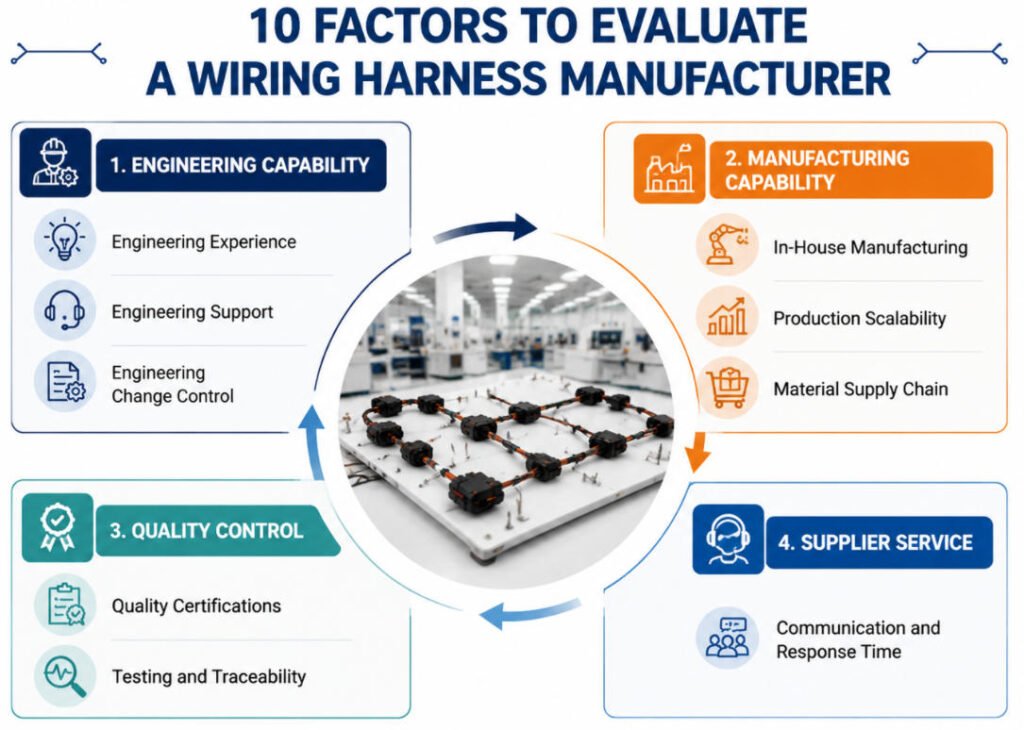
When evaluating a wire harness supplier or custom wire harness manufacturer, consider the following 10 factors:
1. Relevant Industry Experience
Choose a manufacturer with experience in your application, such as automotive, industrial equipment, medical devices, robotics, or energy systems.
A qualified OEM wire harness manufacturer should understand your industry’s requirements, environmental conditions, and quality expectations.
2. Engineering Support
A capable supplier should support:
- Drawing review
- Material selection
- Connector recommendation
- Design for Manufacturability (DFM)
- Prototype improvement
At Yihetai we think engineering involvement at an early stage can help prevent production issues later.
3. Quality Certifications
Check whether the manufacturer has relevant quality systems, such as:
- ISO 9001
- IATF 16949 for automotive projects
- ISO 13485 for medical applications
Certification requirements depend on the product and your specifications.
4. In-House Manufacturing Capability
A reliable cable harness manufacturer should control key processes, including:
- Wire cutting and stripping
- Crimping
- Soldering
- Assembly
- Overmolding
- Electrical testing
At Yihetai, we integrate wire production, cable processing, harness assembly, and testing in-house. This helps improve quality consistency, production control, and delivery reliability for custom wire harness and OEM projects.
5. Testing and Traceability
Ask how the supplier verifies quality.
Important capabilities include:
- Continuity testing
- Wire sequence testing
- Insulation testing
- Pull-force testing
- Production records and batch traceability
6. Prototype Support
A good supplier should support the full development process, from sample builds and engineering validation to pilot production and mass manufacturing.
7. Material Supply Chain
Confirm whether the supplier can provide reliable sourcing for:
- Wires
- Terminals
- Connectors
- Protective materials
Stable material supply helps reduce production delays.
8. Production Scalability
The right manufacturer should be able to support your current requirements while having the capacity to increase production as demand grows.
9. Engineering Change Control
OEM projects often require design updates. A professional supplier should have a controlled process for managing:
- Drawing revisions
- BOM changes
- Material changes
- Production updates
10. Communication and Response Time
Fast and clear communication is important during development and production. Suppliers should be able to provide timely feedback on technical questions, samples, production status, and quality issues.
The best supplier is not always the one offering the lowest quotation. A reliable custom wire harness manufacturer should combine manufacturing capability, engineering support, quality control, and supply stability to reduce risks throughout the product lifecycle.
At Yihetai, we support OEM customers with custom wire harness and cable assembly solutions, from engineering review and prototype development to stable production, helping customers select a solution that fits their technical and commercial requirements.
Conclusion
A wiring harness is a critical system for transmitting power, signals, and data between components. Reliable performance depends on proper electrical design, mechanical protection, environmental resistance, and controlled manufacturing processes.
For OEM projects, buyers should focus on crimping quality, testing, traceability, and engineering support when selecting a wire harness manufacturer.
With 25+ years of manufacturing experience, Yihetai provides custom wiring harness, OEM wire harness, cable assembly, and overmolded solutions from prototype to mass production. Share your drawing, BOM, or sample with us for engineering review and quotation.
Read more: What Is a Wiring Harness? A Complete OEM Guide to Types, Components, Manufacturing, Testing and Supplier SelectionRelated Wire Harness Articles:
- How to Design a Custom Wire Harness for Harsh Environments?
- How to Choose the Right Heat Shrink Tubing for Your Wire Harness?
- Automotive Wire Harness Protection Materials: Corrugated Tube, Tape, Sleeves and Foam Compared
- Why Terminal Selection Important in Custom Wire Harnesses?
- Top 25 Wire Harness Manufacturers in China: The Ultimate Buyer’s Guide