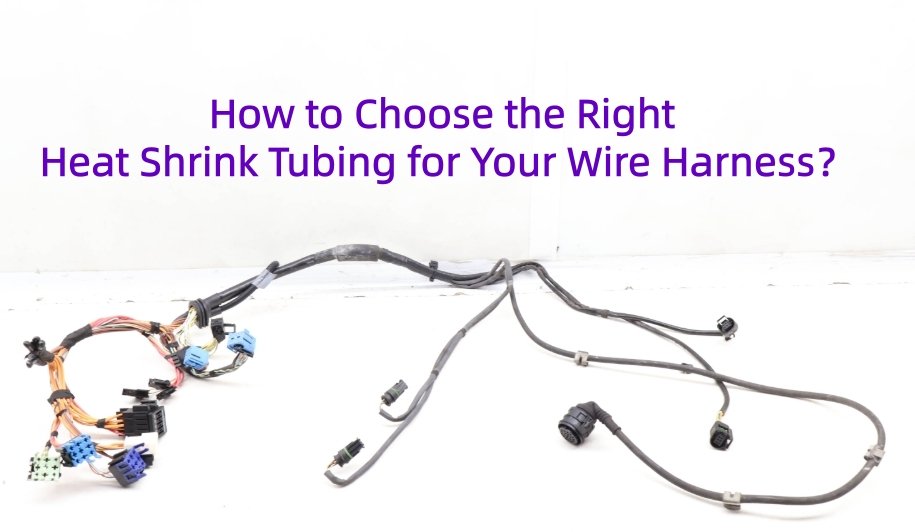
Many engineers and buyers assume heat shrink tubing is a small detail in a wire harness, but in my experience, it often becomes a hidden cause of bigger problems. I have seen harnesses fail early because the tubing was too thin, the shrink ratio was wrong, or the material could not handle heat, vibration, or moisture. What looks like a simple sleeve can directly affect insulation, strain relief, sealing, and long-term reliability.
The real problem is that there are too many options, and choosing by size alone is a mistake I see quite often. When the tubing does not match the wire harness structure or application environment, it can lead to loose coverage, poor protection, rework, and even field failure.
In this blog, I will share how I choose the right tubing for reliable wire harness protection.
What Is Heat Shrink Tubing?
Heat shrink tubing is a polymer tube that shrinks in diameter when heated to a specified recovery temperature. I usually explain it to customers as a protective sleeve that starts in an expanded form, slides easily over a wire, splice, terminal, or branch point, and then contracts tightly around that area when heat is applied. This shrinking action creates a close-fitting layer that improves insulation, mechanical protection, and overall harness durability.
In our wire harness manufacturing work, I often use heat shrink tubing to cover solder joints, terminal transitions, inline splices, and breakout areas where the harness branches into multiple circuits. It is widely used in automotive, industrial, medical, energy storage, and household appliance wire harnesses because these applications often face real-world stresses such as vibration, heat, moisture, dust, and repeated handling. When selected correctly, heat shrink tubing helps protect vulnerable points in the harness and improves both safety and service life.
Main Functions of Heat Shrink Tubing
1.Electrical Insulation
One of the first reasons I use heat shrink tubing is to improve electrical insulation. In a wire harness, exposed conductors, crimp transitions, and soldered joints can become electrical risk points if they are not properly covered. Heat shrink tubing adds an extra insulating layer around these areas and helps reduce the chance of short circuits, current leakage, or accidental contact.
From my experience, this is especially important in compact harness layouts where wires are routed close together, or in power applications where higher voltage and current demand more reliable insulation performance. The tubing material, wall thickness, and dielectric properties all matter here, not just the fit.
2.Mechanical Protection
I have seen many wire harness failures caused not by electrical overload, but by mechanical damage. Wires can rub against metal brackets, plastic housings, sharp edges, or neighboring components during operation. Heat shrink tubing helps create a protective outer layer that reduces abrasion, surface wear, and minor impact damage.
In industrial equipment, automotive assemblies, and energy systems, harnesses are often exposed to constant movement and vibration. In these environments, tubing can protect splices and transition points that would otherwise become weak spots over time. This is why I never look at heat shrink tubing as only an insulating sleeve; it is also part of the harness’s mechanical defense system.
3.Strain Relief
Strain relief is another major function that I pay close attention to. The connection area between wire and terminal is often one of the most stressed sections in a harness. If the wire flexes repeatedly at the same point, conductor fatigue or terminal pullout can happen much earlier than expected.
By applying heat shrink tubing over the transition zone, I can reinforce that area and distribute bending stress more gradually. In our factory, this is a common practice on harness sections that are handled frequently during installation or used in moving equipment. Proper strain relief can significantly improve long-term durability, especially in robotics, automotive subassemblies, and portable medical devices.
4.Moisture and Dust Sealing
When a wire harness operates in humid, dusty, or contaminated conditions, I usually consider sealing performance just as important as insulation. Standard heat shrink tubing offers surface protection, but adhesive-lined dual-wall heat shrink tubing can provide a much better seal by melting an inner adhesive layer during heating. This helps close gaps around the wire or splice area and blocks the entry of moisture, dust, and other contaminants.
I have found this especially useful in automotive under-hood harnesses, outdoor industrial equipment, battery systems, and appliances exposed to condensation. If moisture reaches a splice or terminal area, it can cause corrosion, increase resistance, and shorten service life. That is why sealing should always be evaluated based on the actual application environment.
5.Harness Organization and Identification
Heat shrink tubing also helps with harness organization and identification, which is often overlooked in early design discussions. In complex wire harnesses, I use tubing not only for protection, but also to keep sections neat, grouped, and easier to recognize during assembly, inspection, and maintenance.
Color-coded tubing, printed heat shrink markers, and section bundling can all improve production efficiency and reduce wiring mistakes. In our manufacturing practice, clear identification becomes even more important when a harness includes multiple branches, similar circuit paths, or field-service requirements. A well-organized harness is easier to build, easier to inspect, and easier for the end customer to install correctly.
For that reason, heat shrink tubing is not just a protective material. In many cases, it also supports better process control, cleaner routing, and more reliable traceability in the final wire harness assembly.
What Are The Main Types of Heat Shrink Tubing
As I continue evaluating how to choose the right heat shrink tubing for a wire harness, I also need to understand that not all heat shrink tubing is the same. Different types are designed for different levels of protection, flexibility, and environmental performance. By knowing the main categories of heat shrink tubing, I can more easily match the right option to the specific needs of my wire harness application, whether I need basic insulation, moisture sealing, or protection in harsh operating conditions.
What Are the Main Types of Heat Shrink Tubing?
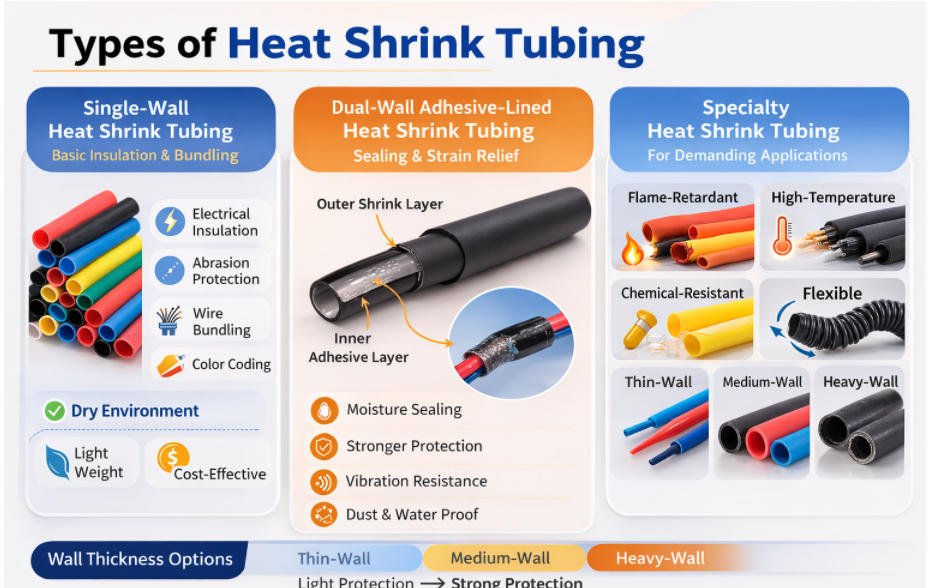
Heat shrink tubing is available in several types, each designed to meet different application requirements. When I select tubing for a wire harness, I need to consider the working environment, the level of protection required, and whether the harness will be exposed to moisture, chemicals, heat, vibration, or mechanical stress. In most wire harness applications, the main types of heat shrink tubing can be grouped into three categories: single-wall heat shrink tubing, dual-wall adhesive-lined heat shrink tubing, and specialty heat shrink tubing.
1.Single-Wall Heat Shrink Tubing
Single-wall heat shrink tubing is one of the most common and widely used types. It consists of a single layer of shrinkable material, usually polyolefin, that contracts when heated and forms a snug fit around wires, splices, or terminals.
I usually consider single-wall heat shrink tubing when the main goal is basic insulation, light abrasion protection, and wire bundling in dry environments. It is a practical and cost-effective choice for applications where sealing against water or dust is not critical. Because it is generally lightweight and flexible, it is easy to install and works well in many standard wire harness assemblies.
This type of tubing is often used in automotive interiors, household appliances, control panels, consumer electronics, and general industrial wiring where the environment is relatively clean and dry. It helps protect exposed conductors, keeps wire bundles organized, and improves the overall appearance of the harness. However, because it does not contain an inner adhesive layer, it is not the best choice when I need strong sealing performance or enhanced strain relief.
2.Dual-Wall Adhesive-Lined Heat Shrink Tubing
Dual-wall adhesive-lined heat shrink tubing is designed for applications that require both mechanical protection and environmental sealing. It has two layers: an outer shrinkable layer and an inner adhesive layer. When heated, the outer layer shrinks while the inner adhesive softens and flows around the wire or connection area, helping create a tight, sealed barrier.
I use this type of tubing when moisture sealing, stronger strain relief, and better environmental protection are required. It is especially useful in wire harnesses that will be exposed to water, humidity, dust, chemicals, vibration, or temperature changes. The adhesive lining helps fill gaps and improves the seal around irregular shapes such as splices, terminals, and branch points.
Dual-wall tubing is commonly used in automotive engine compartments, industrial machinery, outdoor electrical systems, renewable energy equipment, and energy storage applications. In these environments, the added sealing protection can help prevent corrosion, contamination, and premature harness failure. Compared with single-wall tubing, it usually offers better durability and stronger reinforcement, although it may be thicker, less flexible, and more expensive. Even so, when reliability in harsh environments matters, this is often the better choice.
3.Specialty Heat Shrink Tubing
Specialty heat shrink tubing is designed for demanding applications where standard tubing may not provide enough performance. This category includes a wide range of options, such as flame-retardant, high-temperature, chemical-resistant, highly flexible, thin-wall, medium-wall, and heavy-wall tubing.
I choose specialty heat shrink tubing when the wire harness must meet specific technical or environmental requirements. For example, flame-retardant tubing may be important in applications where fire safety standards are critical. High-temperature tubing is useful in engine compartments, industrial equipment, or other high-heat environments. Chemical-resistant tubing can protect wire harnesses used in factories, laboratories, or medical equipment where exposure to oils, solvents, or cleaning agents is possible.
Flexible tubing is ideal when the harness needs to bend easily in tight spaces, while thin-wall tubing works well when I want lightweight insulation with minimal added bulk. Medium-wall and heavy-wall options are better when additional mechanical strength, impact resistance, and sealing performance are needed. These specialty products are often used in aerospace, defense, medical devices, rail systems, industrial automation, and advanced energy systems where performance requirements are more demanding.
Because there are many specialty options available, I need to carefully match the tubing properties to the actual operating conditions of the wire harness. Choosing the wrong type could reduce performance, while choosing the right one can greatly improve reliability, safety, and service life.
7Keys Factors to Consider When Choosing Heat Shrink Tubing
As I move from understanding the main types of heat shrink tubing to making the right selection, I need to focus on the factors that truly affect performance in real applications. Choosing heat shrink tubing is not only about picking a size or material that looks suitable. I also need to make sure the tubing matches both the structure of the wire harness and the actual operating environment. A tubing option that works well in a dry indoor application may fail in a high-temperature, high-vibration, or moisture-exposed environment. That is why careful selection is essential for achieving reliable insulation, protection, sealing, and long-term durability.
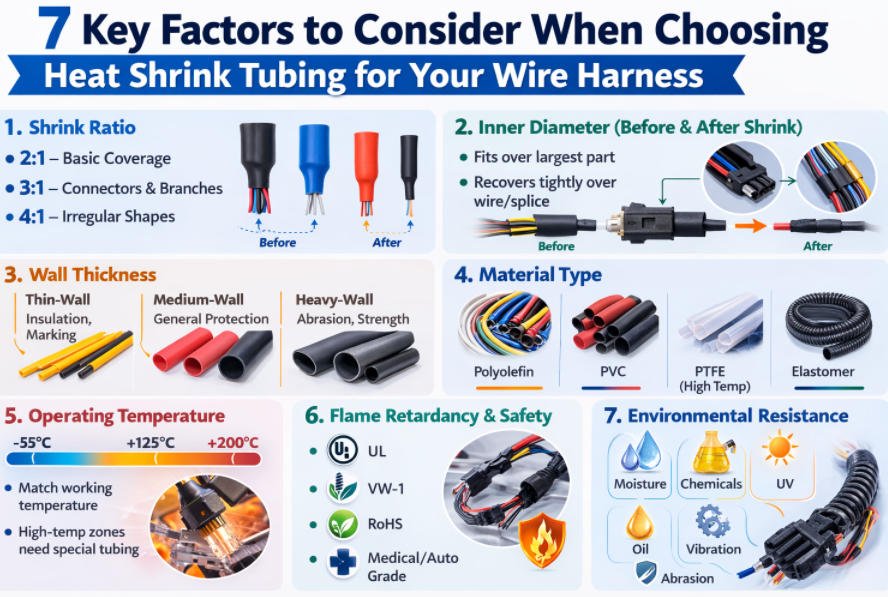
7 Key Factors to Consider When Choosing Heat Shrink Tubing
1.Shrink Ratio
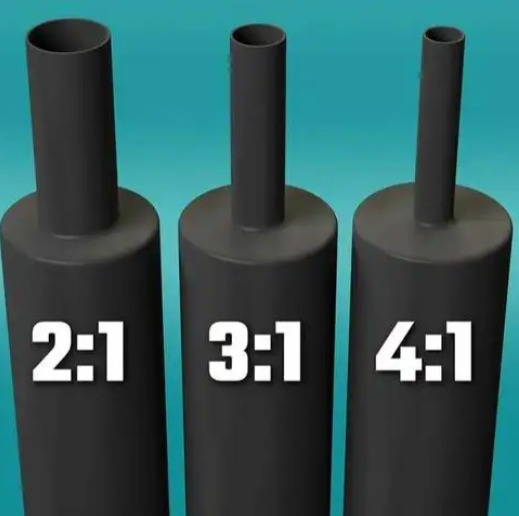
One of the first things I need to check is the shrink ratio of the tubing. The shrink ratio tells me how much the tubing will reduce in diameter after heat is applied. Common options include 2:1, 3:1, and 4:1.
A 2:1 shrink ratio is often suitable for standard wire covering and simple bundling applications where the size difference between the wire and the covered area is relatively small. A 3:1 shrink ratio offers more flexibility and is commonly used when I need the tubing to fit over slightly uneven shapes or larger splices. A 4:1 shrink ratio is especially useful when covering connectors, irregular shapes, or areas with large diameter differences.
In general, the more complex the harness shape is, the more important the shrink ratio becomes. If I choose a ratio that is too low, the tubing may not fit over the assembly during installation. If I choose the right ratio, I can make assembly easier while still getting a tight and secure fit after recovery.
2.Inner Diameter Before and After Shrink
When selecting heat shrink tubing, I must always check both the expanded inner diameter before shrinking and the recovered inner diameter after shrinking. This is one of the most practical and important sizing steps.
Before heating, the tubing needs to slide easily over the largest part of the harness section, such as a splice, terminal, or connector. After heating, it must recover tightly enough around the wire, splice, or branch point to provide the protection and support I need.
If the tubing is too small before shrinking, I may not be able to install it at all. If it is too large after shrinking, it may remain loose and fail to provide proper insulation, strain relief, or sealing. That is why I need to look at both dimensions carefully rather than focusing on only one size number.
3.Wall Thickness
Wall thickness also plays a major role in determining how well the tubing will perform. Heat shrink tubing is generally available in thin-wall, medium-wall, and heavy-wall options.
Thin-wall tubing is commonly used for basic insulation, color coding, marking, and light-duty wire bundling. It is flexible, lightweight, and easy to use in compact harness designs where space is limited.
Medium-wall tubing provides a better balance between flexibility and protection. I may choose it when the harness requires more mechanical strength or a stronger outer layer without becoming too bulky.
Heavy-wall tubing is designed for applications that need strong abrasion resistance, impact protection, and higher mechanical durability. It is often used in harsh industrial or outdoor environments where the wire harness may be exposed to rough handling or physical stress.
The thicker the wall, the stronger the protection usually becomes, but thicker tubing may also reduce flexibility. For that reason, I need to match wall thickness to the actual demands of the harness.
4.Material Type
The material of the heat shrink tubing has a direct effect on its flexibility, insulation performance, temperature resistance, and environmental durability. Different materials are suited to different wire harness applications.
Polyolefin is one of the most common materials and is widely used for general wire harness applications. I often see it chosen because it offers a good balance of insulation, flexibility, durability, and cost-effectiveness.
PVC is often used in flexible, low-cost applications where extreme heat or chemical resistance is not required. It can be a practical choice for less demanding environments.
PTFE or fluoropolymer tubing is better suited for high-temperature environments and applications that require superior chemical resistance. This makes it useful in demanding electrical and industrial systems.
Elastomer tubing is often selected for harsh industrial or automotive conditions because it offers excellent flexibility and can perform well in environments involving vibration, temperature changes, and mechanical stress.
When I choose the material, I need to think beyond cost and consider how the tubing will perform during the full life of the wire harness.
5.Operating Temperature
Another critical factor is operating temperature. The heat shrink tubing I select must be able to handle the normal working temperature of the wire harness without softening, cracking, shrinking further, or losing its protective properties.
In many standard applications, general-purpose tubing may be enough. However, high-temperature zones near motors, power electronics, batteries, or lighting systems require more heat-resistant materials. In these areas, standard tubing may fail much sooner if it is not designed for elevated temperatures.
I need to consider both the installation temperature and the long-term service temperature. Choosing tubing that matches the real thermal conditions of the harness helps improve safety, reliability, and service life.
6.Flame Retardancy and Safety Requirements
In many applications, I also need to consider flame retardancy and safety compliance. Some industries require tubing materials that meet specific fire resistance or safety standards to reduce risk in the event of overheating or electrical failure.
This is especially important in automotive, medical, and consumer electrical products, where safety performance is closely linked to product design and regulatory expectations. Flame-retardant tubing can help improve system safety and support compliance with application-specific requirements.
When selecting tubing for these markets, I should not assume that all materials offer the same level of protection. The right choice depends on the end-use environment, customer requirements, and any applicable safety standards.
7.Environmental Resistance
Finally, I must consider the real environmental conditions the wire harness will face. In many cases, the environment is the deciding factor in whether standard tubing is enough or whether I need a more advanced solution such as adhesive-lined tubing.
Important environmental exposures include:
Moisture – Water or humidity can lead to corrosion or insulation failure if the connection is not properly protected.
Chemicals – Industrial fluids, cleaning agents, or process chemicals may damage certain tubing materials.
UV exposure – Outdoor or sunlight-exposed applications may require tubing with better UV stability.
Oil – In automotive and industrial systems, oil resistance can be essential for long-term durability.
Vibration – Repeated movement can place stress on wire connections and require stronger mechanical support.
Abrasion – Contact with surfaces, edges, or moving components can wear down unprotected harness areas.
If the harness will operate in harsh conditions, standard single-wall tubing may not provide enough sealing or durability. In those cases, adhesive-lined heat shrink tubing is often the better choice because it adds both environmental sealing and stronger strain relief. By matching the tubing to the real environment, I can help prevent premature failure and improve the overall reliability of the harness.
How Application Requirements Affect Tubing Selection
When choosing heat shrink tubing, I always match the tubing not only to the wire harness structure, but also to the way the harness will actually be used. Application requirements directly affect what level of protection, flexibility, sealing, and material performance is needed. In real manufacturing, this is one of the most important parts of tubing selection, because a harness that works perfectly in one environment may fail quickly in another.
Indoor vs. Outdoor Wire Harnesses
One of the first questions I ask is whether the wire harness will be used indoors or outdoors. This has a major impact on tubing selection.
For indoor wire harnesses, the environment is usually more controlled. The harness may be installed inside equipment cabinets, appliances, control systems, or medical devices where exposure to sunlight, rain, and contamination is limited. In these cases, standard single-wall heat shrink tubing is often sufficient for insulation, bundling, and light mechanical protection.
For outdoor wire harnesses, I take a much stricter approach. Outdoor applications are usually exposed to moisture, dust, UV radiation, temperature changes, and mechanical wear. In these cases, the tubing often needs better sealing, UV resistance, and stronger mechanical protection. I frequently recommend adhesive-lined tubing or more durable specialty materials for outdoor equipment, vehicle systems, renewable energy installations, and exposed industrial wiring.
In my experience, outdoor failures often begin at small unprotected transition points. Moisture enters, UV weakens the material, and vibration gradually damages the harness. That is why outdoor applications usually require more than basic insulation.
Low-Voltage Signal Harness vs. Power Harness
The electrical function of the harness also affects tubing selection. I always distinguish between a low-voltage signal harness and a power harness, because the performance priorities are different.
For a low-voltage signal harness, the main concern is often stable insulation, compact routing, and protection of sensitive signal lines. In these applications, I usually focus on fit, flexibility, and insulation coverage, especially around splices, sensor leads, and connector transitions. Thin-wall tubing is often sufficient if the environment is clean and the mechanical stress is low.
For a power harness, the requirements are usually more demanding. Power circuits often generate more heat and carry higher current, so I pay more attention to temperature resistance, wall thickness, and insulation reliability. In many cases, power harnesses need tubing with stronger dielectric performance, better mechanical strength, and more robust long-term stability.
I have seen power applications fail because the tubing was selected as if it were only for simple wire covering. In reality, power harnesses may require thicker-wall tubing, higher temperature-rated materials, and more reliable protection at branch points and termination areas, especially near battery systems, inverters, motors, or power distribution units.
Static Equipment vs. Moving Equipment
Another key factor is whether the harness will remain in a fixed position or move repeatedly during operation.
In static equipment, such as fixed control cabinets, stationary appliances, and panel wiring, the tubing does not need to handle constant bending or repeated motion. In these cases, standard tubing may perform well as long as the insulation level and environmental resistance are appropriate.
In moving equipment, the situation is very different. I pay much more attention to flexibility and fatigue resistance when the harness is used in robotics, automation systems, movable machinery, or vehicle applications. Repeated bending, vibration, and dynamic routing can place constant stress on the tubing and on the wire termination points underneath.
For these applications, I often look for tubing materials that remain flexible over time and do not crack, harden, or lose grip after repeated motion. I also pay close attention to strain relief, because movement tends to concentrate stress at connector exits, branch points, and transition areas.
In our manufacturing experience, moving equipment harnesses usually require more careful selection than static harnesses. A tubing material that performs well in fixed equipment may not survive long in robotic arms, conveyor systems, or vehicle body harnesses.
Industry-Specific Requirements
Different industries also have different expectations for heat shrink tubing performance. This is why I never recommend tubing without first understanding the end-use sector.
In automotive applications, I usually consider temperature resistance, vibration durability, fluid exposure, and long-term reliability. Tubing may also need to support stricter quality and performance expectations because the harness often operates in harsh environments such as engine compartments, chassis areas, or high-vibration cabin systems.
In industrial equipment, I focus more on abrasion resistance, oil exposure, chemical resistance, and mechanical durability. Factory automation, control equipment, and machinery often place the harness in environments where protective performance matters more than appearance.
In medical applications, the priorities may include cleanliness, compact size, flexibility, and material suitability for sensitive devices. Some medical cable assemblies also require more careful control of material properties, processing conditions, and appearance quality.
In energy applications, such as battery systems, charging equipment, solar systems, and power distribution assemblies, I usually pay close attention to insulation reliability, heat resistance, and long-term environmental durability. These applications often combine electrical stress with temperature rise and exposure to outdoor or semi-protected environments.
From my perspective, industry-specific requirements often decide whether general-purpose tubing is enough or whether a more advanced solution is necessary. The same heat shrink tube will not perform equally well across automotive, medical, industrial, and energy systems.
Choosing tubing based on the application is one of the most effective ways to avoid premature failures. Once I understand whether the harness is indoor or outdoor, signal or power, static or moving, and what industry standards apply, I can make a much more accurate and reliable tubing selection.
How to Size Heat Shrink Tubing Correctly
Correct sizing is one of the most important parts of heat shrink tubing selection. In my experience, even a good material will not perform properly if the tubing size is wrong. The goal is simple: the tubing must be large enough to install easily, but small enough to recover tightly and protect the wire harness effectively.
Measure the Largest and Smallest Harness Sections
The first thing I do is measure both the largest and smallest sections of the harness area that the tubing will cover. This is essential because the tubing must work across the full shape of the assembly, not just one point.
I always account for features such as terminals, splices, branch points, and connector backshells, because these are often the areas that determine whether the tubing can actually be installed. The largest diameter tells me the minimum expanded size I need for installation. The smallest section tells me how tightly the tubing must recover after heating.
For example, if the tubing needs to pass over a crimped terminal or a molded transition and then shrink onto a smaller wire bundle, both measurements matter. In our factory, this is one of the first checks we make before confirming tubing size for production.
Leave Room for Installation
After measuring the harness, I make sure the tubing has enough clearance to slide over the largest assembly point without damage. This is especially important during real production, where the operator may need to install the tubing over uneven or sensitive components.
If the tubing is too tight before heating, it may scrape against the insulation, catch on the terminal area, or become damaged during assembly. This can slow production and increase the risk of rework. I have seen this happen when tubing was chosen too aggressively based on final recovered size without enough attention to installation clearance.
That is why I always leave practical room for installation, especially when the harness includes large transitions, irregular shapes, or adhesive-lined tubing, which is generally less forgiving during assembly than standard single-wall tubing.
Confirm Final Recovered Fit
Good installation clearance alone is not enough. I also need to confirm that the tubing will recover tightly after heating. Once shrunk, it should fit securely around the wire, splice, or harness section without being too loose or too compressed.
A proper recovered fit helps ensure good insulation, mechanical support, and sealing performance. If the tubing remains loose, it may not protect the harness properly. If it is forced into excessive compression, it may create stress, reduce flexibility, or fail to seal correctly in certain areas.
This is especially important for adhesive-lined tubing, because the final fit affects how well the adhesive flows and seals around the surface. In my experience, the best result is a snug and uniform recovery that follows the shape of the harness without gaps, distortion, or incomplete coverage.
Avoid Common Sizing Mistakes
I have seen several common mistakes when customers choose heat shrink tubing size.
One mistake is choosing tubing only by wire gauge. Wire gauge alone does not tell me the full installation diameter, especially when terminals, splices, or branch structures are involved. Another mistake is ignoring adhesive flow in dual-wall tubing. When adhesive-lined tubing shrinks, the adhesive also needs space to melt and flow properly, which can affect the final fit and sealing result.
A third common issue is overlooking branch transitions. In branched harnesses, the tubing may need to pass over one geometry and recover onto another, which makes sizing more complex than on a straight cable section. If this is not considered in advance, the tubing may either fail to install or fail to recover tightly where protection is needed most.
In our production experience, the most reliable approach is to size tubing based on the real assembled harness shape, not just the nominal wire size. That is the best way to avoid installation problems and achieve consistent protection in the final application.
When to Use Adhesive-Lined Heat Shrink Tubing
As I evaluate different heat shrink options for a wire harness, one question comes up very often: when is standard tubing enough, and when is adhesive-lined tubing the better choice? In real applications, this decision can make a big difference in sealing performance, strain relief, and long-term reliability. I have seen many harnesses work well with standard single-wall tubing, but I have also seen cases where moisture, vibration, or mechanical stress caused early failures because the connection area was not sealed or supported properly. That is why I always treat adhesive-lined heat shrink tubing as a functional protection solution, not just an upgraded sleeve. It should be used where the application truly needs extra sealing and mechanical reinforcement.
When to Use Adhesive-Lined Heat Shrink Tubing
Moisture and Dust Sealing
One of the most common reasons I choose adhesive-lined heat shrink tubing is for moisture and dust sealing. This type of tubing has an inner adhesive layer that melts during heating and flows around the wire, splice, or terminal area. After cooling, it helps create a tighter barrier against water, dust, and other contaminants.
In my experience, this is especially useful for harnesses used in outdoor equipment, high-humidity environments, or washdown areas. For example, if a wire harness is installed in agricultural machinery, industrial outdoor equipment, battery systems, or appliances exposed to moisture, standard tubing may not provide enough protection on its own. Even when the outer tubing looks tight, small gaps can still allow water vapor or dirt to enter over time. Adhesive-lined tubing helps reduce that risk and improve long-term reliability.
Strain Relief at Transition Points
I also often use adhesive-lined heat shrink tubing when I need better strain relief at transition points. In a wire harness, the most vulnerable areas are often where the wire meets a terminal, connector, or splice. These transition zones are exposed to concentrated bending and repeated stress, especially during installation and service.
When adhesive-lined tubing is applied over these areas, it not only shrinks around the outer surface but also bonds more closely to the underlying shape. This helps support the transition and reduce movement between the wire and the connected component. I have found this especially helpful at wire-to-terminal and wire-to-connector areas, where better support can reduce fatigue damage and improve harness durability.
Extra Mechanical Support
Another reason I select adhesive-lined tubing is when the harness needs extra mechanical support. Some harness sections are simply more fragile or more exposed to stress than others. Splices, repaired sections, and molded transition areas are good examples.
For splices, adhesive-lined tubing can improve both sealing and structural support. For repaired sections, it can help restore protection in areas where the original insulation or covering was interrupted. For molded or irregular transitions, it can fill small voids and improve the final fit around uneven surfaces. In my experience, this added reinforcement is very valuable in applications exposed to vibration, movement, or rough handling, where a basic shrink tube may not provide enough support by itself.
Situations Where Adhesive-Lined Tubing Is Not Ideal
Although adhesive-lined heat shrink tubing offers clear advantages, I do not recommend it for every harness. In some cases, it adds cost, bulk, and processing steps without providing real benefit.
For simple indoor harnesses used in clean, dry, and protected environments, standard single-wall tubing is often sufficient for insulation and appearance. If there is no real need for sealing or added mechanical reinforcement, adhesive-lined tubing may be unnecessary.
It is also not always the best choice for very tight high-density assemblies. Because the adhesive layer and thicker wall increase the final diameter, the tubing can take up more space after recovery. In compact harnesses with limited clearance, this extra bulk may interfere with routing, connector fit, or overall assembly layout. I have also seen cases where excessive adhesive flow created an untidy finish in very small assemblies. For these reasons, adhesive-lined tubing should be selected when its functional benefits match the actual application, not simply as a default upgrade.
Final Thought
When I decide whether to use adhesive-lined heat shrink tubing, I always start with the real protection requirements of the harness. If the application involves moisture, dust, vibration, or weak transition points, adhesive-lined tubing can provide much better sealing, strain relief, and mechanical support. But if the harness is simple, dry, and space-limited, standard tubing may be the more practical choice. The best decision always comes from balancing protection needs, assembly conditions, and long-term reliability.
Common Mistakes Engineers and Buyers Should Avoid
As I get closer to making a final tubing decision, I also need to pay attention to the mistakes that can cause problems later in production or in actual use. Even when a heat shrink tubing option looks acceptable at first, it may still create reliability issues, assembly difficulties, or unnecessary cost if it is not evaluated carefully. For engineers and buyers, choosing the right tubing is not only about meeting technical specifications on paper. It is also about making sure the tubing performs well in real harness conditions, fits the production process, and supports long-term product quality. By understanding the most common mistakes, I can make better decisions and reduce the risk of failure.
Common Mistakes Engineers and Buyers Should Avoid
Choosing Based on Price Only
One of the most common mistakes I see is choosing heat shrink tubing based only on price. Low-cost tubing may look attractive from a purchasing perspective, but it can create much bigger problems if it does not perform well in the actual application. In many wire harnesses, the tubing must withstand heat, vibration, moisture, abrasion, or chemical exposure over a long service life. If the material quality is too low, the tubing may crack, loosen, discolor, shrink unevenly, or lose its protective properties much sooner than expected.
What seems like a cost saving at the beginning can turn into a higher total cost later through rework, warranty claims, maintenance issues, or product failure. That is why I should always evaluate price together with performance, durability, and application suitability. The best choice is not simply the cheapest tubing, but the tubing that gives reliable performance and good overall value.
Ignoring Production Efficiency
Another important mistake is ignoring production efficiency. Some heat shrink tubing may perform well technically, but it may be difficult to process consistently in volume manufacturing. If the tubing is hard to cut, position, shrink evenly, or apply within the required cycle time, it can slow down production and increase variation between assemblies.
In mass production, I need to think beyond the material properties alone. I also need to ask whether the tubing works smoothly in the real manufacturing process. Tubing that requires excessive handling, precise positioning, or unusually careful heat control may lead to lower efficiency, inconsistent results, or higher labor cost. For this reason, engineers and buyers should consider not only whether the tubing can work, but also whether it can be processed reliably and repeatedly at scale.
Overlooking Compatibility with Connectors and Terminals
I also need to make sure the tubing is compatible with the connectors, terminals, and other components used in the wire harness. A poor tubing choice can interfere with insertion, locking, routing, or final assembly. For example, tubing that is too thick, too stiff, or improperly sized may block connector engagement, affect terminal seating, or create unwanted stress around the connection area.
This is especially important in compact harness designs, high-density assemblies, or applications with precise mechanical tolerances. Even if the tubing provides good insulation and protection, it is still the wrong choice if it makes the harness harder to assemble or affects connector performance. That is why I should always evaluate tubing selection in the context of the full harness design, not as a separate material decision.
Forgetting Testing and Validation
A final mistake that engineers and buyers should avoid is forgetting testing and validation. Heat shrink tubing should never be selected based only on catalog data or general assumptions. Even when the specifications look correct, the tubing still needs to be verified under actual harness conditions before mass production begins.
I need to confirm that the tubing fits properly, shrinks consistently, seals as expected, and performs well under the real thermal, mechanical, and environmental stresses of the application. Testing may include installation trials, temperature exposure, vibration checks, sealing evaluation, or other application-specific validation steps. Without this process, there is a greater risk of discovering problems only after production has started, when changes are more costly and disruptive.
Best Practices for Selecting Heat Shrink Tubing for Custom Wire Harnesses
After reviewing common mistakes, I always like to end with a more practical question: what does good tubing selection look like in a real custom wire harness project? In my experience, the best results do not come from choosing the most expensive tubing or the most advanced material. They come from matching the tubing to the actual application, the harness structure, and the production process. I have seen many avoidable problems happen because the tubing was selected too early, without fully considering temperature, routing, assembly sequence, or validation. That is why I always recommend following a few clear best practices. They help engineers and buyers make better decisions and reduce risk before the harness moves into volume production.
Best Practices for Selecting Heat Shrink Tubing for Custom Wire Harnesses
Define the Real Working Environment First
The first thing I always do is define the real working environment of the wire harness. This sounds simple, but it is where many wrong tubing decisions begin. A tube that performs well in a clean indoor control box may fail quickly in an automotive compartment, a battery system, or an industrial machine.
I always look at the actual service conditions, including temperature, bending, chemicals, moisture, vibration, abrasion, and installation constraints. These factors should drive the selection process from the beginning. For example, if the harness is routed near a motor, inverter, or lighting module, the tubing must handle higher temperature exposure. If the harness is installed outdoors or in a humid environment, sealing performance becomes much more important. If the wire bundle moves repeatedly, then flexibility and fatigue resistance matter more than simple wall thickness.
In my experience, tubing selection becomes much easier once the real operating conditions are clearly defined. Without that step, engineers and buyers are often choosing blindly.
Match Tubing to Harness Process
I also always check whether the tubing matches the actual harness manufacturing process, not just the final application. A tubing that looks correct in design review may still create problems on the production floor if it does not fit the assembly method.
In real wire harness manufacturing, the tubing selection should be compatible with cutting, crimping, soldering, assembly sequence, and heating method. For example, the tubing must be easy to cut to consistent lengths, easy to position during assembly, and able to shrink reliably with the available heating equipment. If soldering is involved, the tubing should also be chosen with enough thermal stability and correct installation timing. If crimp terminals and connector housings are used, the tubing must not interfere with insertion or locking.
I have seen some tubing perform well technically but create unnecessary production variation because it was too difficult to handle consistently. Good selection should support smooth processing, repeatable heating, and stable final quality.
Validate with Samples Before Full Production
Before approving any heat shrink tubing for mass production, I always recommend sample validation. This is one of the most effective ways to avoid costly selection errors.
A trial build helps confirm whether the tubing actually fits the real harness section, passes over the largest assembly point, and recovers properly over the final target area. It also allows the team to evaluate fit, shrink recovery, visual appearance, strain relief, and sealing performance before the project moves further. In the case of adhesive-lined tubing, sample testing is even more important because adhesive flow and final shape can look very different from what people expect on paper.
In my experience, many issues only become visible during real sample builds. A tube that seems suitable in theory may recover too loosely, add too much bulk, interfere with adjacent components, or create inconsistent results during heating. That is why I always see trial validation as a necessary engineering step, not an optional extra.
Work with an Experienced Wire Harness Manufacturer
One of the best ways to avoid tubing selection problems is to work with an experienced wire harness manufacturer. In custom harness projects, heat shrink tubing is rarely a standalone item. It has to work together with the wire type, terminals, connectors, splices, branch design, and the full production process.
A manufacturer with real harness design and processing experience can often identify risks that are easy to miss during early design or sourcing review. In my experience, this includes issues such as incorrect shrink ratio, poor fit over connector exits, excessive recovered thickness, adhesive overflow, or tubing that slows down assembly in volume production. An experienced supplier can also recommend more suitable materials and validate whether the tubing matches the real harness application.
This kind of support helps prevent costly errors before they affect tooling, purchasing, and mass production. It is especially valuable in custom projects where the harness geometry, environment, and performance requirements are more complex than standard catalog assemblies.
How Yihetai Supports Heat Shrink and Wire Harness Selection
1.Engineering-Based Material Selection
At Yihetai, heat shrink and wire harness selection can be supported from an engineering perspective rather than by material choice alone. The company states that it develops custom cable and wire solutions based on specific application requirements, including temperature, moisture, size, and other design needs, and that it can support both small-batch and high-volume production. This kind of approach is important because heat shrink tubing must match the environment, connector type, wire specification, and assembly method of the harness, not just the nominal wire size.
In practical terms, this means Yihetai can help align tubing and harness design with the real conditions of use. For a customer, that reduces the risk of choosing tubing that is technically acceptable on paper but unsuitable for the final harness structure or operating environment.
2.Manufacturing and Testing Capability
Yihetai also presents in-house manufacturing and testing capabilities that support more reliable harness production. Its materials describe a process flow that includes cutting, crimping, assembly, bundling, final inspection, electrical testing, insulation resistance, withstand voltage checks, and appearance inspection. The documents also show capabilities related to terminal processing, welding, testing areas, and injection-related production, all of which are relevant when selecting and processing heat shrink tubing in real harness assemblies.
This matters because even the right tubing can perform poorly if the processing method is inconsistent. Proper control from wire processing and terminal crimping to continuity testing and final inspection helps improve harness reliability and ensures the selected tubing performs as intended in production.
3.Support for Different Industries
Yihetai’s company materials show support for a wide range of industries and applications. Its profiles mention products and processing for automotive, new energy, energy storage, photovoltaic, industrial machinery, telecommunication, consumer products, and medical-related applications. The documents also show dedicated medical production capability and references to medical wire and medical workshop facilities.
This broad industry coverage is useful because tubing requirements vary significantly across applications. Automotive harnesses may emphasize heat and vibration resistance, photovoltaic and outdoor systems may require better UV and moisture protection, industrial equipment often demands mechanical durability, and medical-related cable processing may involve cleaner production expectations. A manufacturer serving multiple industries is often better positioned to recommend a more suitable heat shrink solution for each use case.
4.Certified Quality System
Yihetai states that it has more than 23 years of manufacturing experience and that its production processes comply with ISO 9001:2015, with UL and IATF 16949 certifications also listed in its company materials. Its profile further shows the company was founded in December 2001, which supports the experience claim, and includes additional certification references in its quality system section.
FAQ
1.What shrink ratio is best for wire harnesses?
The best shrink ratio depends on the shape and diameter difference of the harness section you need to cover. In my experience, 2:1 heat shrink tubing is suitable for simple wire insulation and bundling where the size difference is small, while 3:1 tubing is a more flexible choice for many standard wire harness applications because it can fit over terminals or splices more easily and still recover tightly. 4:1 tubing is usually better when the tubing must pass over larger connectors, irregular shapes, or branch transitions and then shrink down onto a much smaller wire section. The right ratio should always be selected based on the actual harness geometry, not just the wire size alone.
2.When should I use adhesive-lined heat shrink tubing?
I usually recommend adhesive-lined heat shrink tubing when the wire harness needs better sealing, stronger strain relief, or added mechanical support. It is especially useful in outdoor, high-humidity, dusty, or washdown environments, where moisture or contamination could affect the splice or terminal area. It also works well at wire-to-terminal, wire-to-connector, and repaired splice sections, because the melted adhesive helps fill gaps and support the transition point more securely. However, for simple indoor harnesses in clean and dry conditions, standard single-wall tubing is often enough, so adhesive-lined tubing should be used where its extra protection is truly needed.
3.Can heat shrink tubing replace other wire harness protection materials?
In my experience, heat shrink tubing can provide excellent insulation, sealing, strain relief, and local mechanical protection, but it cannot always replace every other wire harness protection material. It works very well for splices, terminals, branch points, and short transition areas, but for long harness runs or areas exposed to heavy abrasion, repeated movement, or strong mechanical stress, other materials such as corrugated conduit, braided sleeving, tape wrapping, or molded protection parts may still be necessary. The best approach is usually to treat heat shrink tubing as one part of the overall harness protection system, rather than as a universal replacement for all other protective materials.
4.How do I know what tubing size to choose?
I always determine heat shrink tubing size by checking both the largest assembly point and the smallest final coverage area. The tubing must be large enough before shrinking to slide over the biggest part, such as a terminal, splice, branch point, or connector backshell, but after heating it must recover tightly enough around the wire or splice to provide proper insulation, support, or sealing. That is why I never choose tubing size based only on wire gauge. I also look at the actual outer diameter of the insulated wire, the shape of the harness section, and whether adhesive-lined tubing will need room for adhesive flow. Good sizing always balances easy installation with a secure final recovered fit.
Choosing the right heat shrink tubing for your wire harness is not just about finding a tube that fits. In my experience, the right choice must match the wire size, shrink ratio, operating temperature, insulation needs, and environmental conditions of the final application. A small mistake in tubing selection can lead to poor sealing, weak strain relief, faster wear, and long-term reliability issues.
At Yihetai, we have more than 23 years of experience in custom wire harness and cable assembly manufacturing. We help customers select the right materials, optimize harness protection, and ensure reliable production quality from prototype to mass production. If you are looking for expert support for your next wire harness project, contact Yihetai today to discuss your application and find the most suitable solution.
Read more: How to Choose the Right Heat Shrink Tubing for Your Wire Harness?