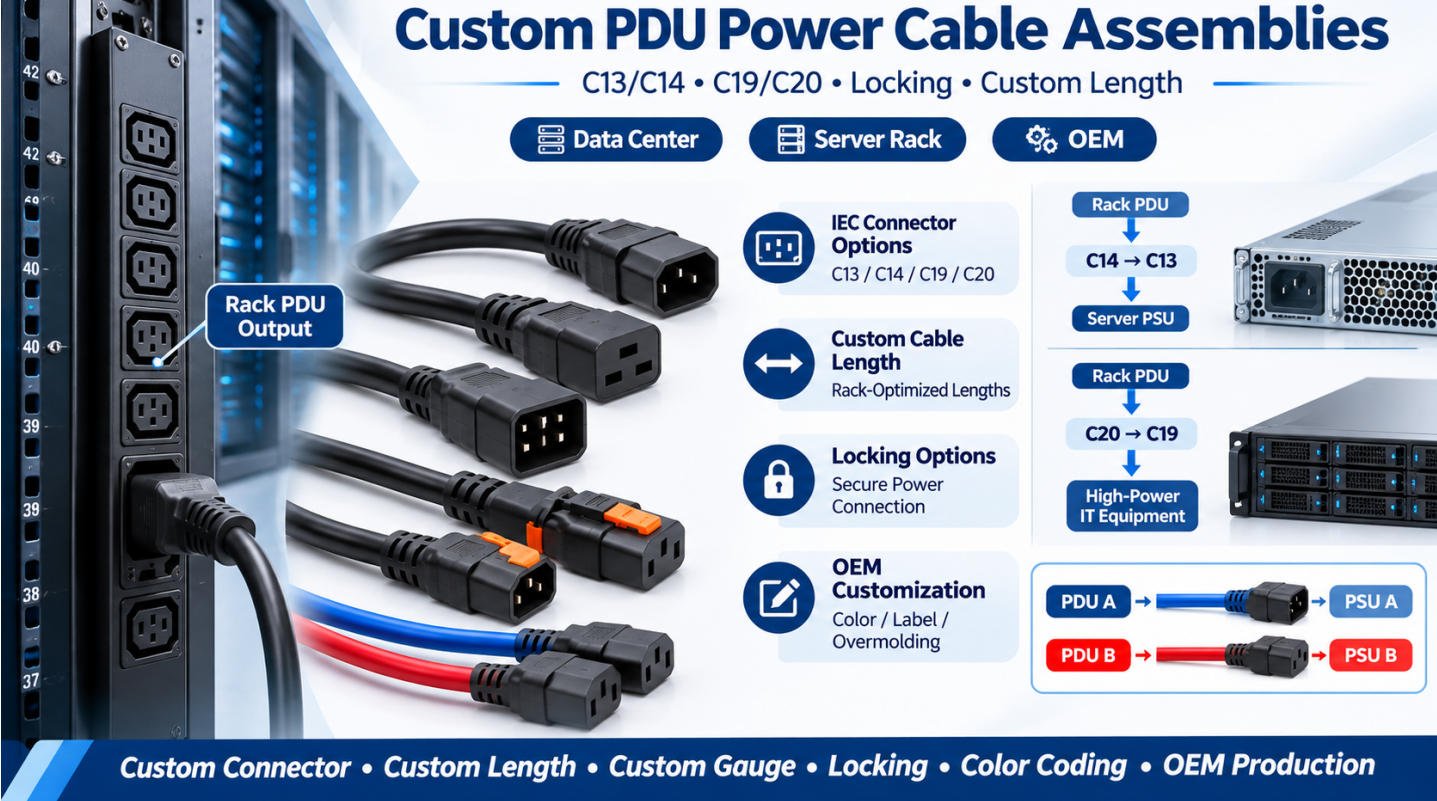

Yihetai custom PDU power cables, IEC power cords and cable assemblies for data centers, server racks, networking equipment, UPS systems and OEM power distribution applications.
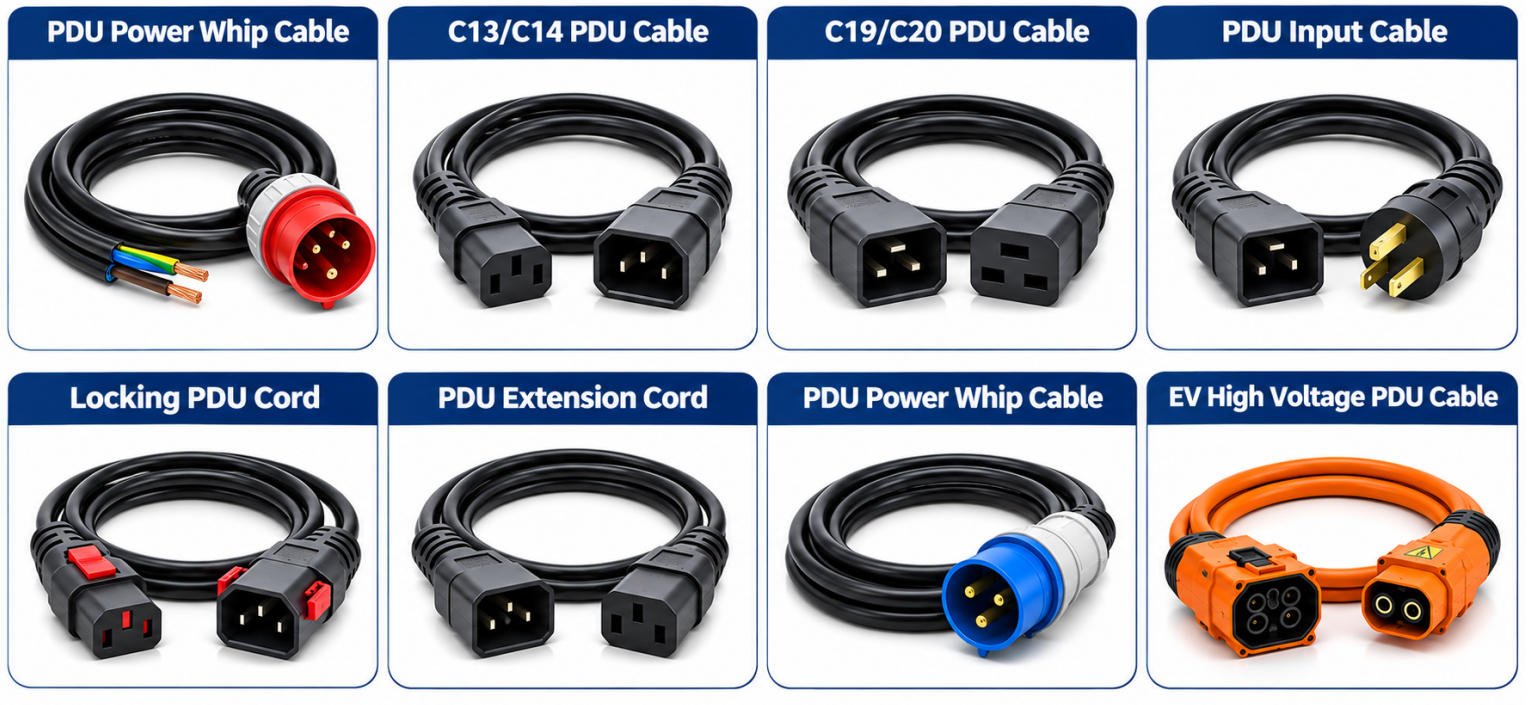
A PDU power cable is used to connect power distribution equipment to an electrical supply or deliver power from a Power Distribution Unit (PDU) to connected devices. Commonly used in data centers, server racks and IT infrastructure, these cables help provide organized and reliable power connections.
A PDU power cable is an electrical cable assembly designed for compatible power distribution connections. Depending on the application, it may feature IEC C13/C14, C19/C20, NEMA or other specified connectors.
A PDU power cord connects an appropriate power source to a rack PDU or links a PDU outlet to a server, network switch or other IT device.
For example, an IEC C14-to-C13 jumper cord commonly connects a compatible rack PDU outlet to a server power inlet.
A PDU input cable supplies power to the distribution unit, while an output jumper cord carries power from the PDU to individual equipment.
A facility-level PDU power whip cable is a different type of distribution assembly used for specified electrical installations.
Unlike a general-purpose power cord, a PDU cable is selected for specific distribution interfaces, electrical ratings, installation conditions and cable routing requirements.
Yihetai manufactures custom PDU cable assemblies according to customer-approved drawings and specifications.
Yihetai provides custom PDU power cable and power cord assembly manufacturing for data centers, server racks, power distribution equipment and OEM electrical applications.
Different PDU cable types are designed for specific power connections, including IEC C13/C14 and C19/C20 jumper cords, PDU input power cables, locking connectors, extension cables and facility-level power distribution assemblies.
As an experienced custom cable manufacturer, Yihetai supports customer-specified connectors, cable lengths, conductor sizes, insulation materials, termination designs and packaging. Each assembly must be evaluated against its intended electrical ratings, applicable standards and approved manufacturing specifications.
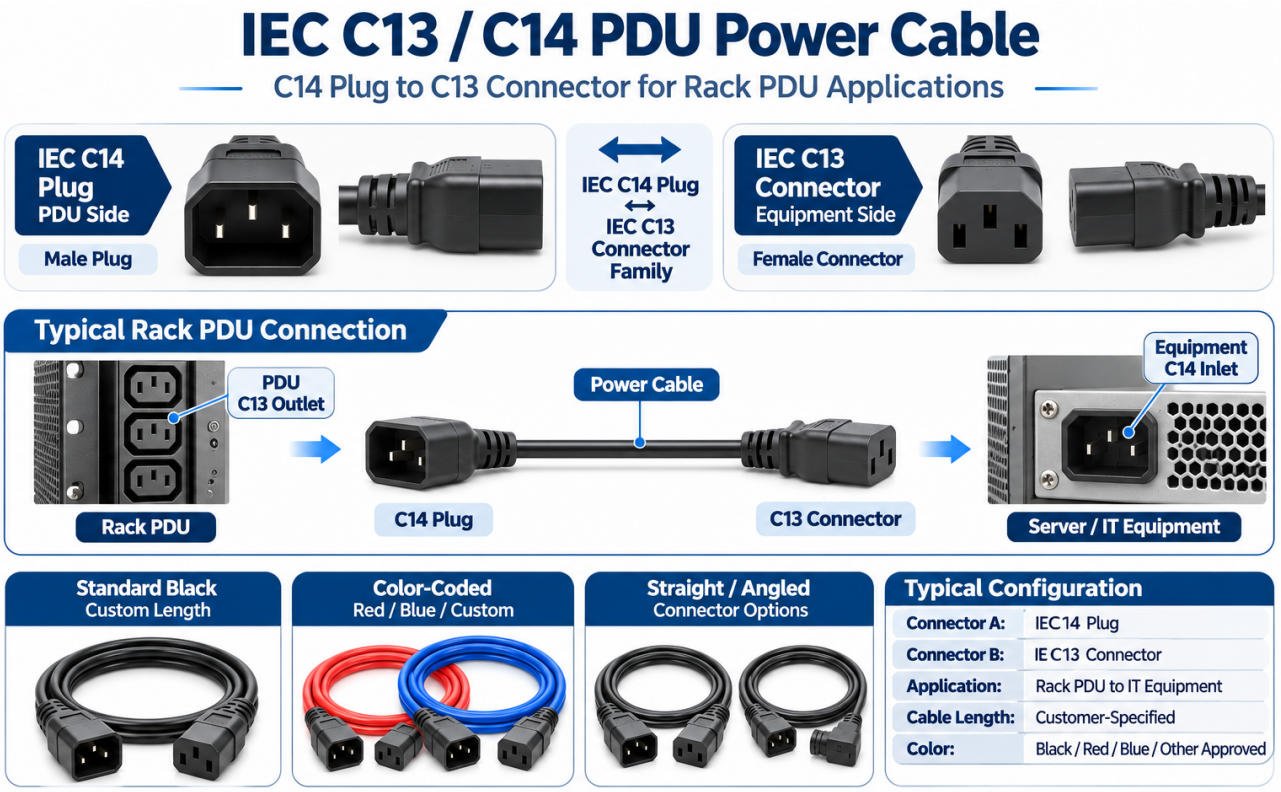
IEC C13/C14 power cords are widely used for rack-level power distribution in data centers, server rooms and networking cabinets. Although buyers often search for a C13 to C14 power cord or PDU power cable C13 to C14, the typical rack jumper configuration is technically identified as an IEC C14 plug to IEC C13 connector cable.
A C13 PDU cable connects a compatible rack PDU outlet to IT equipment such as servers, switches, storage systems and other rack-mounted devices.
A common power path is:
PDU C13 Outlet → C14 Plug → Power Cable → C13 Connector → Equipment C14 Inlet
This configuration provides a compact rack-level connection between the power distribution unit and downstream equipment.
A typical C13 C14 power cord consists of:
Straight, angled or project-specific connector configurations may be available depending on the approved design.
Yihetai can manufacture custom cable lengths to support rack layout and cable-management requirements.
IEC C19/C20 power cords are commonly used in rack power distribution systems where equipment requires a higher power capacity than typical C13/C14 connections. These cords are widely found in enterprise servers, UPS systems, storage platforms, high-density computing equipment, and other demanding PDU applications.
However, the finished cord rating should always be determined by the complete approved assembly, including connector rating, cable size, insulation, temperature class, regional requirements, and product certification.
A typical c19 c20 PDU power cable uses:
IEC C20 Male Plug → Cable → IEC C19 Female Connector
In rack applications, the C20 plug connects to a compatible PDU outlet, while the C19 connector mates with equipment using a C20 inlet.
Custom options can include cable length, wire gauge, jacket material, connector orientation, color, labeling, and packaging.
C13/C14 cords are widely used for standard IT equipment, while C19/C20 connections are generally selected for equipment with higher power requirements.
| Feature | C13 / C14 | C19 / C20 |
|---|---|---|
| Typical Application | General servers, switches, network equipment | Higher-power servers, UPS, storage, compute systems |
| Connector Size | Smaller IEC form | Larger IEC form |
| Power Use | Standard rack equipment | Higher-demand rack equipment |
| Final Rating | Based on complete approved assembly | Based on complete approved assembly |
A high current PDU cable may be used for:
Yihetai can manufacture custom PDU power cord assemblies according to approved drawings and electrical requirements.
Yihetai can manufacture third-party APC-compatible power cord assemblies for rack PDU applications based on the exact APC PDU model, outlet type, connected equipment inlet, cable rating, and approved connector specification.
Depending on the PDU model and connected equipment, compatible cable configurations may include:
The exact cable configuration should always be verified against the target PDU and equipment interfaces.
For compatible rack PDU applications, a common connection is:
PDU C13 Outlet → C14 Plug → Power Cable → C13 Connector → Equipment C14 Inlet
Yihetai can customize cable length, conductor size, color, connector orientation and identification according to the approved specification.
For equipment using higher-capacity IEC interfaces, a typical configuration is:
PDU C19 Outlet → C20 Plug → Power Cable → C19 Connector → Equipment C20 Inlet
A PDU input power cable connects a rack PDU to its upstream power source, such as a UPS, facility receptacle or power-distribution system. Unlike short rack jumper cords used between the PDU and IT equipment, the input cord must be selected according to the installation voltage, current, phase configuration, input connector and applicable market requirements.
PDU Input Connector Selection Guide
| Selection Item | Engineering Requirement |
|---|---|
| Country / Market | Match regional plug and regulatory requirements |
| Supply Voltage | Must match PDU input specification |
| Current Requirement | Must match cable, plug, connector, and equipment rating |
| Phase Configuration | Single-phase or multi-phase as specified |
| Source Connector | NEMA / IEC 60309 / regional plug / other |
| PDU Inlet | IEC / industrial / customer-specified |
| Cable Size | Selected according to electrical and thermal requirements |
| Certification | Per applicable market and complete approved assembly |
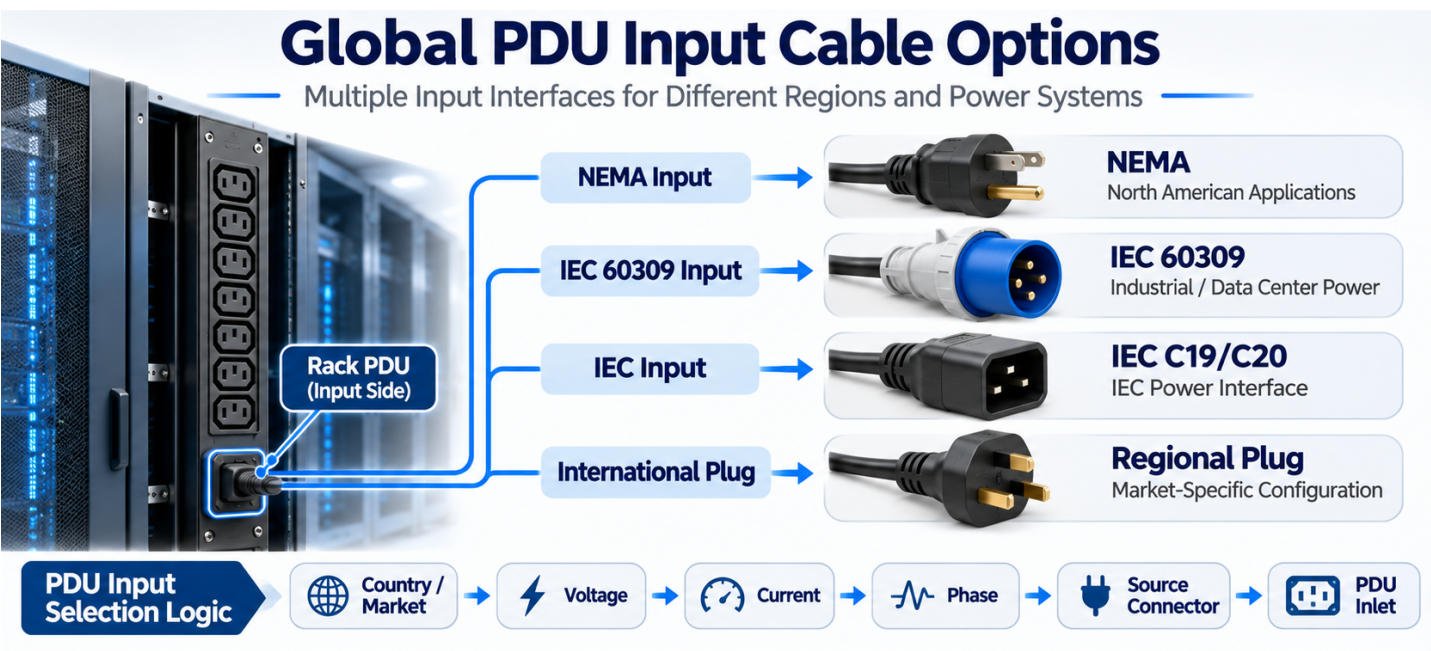
A PDU extension cord may be used when the distance between the rack PDU and connected equipment requires a longer cable connection.
Typical options may include:
The extension cord must match the PDU outlet, equipment inlet, complete cable rating and applicable installation requirements.
A locking PDU power cord can help reduce accidental disconnection in server racks, data centers and other equipment installations.
Locking options may be available for compatible C13/C14 and C19/C20 interfaces. Because locking mechanisms vary by connector system and PDU design, compatibility should be verified before production.
H3;Right-Angle & Low-Profile PDU Cables
A right-angle PDU cable can help reduce rear clearance requirements and improve cable routing in space-constrained racks.
Custom connector orientations may include:
Connector orientation should be confirmed against the actual PDU outlet and equipment inlet position.
Yihetai can customize cable length, conductor size, jacket, molding and strain-relief design to suit rack layout and equipment requirements.
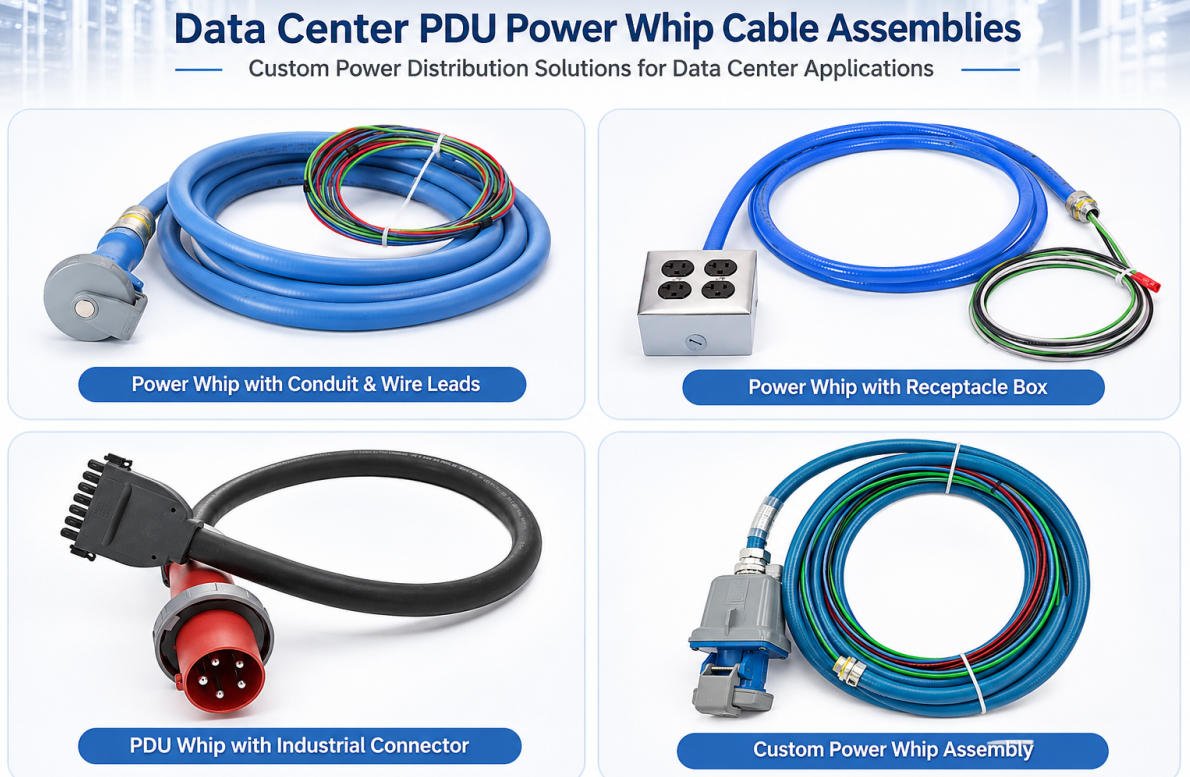
A PDU Power Whip Cable is a facility-level power distribution assembly used to carry branch-circuit power from an approved distribution source to a rack, PDU or other data center equipment. Unlike a short IEC C13/C14 rack jumper cord, a power whip may incorporate power conductors, flexible conduit or cable, equipment tails, receptacles or specified power connectors as part of a project-defined assembly.
For customers developing specialized power distribution equipment, Yihetai can evaluate custom PDU whip cable assembly requirements based on engineering drawings and project specifications.
Potential customization areas include:
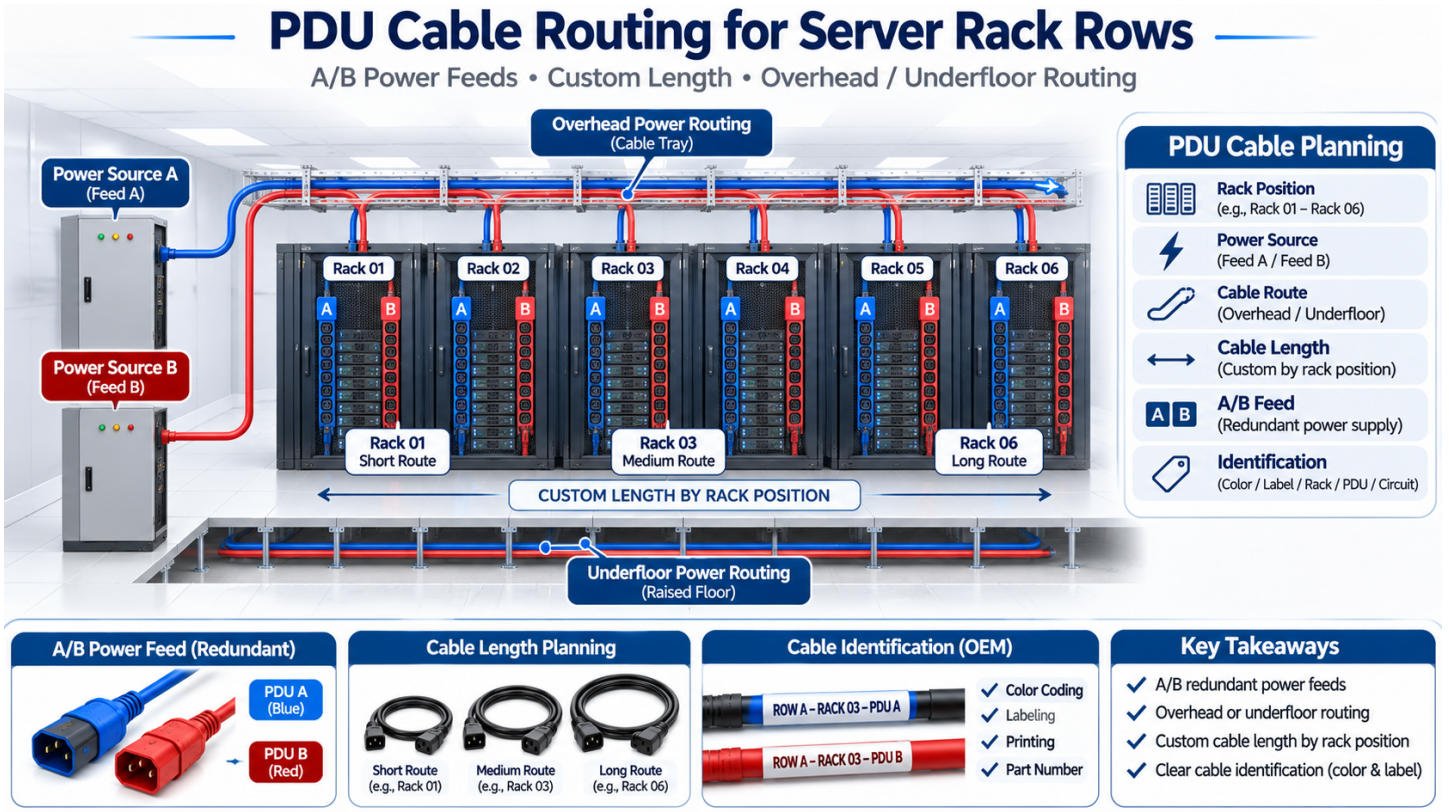
Proper PDU cable routing across server rack rows helps improve power distribution organization, cable identification and maintenance access in data centers. Instead of treating every rack as an isolated connection point, power cables can be planned according to rack position, power source, cable route, connection distance and A/B feed requirements.
In a typical rack row, each cabinet may require multiple power connections from rack PDUs, in-row distribution equipment or approved facility power sources.
A planned routing layout helps determine:
The cable route should follow the approved data center power-distribution design and installation requirements.
An in-row PDU cable layout can be organized according to rack number and equipment position.
For example:
Power Feed A → Rack 01 → Rack 02 → Rack 03
Power Feed B → Rack 01 → Rack 02 → Rack 03
Where dual power supplies are used, separate A and B power paths can help maintain clear redundant-feed identification.
Rack row power cabling may be routed through:
Overhead Routing
Using approved cable trays, ladder racks or power-distribution pathways above the cabinets.
Underfloor Routing
Using approved pathways below a raised floor where the facility design supports underfloor power distribution.
The selected route affects required cable length, installation method, bend management and service allowance.
Custom cable lengths can be planned according to the actual installed route rather than only the straight-line distance between the PDU and equipment.
Color coding and identification can also help distinguish different circuits, racks or power feeds.
Typical options may include:
Yihetai can manufacture custom rack row power cabling and PDU power cord assemblies according to customer-defined connector configurations, cable lengths, colors and identification requirements.
Yihetai can manufacture custom PDU cable assemblies according to customer-approved electrical specifications, drawings and testing requirements.
| Item | OEM Specification Options |
|---|---|
| Product | PDU Input / Output / Custom Cable |
| Connector | IEC / NEMA / Customer-Specified |
| Rated Voltage | Per Approved Application |
| Rated Current | Per Complete Assembly |
| Wire Gauge | Specified AWG / mm² |
| Conductors | Approved Conductor Configuration |
| Jacket | PVC / Rubber / Other Approved Material |
| Length | Custom |
| Temperature | As Specified and Approved |
| Testing | Applicable Electrical and Mechanical Tests |
PDU Cable Wiring, Grounding & Pinout Guide
Correct PDU power cable wiring is essential for safe electrical connections between rack power distribution units and IT equipment. Common IEC C13/C14 and C19/C20 power cords use three-contact connector systems with designated Line (L), Neutral (N), and Protective Earth (PE) connections.
However, conductor functions and wiring requirements depend on the actual electrical supply and equipment configuration. For example, some data center power circuits use phase-to-phase connections rather than a conventional line-to-neutral supply.
When manufacturing custom PDU power cable assemblies, Yihetai reviews customer-approved connector drawings, terminal assignments, grounding requirements, cable specifications, and electrical testing criteria to ensure the finished assembly matches the intended application.
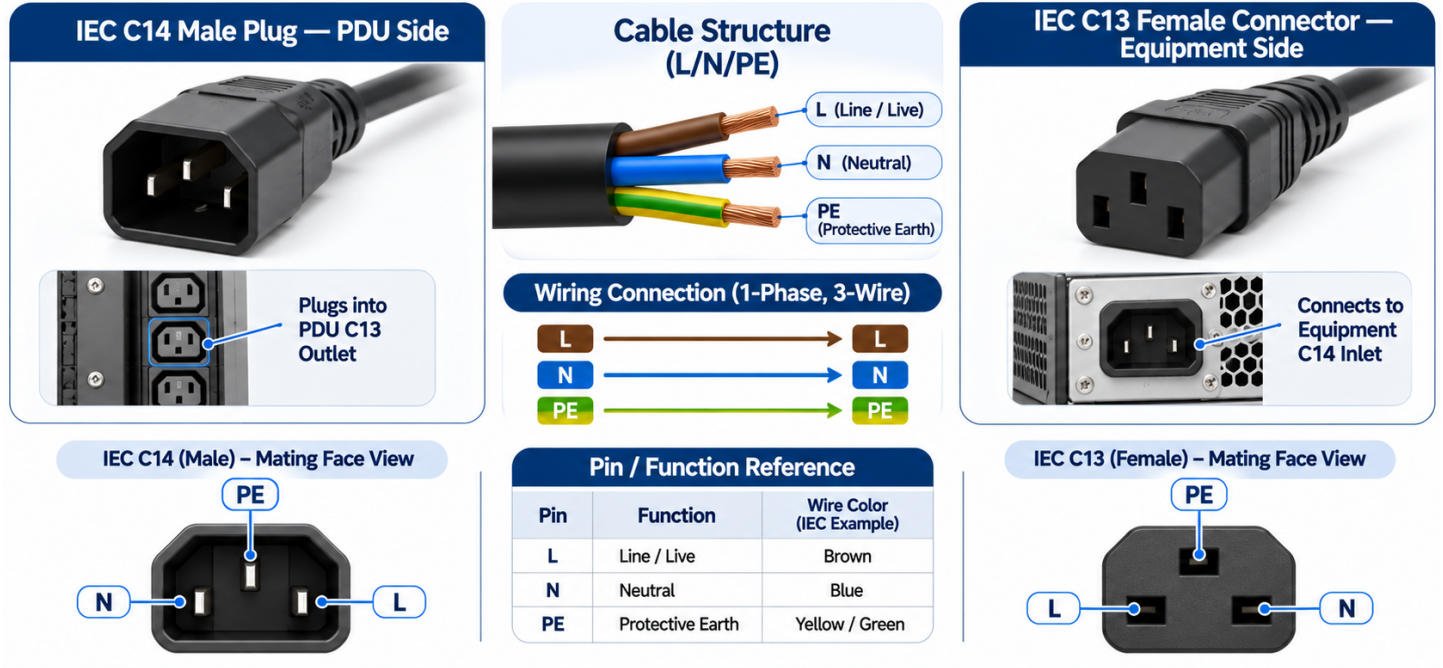
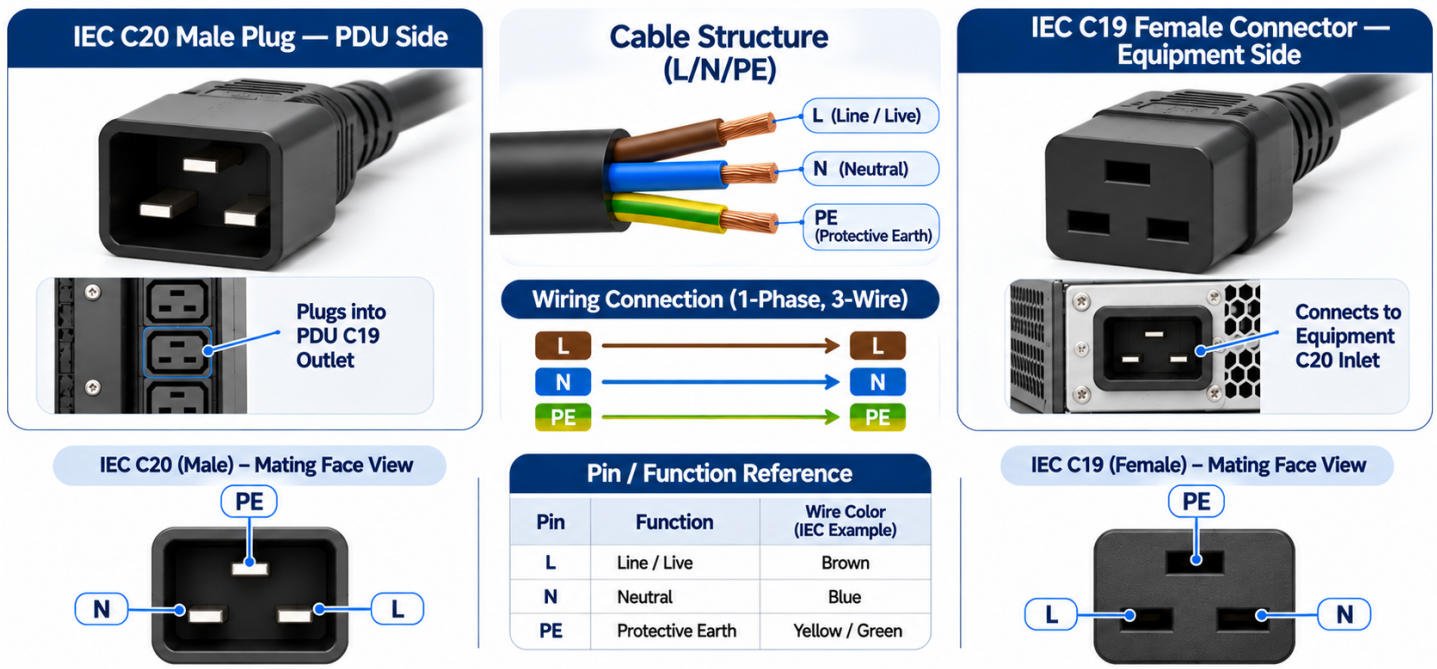
Yihetai supplies custom PDU power cable solutions for data centers, server racks, network equipment, UPS systems, control cabinets, PDU manufacturers, IT equipment, and OEM electronics, with cable configurations tailored to the required connector type, electrical rating, cable length, and installation environment.

IEC / NEMA / OEM
Standard / Custom
AWG / mm²
Conductor / Jacket
Black / Red / Blue
Locking / Angled
Label / Printing
Bulk / Individual
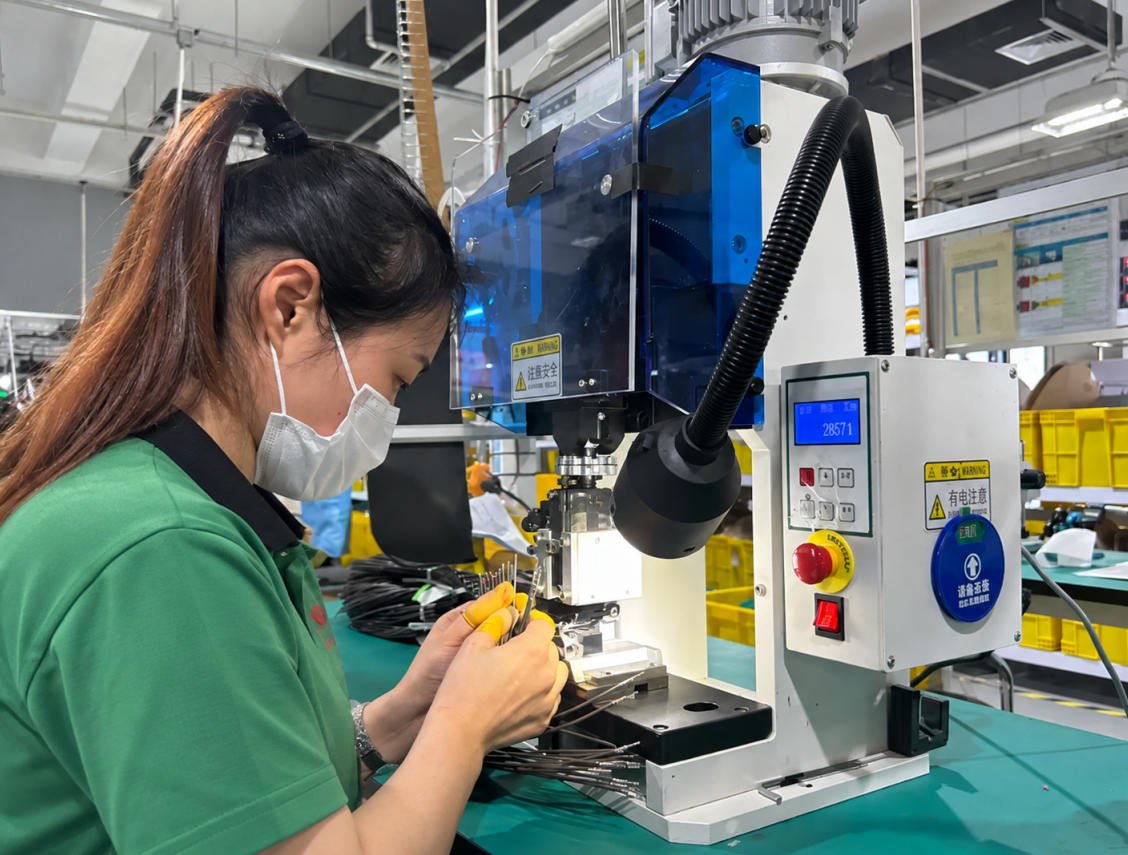
In addition to external PDU power cords, Yihetai can manufacture custom PDU wiring harnesses and internal cable assemblies for power distribution equipment. These assemblies can be built according to customer drawings, wiring diagrams, BOMs, terminal specifications, and approved electrical requirements.
With long-term experience in custom wire harness manufacturing, Yihetai can support internal power connections, grounding, terminal block wiring, multi-branch routing, and control or monitoring cable assemblies for OEM PDU and electrical equipment projects.
Send Yihetai your connector types, electrical ratings, cable specifications, and estimated order quantity to discuss your OEM cable assembly project.
We will contact you within 24 hours, please pay attention to the email with the suffix “info@yihetai-cable.com”.