Custom MIDI Cable

Yihetai manufactures custom MIDI cable assemblies for keyboards, synthesizers, controllers, audio interfaces, effects units, studio equipment and electronic musical devices. Custom 5-pin DIN MIDI cables, MIDI IN/OUT cables, USB MIDI interface cables, USB-C MIDI cables, TRS MIDI adapter cables, MIDI splitter cables, cable length, pinout, overmolding and packaging are available according to your drawing, sample or device requirement.

What Is a MIDI Cable?

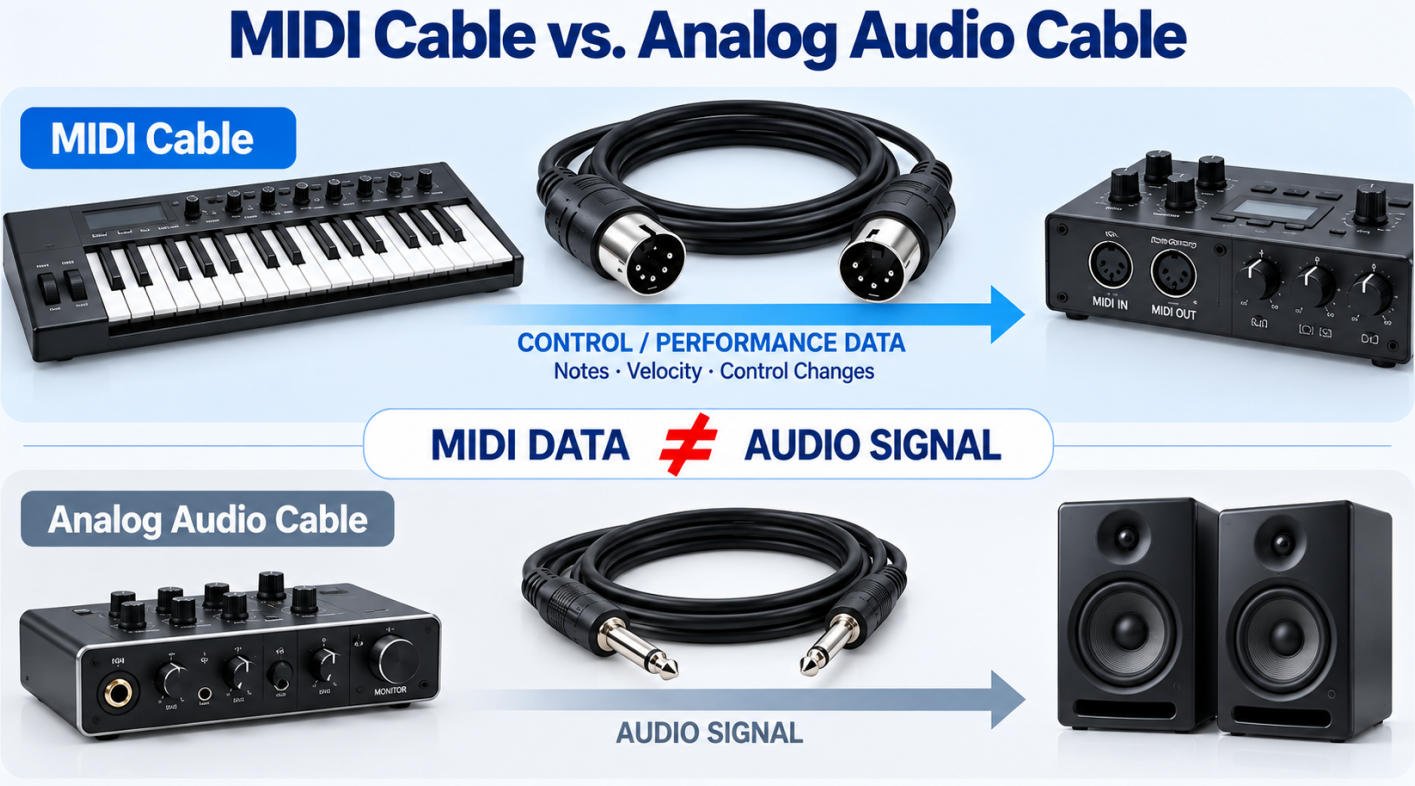
A MIDI cable is used to connect electronic musical instruments and MIDI-enabled equipment, allowing devices to exchange digital control and performance information.

Unlike a conventional analog audio cable, a MIDI cable does not normally carry the actual audio signal. Instead, MIDI communication can transmit information such as note events, velocity, control changes and other performance or device-control data between compatible equipment.

MIDI cables are commonly used with:
·Electronic keyboards
·Synthesizers
·MIDI controllers
·Drum machines
·Audio and MIDI interfaces
·Electronic musical instruments
·Professional audio and studio equipment

For example, a keyboard can send MIDI performance data to a synthesizer, sound module, computer interface or other MIDI-compatible device without transmitting the keyboard’s analog audio output through the MIDI connection.

Types of MIDI Cable Assemblies

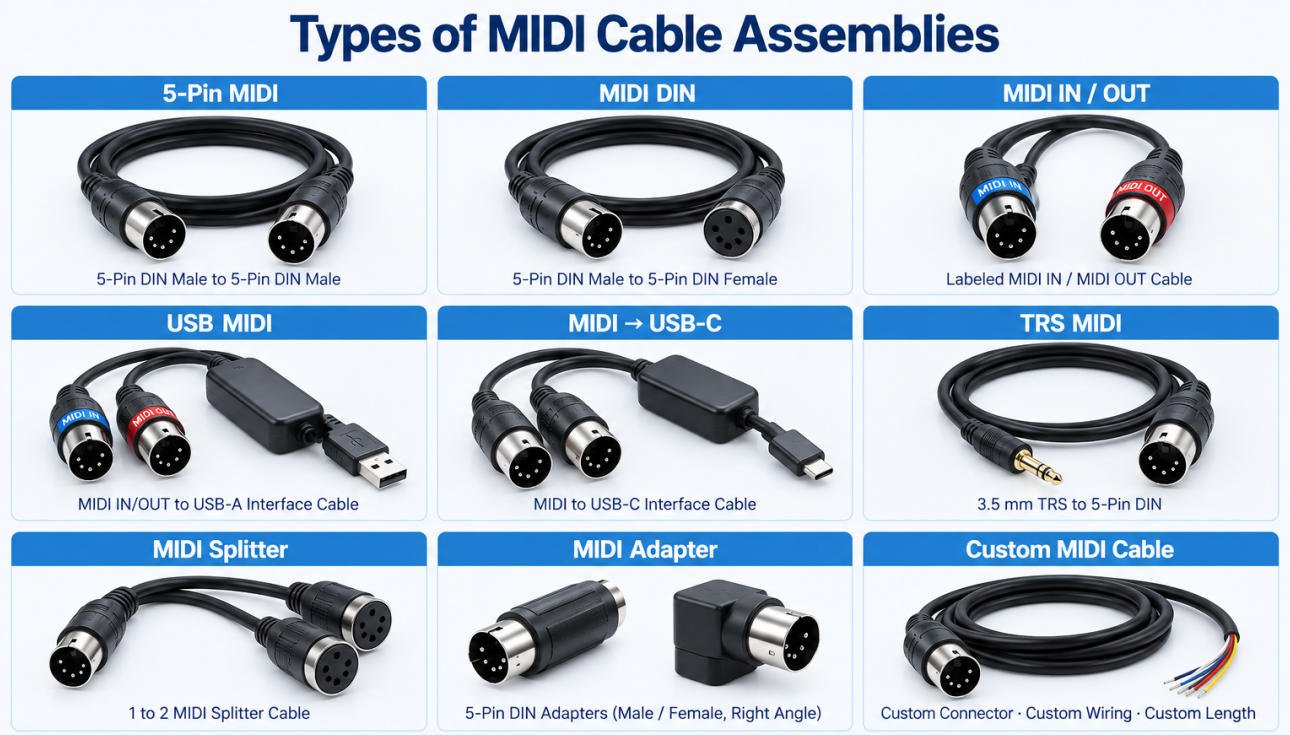
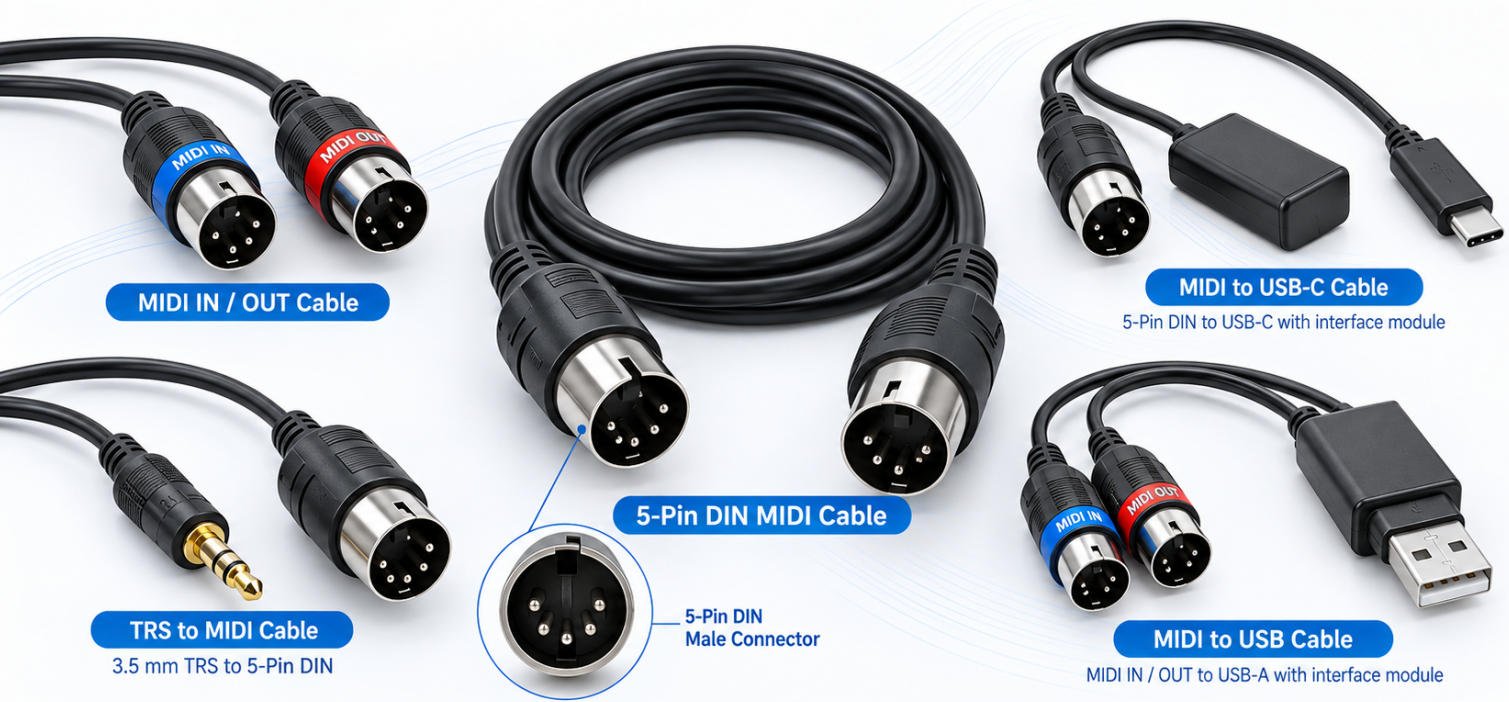
MIDI cable assemblies are available in different connector configurations depending on the equipment, interface standard, and application requirements. From traditional 5-pin DIN MIDI cables to USB, USB-C, TRS, splitter, and custom adapter designs, each cable type is intended for a specific connection method.

The table below provides an overview of the most common MIDI cable assembly types and their typical applications.

MIDI Cable TypeTypical Use
5 Pin MIDI CableTraditional MIDI connection between keyboards, synthesizers, drum machines, controllers, and other MIDI-compatible devices
MIDI DIN Cable5-pin DIN connection used for standard MIDI input and output ports
MIDI IN and OUT CableConnects MIDI IN and MIDI OUT ports for transmitting and receiving MIDI control data between compatible devices
USB MIDI CableConnects MIDI-enabled equipment to computers, controllers, or other USB host devices
MIDI to USB Interface CableUsed for MIDI DIN-to-USB interface applications where MIDI data needs to connect to a USB system
MIDI to USB-C CableDesigned for connecting MIDI equipment to USB-C devices such as computers, tablets, controllers, and compatible interfaces
TRS MIDI CableCompact MIDI connection used by selected controllers, pedals, synthesizers, and other devices with TRS MIDI ports
MIDI Splitter CableSplits or routes MIDI connections according to the wiring and interface requirements of the equipment
Custom MIDI Adapter CableDevice-specific MIDI cable assembly with custom connectors, pin assignments, cable lengths, shielding, or overmolding requirements

Yihetai can manufacture custom MIDI cable assemblies according to customer drawings, connector specifications, pinouts, cable length, conductor requirements, shielding, jacket materials, overmolding, labeling, and other application-specific requirements.

5-Pin MIDI & DIN MIDI Cable Options

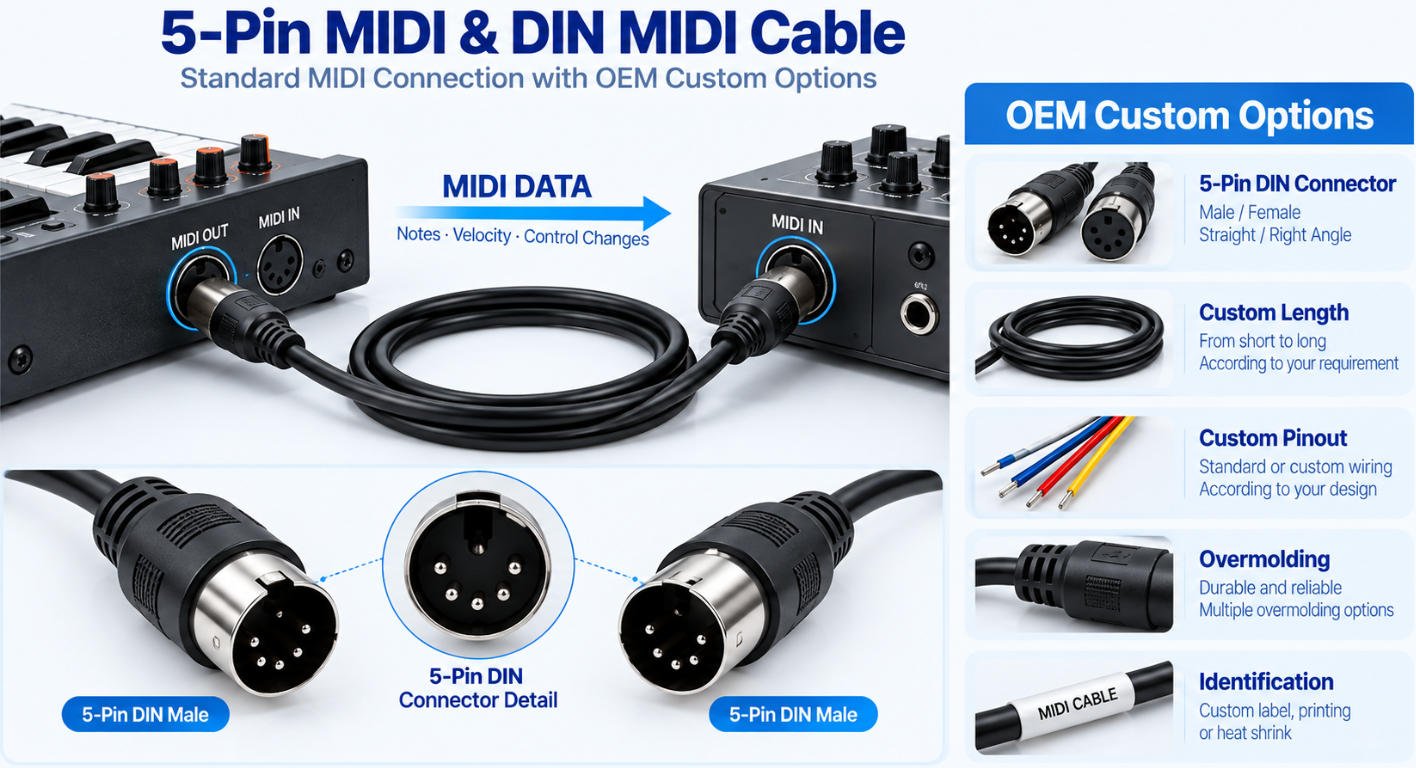
5-pin MIDI cables remain one of the most widely used connection solutions for traditional MIDI equipment, including keyboards, synthesizers, drum machines, MIDI controllers, sound modules, and other electronic instruments.

5-Pin MIDI Cable

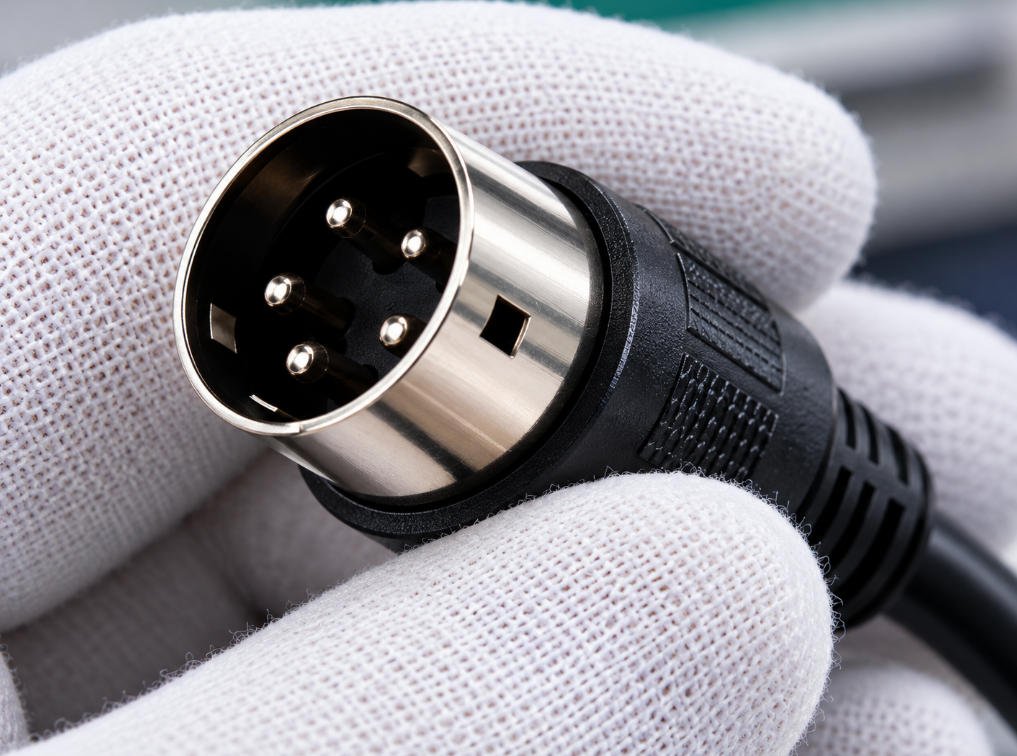
A standard 5-pin MIDI cable typically uses 5-pin DIN connectors for MIDI communication between compatible devices. Male-to-male configurations are commonly used for connecting MIDI OUT ports to MIDI IN ports on musical instruments and electronic audio equipment.

Depending on the application, Yihetai can manufacture different MIDI cable 5 pin configurations, including:

  • 5-pin DIN male to 5-pin DIN male
  • 5-pin DIN male to female
  • Straight or right-angle connector designs
  • Custom cable lengths
  • Shielded or non-shielded cable constructions
  • Custom wire gauge and conductor specifications
  • Custom pin assignments
  • Overmolded connector assemblies
  • Custom colors, labels, and packaging

For OEM projects, the connector structure, cable diameter, jacket material, strain relief, and internal wiring can be developed according to the customer’s device and application requirements.

MIDI DIN Cable

A MIDI DIN cable uses a DIN-style connector for transmitting MIDI control data between compatible devices. The 5-pin DIN connector is commonly used on traditional MIDI interfaces and provides a durable connection for professional and consumer electronic music equipment.

Yihetai can customize MIDI DIN cable assemblies based on the customer’s equipment design and interface requirements. Available customization options include connector type, cable length, pin assignment, conductor material, shielding structure, jacket material, connector orientation, and overmolding.

Custom DIN MIDI cable assemblies can also be produced for equipment manufacturers that require non-standard wiring configurations or application-specific connector combinations.

MIDI In and Out Cables

MIDI IN and OUT cables are used to connect the output of one MIDI device to the input of another device, allowing MIDI control data to be transmitted between them.

A typical MIDI connection can be illustrated as:

MIDI OUT → MIDI Cable → MIDI IN

For example, a keyboard or MIDI controller can send performance data through its MIDI OUT port, while a synthesizer, sound module, computer interface, or other MIDI-compatible device receives the data through its MIDI IN port.

Yihetai can manufacture custom MIDI out cable and MIDI IN/OUT cable assemblies according to specific connector layouts, cable lengths, pin assignments, and equipment designs. For multi-connector or special OEM applications, custom branch structures, adapter configurations, and molded cable assemblies can also be developed.

USB MIDI Interface Cables

USB MIDI interface cables are used to connect traditional MIDI equipment with computers, USB host devices, and other digital systems. Depending on the product design, a USB MIDI cable may be a simple cable assembly between compatible interfaces, or it may require integrated electronics to convert MIDI communication to USB.

MIDI to USB Cable

A typical MIDI to USB cable may use one or more 5-pin MIDI connectors on the device side and a USB connector on the host side.

However, MIDI and USB are different communication interfaces. In many applications, a cable described as a MIDI connector to USB is not simply a passive wiring connection. It may include interface electronics between the MIDI and USB sides.

For this reason, MIDI-to-USB products should generally be considered in two categories:

Passive Cable Assembly

Used only where the customer’s equipment design already supports the required electrical and communication interface. In this case, Yihetai can manufacture the cable assembly according to the specified wiring, connector, pin assignment, shielding, length, and mechanical requirements.

MIDI-to-USB Interface Cable

Used where conversion between the MIDI interface and USB communication is required. This type of product may include a PCB, integrated circuit, or other electronic interface components within the cable assembly or molded housing.

5-Pin MIDI to USB

A 5 pin MIDI to USB interface cable is commonly designed with traditional 5-pin MIDI connectors on one side and a USB connector on the other.

A typical interface structure may be illustrated as:

5-PIN MIDI IN ─┐
         ├─ MIDI / USB Interface ── USB
5-PIN MIDI OUT ─┘

This type of assembly allows MIDI equipment with standard DIN connectors to interface with USB-based systems when the appropriate electronic conversion circuitry is included.

Custom configurations may include:

  • 5-pin MIDI IN to USB
  • 5-pin MIDI OUT to USB
  • Dual MIDI IN/OUT to USB
  • Custom USB connector type
  • Custom cable length
  • Custom enclosure or overmolding
  • Customer-specified PCB or interface electronics
  • Custom labeling and packaging

MIDI to USB Interface Cable

A MIDI to USB interface cable may incorporate electronic circuitry between the MIDI and USB interfaces. The internal electronics can manage the communication between the MIDI data format and the USB host system.

Because these products may involve more than a standard cable assembly, the complete electrical and mechanical specification should be reviewed before manufacturing.

For OEM projects, Yihetai can manufacture the cable and connector assembly based on customer drawings, samples, BOMs, and approved technical documentation.

MIDI to USB-C Cable Assemblies

MIDI to USB-C Cable Assemblies

MIDI to USB-C cable assemblies provide a modern connection option for MIDI equipment used with USB-C enabled computers, tablets, controllers and other compatible electronic devices.

Depending on the equipment and interface design, MIDI-to-USB-C communication may require dedicated interface electronics for protocol conversion. USB-C is the connector and USB interface; it does not mean that a 5-pin MIDI signal can be converted to USB simply through passive wiring.

5-Pin MIDI to USB-C

A 5-pin MIDI to USB-C cable assembly combines traditional DIN MIDI connectivity with a USB-C interface for compatible equipment.

A typical interface cable may use the following architecture:

5-Pin MIDI IN / OUT → MIDI-USB Interface → USB-C

Where MIDI-to-USB protocol conversion is required, the appropriate interface circuitry must be defined as part of the complete product specification.

USB-C MIDI Interface Cable

A USB-C MIDI interface cable can integrate MIDI connectors, cable branches, an interface module and USB-C termination into a complete cable assembly.

For example:

MIDI IN + MIDI OUT → Interface Module → USB-C

MIDI IN and MIDI OUT branches can be differentiated using molded markings, printed labels, color identification or other customer-specified methods.

For OEM projects, Yihetai can customize the connector configuration, branch length, main cable length, interface housing, strain relief and external appearance according to the equipment design.

Technical Note: USB-C identifies the connector/interface format. If communication between MIDI and USB protocols requires electronic conversion, the interface electronics must be specified and evaluated separately. A passive 5-pin DIN-to-USB-C wiring connection alone does not provide MIDI-to-USB protocol conversion.

Custom USB-C MIDI Cable Assemblies

Yihetai supports custom USB-C MIDI cable assemblies for musical instruments, MIDI controllers, audio equipment and OEM electronic devices.

Custom options can include:

  • MIDI Connector: 5-pin DIN, TRS or customer-specified connector
  • USB Connector: USB-C or other specified USB interface
  • Cable Length: Custom main cable and branch lengths
  • Pin Assignment: According to customer pinout or wiring diagram
  • Cable Construction: Customized according to application requirements
  • Overmolding: Straight, right-angle or customer-specific molded design
  • Identification: MIDI IN/OUT labels, colors, printing and markings
  • Testing: Continuity, pin-to-pin and electrical inspection according to project requirements

Send us your connector requirements, pinout, drawing or existing sample. Our team can evaluate the cable assembly configuration for your OEM project.

MIDI Cables for Keyboards & Musical Instruments

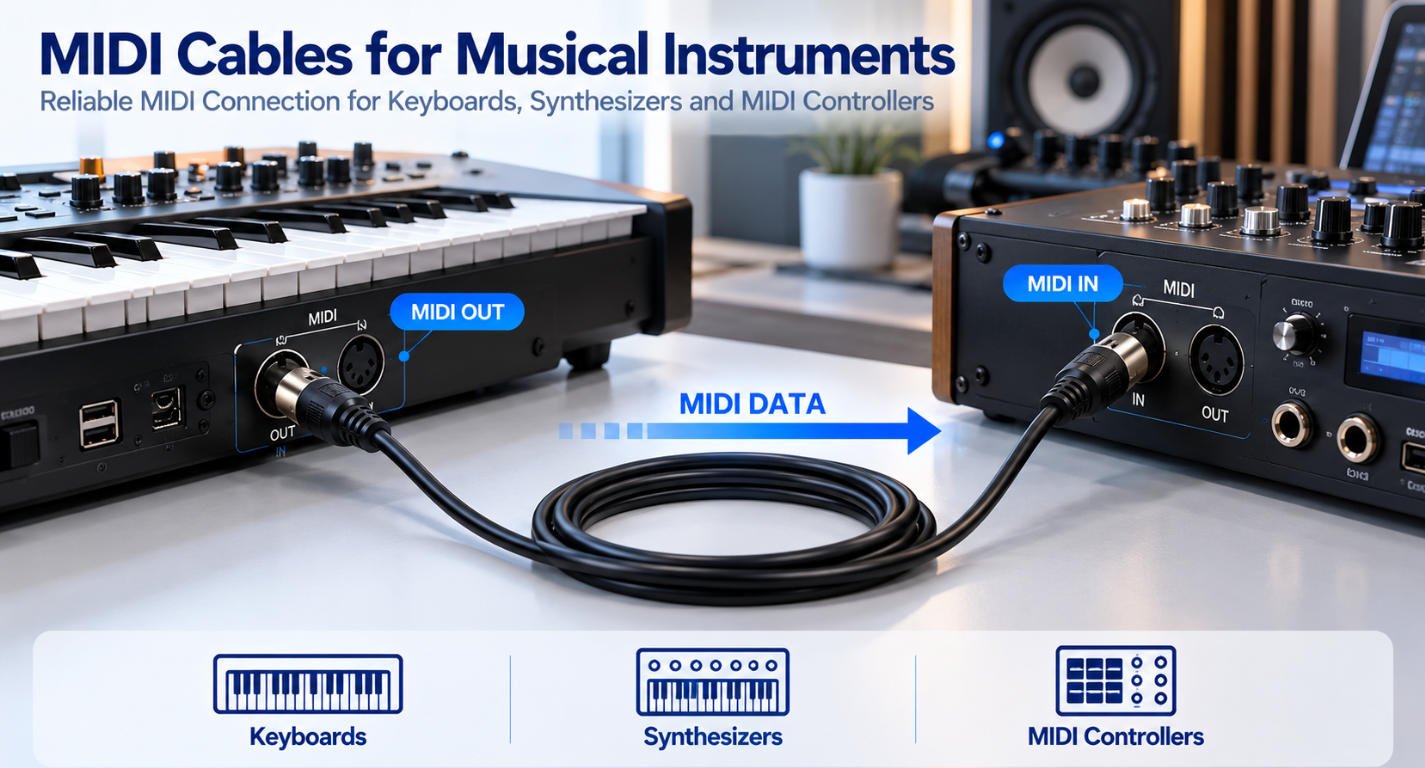
MIDI cables are widely used to connect electronic musical instruments, controllers and compatible audio equipment for MIDI data communication. From keyboards and synthesizers to MIDI controllers and other electronic instruments, the required cable configuration can vary depending on the device interface, connector type and application.

MIDI Cable for Keyboard

A MIDI cable for keyboard can be used to connect a MIDI-enabled electronic keyboard to synthesizers, sound modules, MIDI interfaces, computers or other compatible MIDI equipment.

A typical connection is:

Keyboard MIDI OUT → MIDI Cable → MIDI IN

Depending on the keyboard design, the MIDI connection may use a traditional 5-pin DIN connector, TRS connector or another customer-specified interface.

MIDI Cables for Synthesizers

Synthesizers and other electronic instruments may use MIDI connections for performance data, synchronization and equipment control.

Yihetai can manufacture custom MIDI cables for synthesizers using 5-pin DIN, TRS and other customer-specified connector configurations.

Cable assemblies can be customized according to the instrument design, including connector orientation, cable length, pin assignment, cable construction, strain relief, overmolding and product identification.

MIDI Cables for Controllers & Audio Equipment

MIDI controllers, MIDI interfaces and compatible professional audio equipment may require different cable assemblies depending on the equipment interface and system configuration.

Yihetai supports custom MIDI cable assemblies for applications such as:

  • MIDI controllers
  • Electronic keyboards
  • Synthesizers
  • Drum machines and electronic instruments
  • MIDI interfaces
  • Compatible professional audio equipment
  • Studio and stage equipment
  • OEM electronic devices

TRS MIDI Cable Assemblies

TRS MIDI cables provide a compact alternative to traditional 5-pin DIN MIDI connections and are commonly used where equipment size and connector space are limited.

Because TRS MIDI interfaces can use different pin assignments, the connector type and pinout should always be confirmed according to the equipment specification before production.

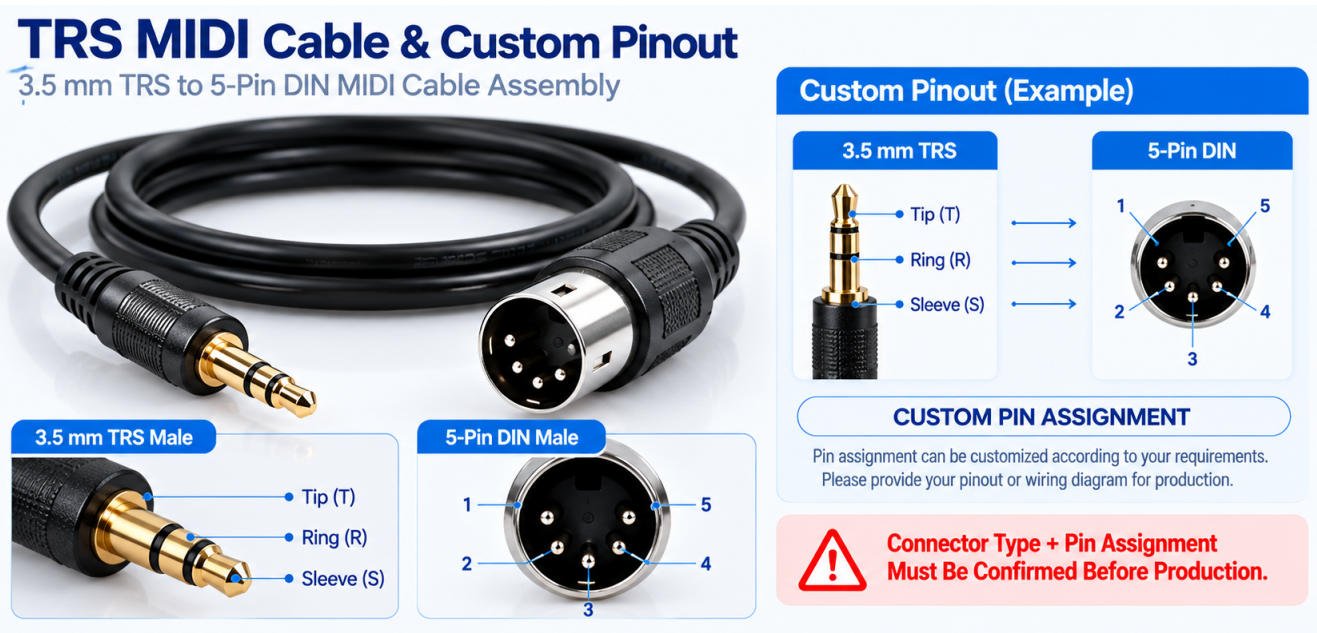
3.5mm TRS MIDI Cable

A 3.5mm TRS MIDI cable uses a compact Tip-Ring-Sleeve connector for MIDI communication with compatible equipment.

Depending on the application, TRS connectors can be used on one or both ends of the cable assembly and can be combined with other MIDI connector types according to the equipment design.

Yihetai can customize:

  • 3.5mm TRS connector configuration
  • Straight or right-angle connectors
  • Cable length and construction
  • Customer-specific pin assignment
  • Strain relief and overmolding
  • Labels, colors and identification
  • Pin-to-pin electrical testing

For OEM projects, production can be based on the customer’s drawing, wiring diagram, pinout specification or approved sample.

TRS to 5-Pin DIN MIDI Cable

A TRS to 5-pin DIN MIDI cable provides a physical connection between equipment using a TRS MIDI interface and compatible equipment using a traditional 5-pin DIN MIDI connection.

A typical cable assembly can be configured as:

3.5mm TRS → Cable → 5-Pin DIN

The connector combination alone, however, does not determine compatibility. The required signal assignment must match the specifications of the connected equipment.

Yihetai can manufacture TRS-to-DIN MIDI cable assemblies with customer-specified cable lengths, connector orientations, pin assignments, molding designs and identification.

Custom TRS MIDI Pinout

The pin assignment is especially important when manufacturing TRS MIDI cables.

TRS connectors may look physically identical while the electrical assignment of the Tip, Ring and Sleeve contacts can differ between equipment designs. A cable with the correct connector shape may therefore still be electrically incompatible if the pinout does not match the device specification.

For custom production, Yihetai can manufacture according to the required:

Tip (T) · Ring (R) · Sleeve (S) → Specified MIDI Pin Assignment

Customers can provide a device specification, pinout drawing, wiring diagram or existing cable sample for confirmation.

Yihetai can perform pin-to-pin verification and continuity testing according to the approved wiring specification to ensure each cable assembly matches the required connection.

MIDI Splitter & Custom Adapter Cables

In addition to standard MIDI cable configurations, Yihetai manufactures custom MIDI splitter and adapter cable assemblies for equipment-specific applications.

These assemblies can be produced according to customer drawings, connector specifications, wiring diagrams and required pin assignments. Because connector configuration alone does not determine electrical or signal compatibility, each custom cable should be manufactured according to the electrical requirements of the intended equipment.

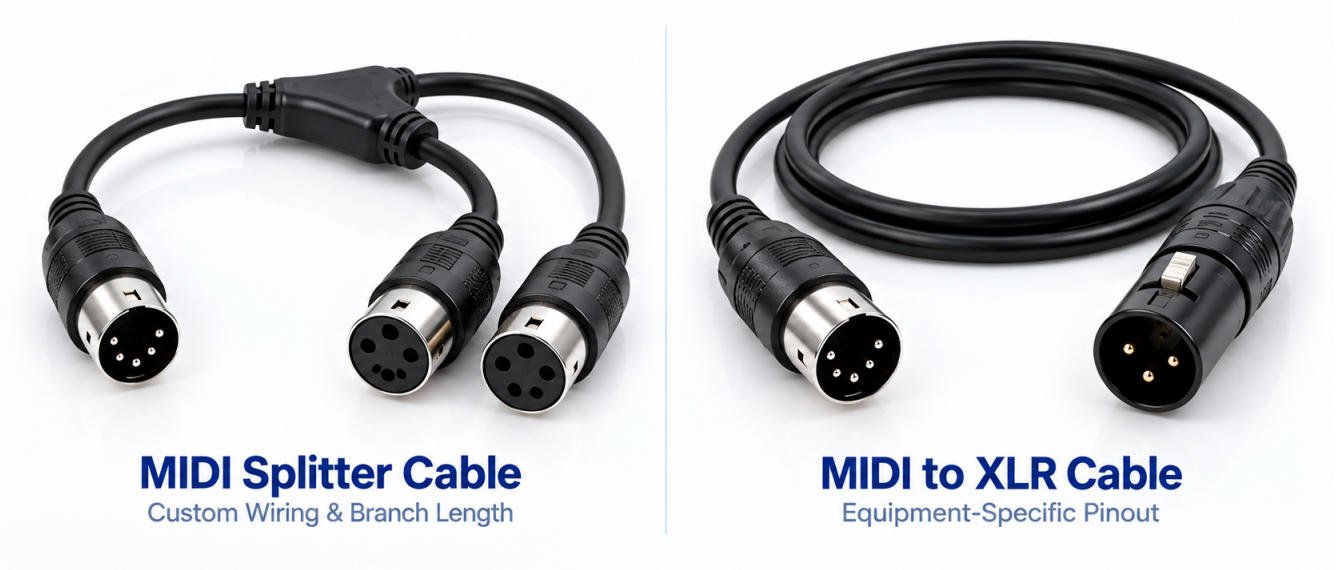
MIDI Splitter Cable

A MIDI splitter cable typically uses a branched cable construction to connect one main connector to two or more specified connectors.

A typical physical configuration may be:

1 Connector → Y-Split Cable → 2 Connectors

Yihetai can manufacture custom MIDI splitter cable assemblies according to the customer’s connector configuration, wiring diagram, pin assignment and electrical requirements.

Customization options can include:

  • Main and branch connector types
  • Number of cable branches
  • Main cable and branch lengths
  • Customer-specified pin assignments
  • Y-junction construction and overmolding
  • Cable jacket and identification
  • Connector labels and color coding
  • Pin-to-pin and continuity testing

MIDI to XLR Cable

A MIDI to XLR cable can be manufactured for specialized equipment designed to use the required signals through an XLR connector interface.

A typical custom cable structure may be:

5-Pin DIN → Custom Wiring → XLR Connector

However, DIN MIDI and XLR describe different connector formats, and using these connectors on opposite ends of a cable does not by itself make two devices electrically or functionally compatible.

For this reason, Yihetai manufactures MIDI-to-XLR cable assemblies according to the specific equipment requirements, connector type, wiring diagram and pin assignment provided or approved by the customer.

Custom options can include XLR connector gender, DIN connector configuration, cable length, pin assignment, cable construction, strain relief, overmolding and identification.

Important: MIDI-to-XLR cable assemblies should be used only with equipment designed for the required signal and wiring configuration. Connector type and pin assignment must be confirmed according to the equipment specification before production.

MIDI Cable Pinout & Wiring Options

MIDI Cable Pinout & Wiring Options

The correct MIDI cable pinout is essential for reliable communication between MIDI-compatible devices. While traditional 5-pin DIN MIDI uses a standardized wiring arrangement, custom MIDI equipment may use different connectors, pin assignments or breakout configurations.

For OEM projects, Yihetai can manufacture MIDI cable assemblies according to your wiring diagram, connector specification, required pinout or existing cable sample.

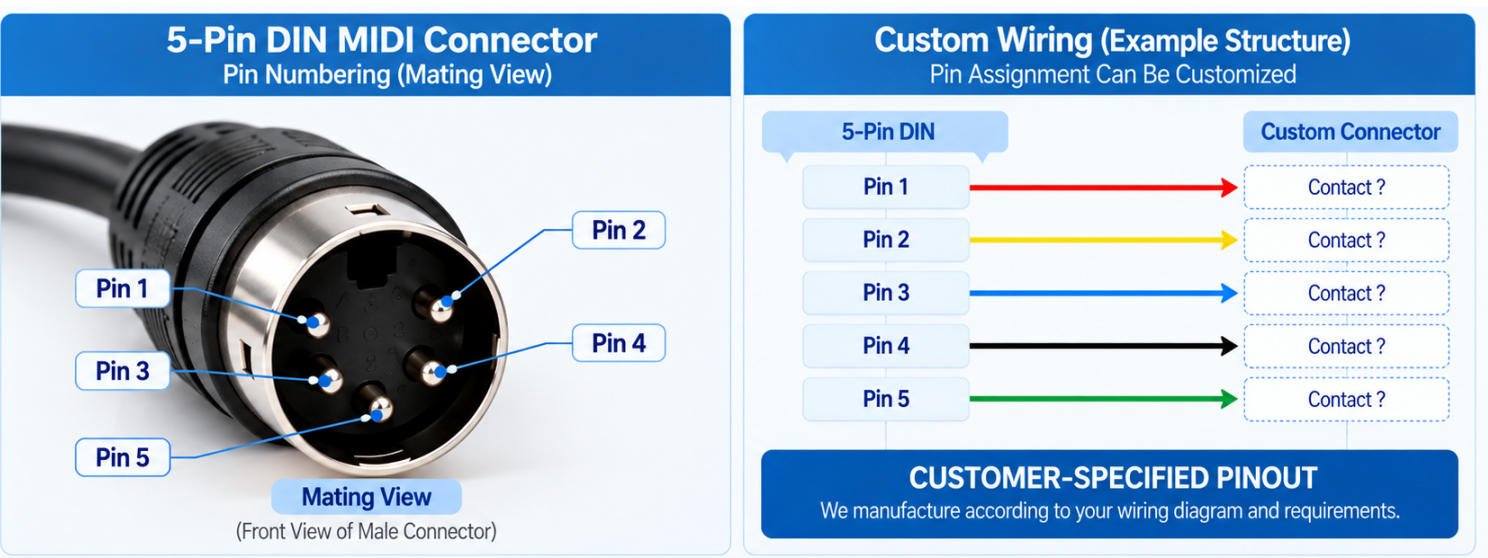
5-Pin DIN MIDI Pinout

Traditional MIDI connections commonly use a 5-pin DIN connector with a shielded twisted-pair cable.

For a standard MIDI cable, the typical conductor functions are:

DIN PinTypical FunctionStandard Cable Connection
Pin 1Normally unused for standard MIDI communicationTypically not connected
Pin 2Shield / cable screen connectionPin 2 → Pin 2
Pin 3Normally unused for standard MIDI communicationTypically not connected
Pin 4MIDI current-loop signal connectionPin 4 → Pin 4
Pin 5MIDI current-loop signal connectionPin 5 → Pin 5

A standard cable connection is typically:

5-Pin DIN Male → Shielded MIDI Cable → 5-Pin DIN Male

When preparing connector drawings or wiring instructions, the connector viewing direction should always be identified because pin positions can appear reversed when viewed from the mating side versus the solder side.

Custom MIDI Pin Assignment

Not every MIDI cable assembly uses the same connector or wiring arrangement.

OEM equipment may use:

  • 5-pin DIN connectors
  • 3.5mm TRS MIDI connectors
  • Multi-pin connectors
  • Device-specific interfaces
  • MIDI breakout connectors
  • Custom adapter configurations
  • MIDI IN / MIDI OUT assemblies

For customer-specific MIDI cable assemblies, Yihetai can manufacture according to the required connector pinout, wiring diagram or existing cable sample.

Custom MIDI Cable Design Options

Connector Type

5-Pin DIN, 3.5mm TRS, USB, USB-C, XLR, and other connector options, or let us customize the connector combination to match your equipment and application requirements.

Cable Length

Main cable and branch lengths can be customized to match your equipment layout, installation space, and specific application requirements.

Pin Assignment

Standard or custom pinouts can be manufactured according to your required wiring diagram, pin configuration, or approved sample.

Cable Construction

Cable construction can be customized to meet the signal, mechanical, and application requirements of your equipment.

Overmolding

Straight, right-angle, or custom-molded connector overmolding and strain relief can be customized to suit your installation space, mechanical requirements, and product design.

Identification

Custom colors, labels, cable printing, and logos can be added for clear identification of connectors, functions, and cable assemblies.

Yihetai MIDI Cable Quality Control

Reliable wiring and consistent electrical performance are essential for custom MIDI cable assemblies. Yihetai applies controlled inspection and testing procedures throughout production to help ensure that each finished cable meets the approved customer specification.

From connector termination and pin assignment to final electrical testing and visual inspection, our quality control process focuses on both electrical integrity and mechanical workmanship.

Quality Focus: Pin-to-Pin Verification · Continuity Testing · Short/Open Testing · Connector Inspection · Visual Inspection · Traceability

Yihetai provides 100% electrical testing for applicable custom cable assemblies according to the approved testing requirements.

Need a Custom MIDI Cable for Your Equipment?

Send us your drawing, pinout, wiring diagram, connector specification or existing cable sample. Our team will evaluate your cable assembly requirements and support your project from sample development to volume production.

Ask For A Quick Quote

We will contact you within 24 hours, please pay attention to the email with the suffix “info@yihetai-cable.com”.