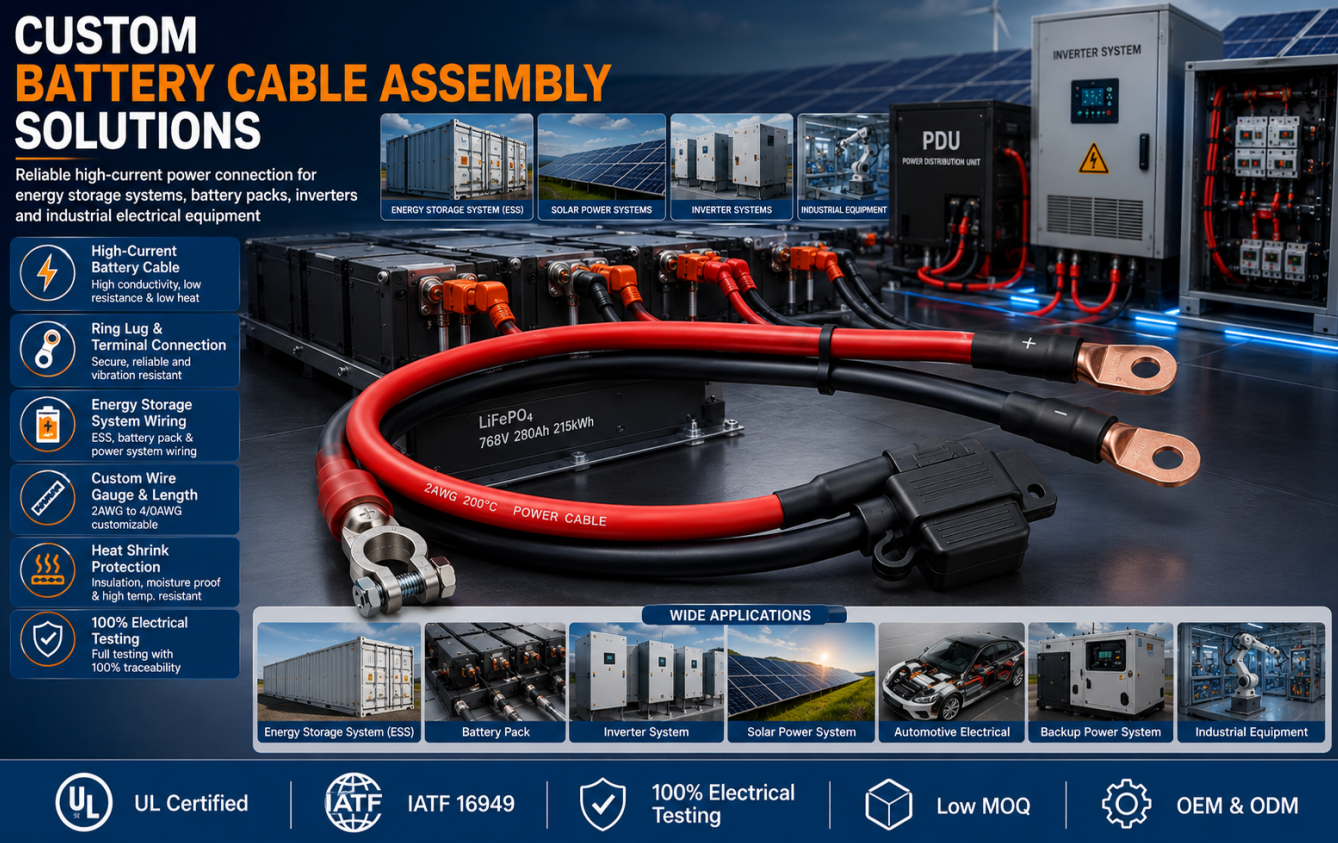
Custom Battery Cable Assembly Manufacturer

Yihetai manufactures custom battery cable assemblies for energy storage systems, automotive electrical systems, battery packs, inverters, power distribution units, industrial equipment, solar power systems and backup power applications.

Battery cable assemblies are designed to carry power between batteries, chargers, inverters, motors, power modules and electrical equipment. Compared with standard low-current wire harnesses, battery cables usually require larger conductor sizes, stronger terminals, lower contact resistance, better insulation protection and reliable crimping quality.

Based on your drawing, sample or application requirements, Yihetai can customize cable length, wire gauge, conductor material, terminal type, ring lug size, insulation material, heat shrink tubing, protective sleeving, color coding, labels and packaging.

What Is Battery Cable Assembly?

A Battery cable assembly is a customized power cable or wire assembly designed to transfer electrical current between batteries, starters, inverters, chargers, control units, grounding points and other power components. It is typically built with heavier-gauge conductors than signal harnesses and may include ring terminals, battery clamps, fuse holders, connectors, insulating boots, corrugated tubing or overmolded protection depending on the application.

Compared with standard off-the-shelf battery cables, a custom battery cable assembly is engineered around the actual current load, voltage level, installation path, mechanical routing, temperature conditions and safety requirements of the end product. This helps improve electrical efficiency, simplify installation, reduce assembly errors and ensure long-term reliability in demanding environments such as automotive systems, energy storage equipment, industrial machines and outdoor power devices.

Battery Cable Size & Current Requirement Guide

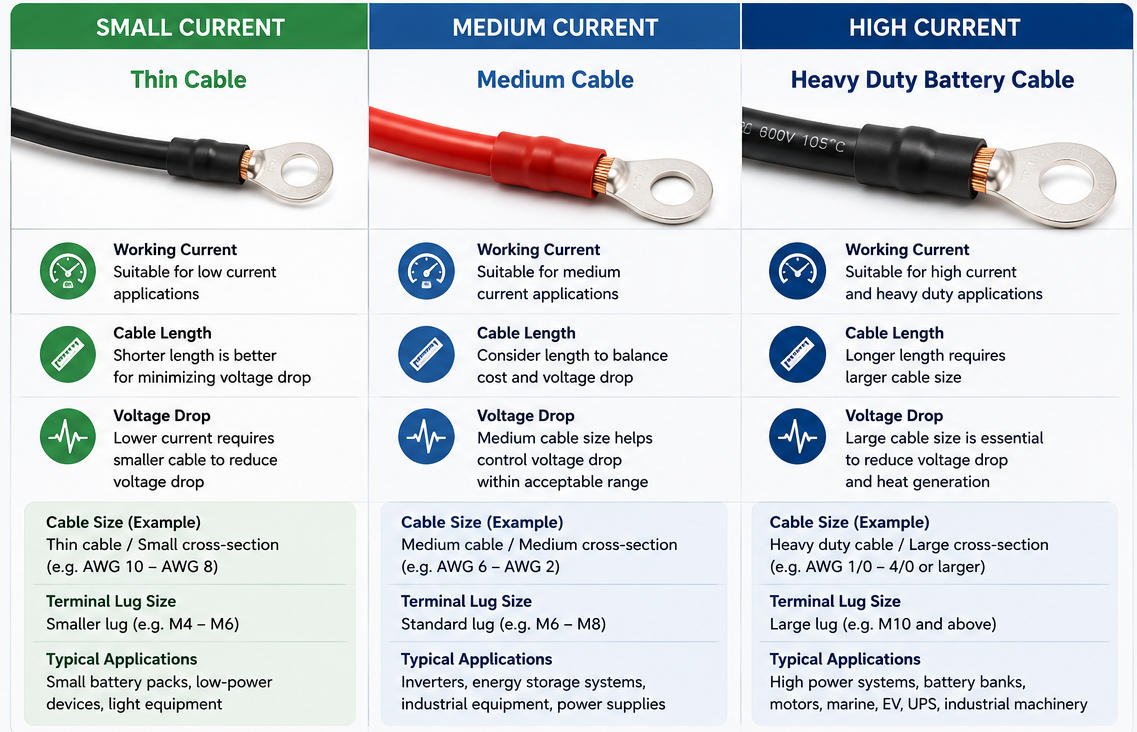
Battery cable size should be selected according to working current, cable length, voltage drop, conductor material, insulation material, temperature and installation environment. For battery packs, power systems and energy storage applications, the cable cross-section, terminal contact area and crimping quality all affect long-term reliability.

Yihetai can help review your battery cable design based on current requirement, cable length, voltage level, terminal type and application environment. Instead of selecting the cable only by appearance, we recommend confirming the electrical and mechanical requirements before production.

Selection FactorWhy It Matters
Working CurrentHigher current usually requires a larger conductor size
Cable LengthLonger cable may require a larger cross-section to reduce voltage drop
Voltage LevelDifferent battery systems may require different insulation and protection designs
TemperatureHigh-temperature areas may need silicone, XLPE or special cable material
Routing SpaceLarger battery cables need more bending space and routing clearance
Terminal SizeCable conductor must match the lug or terminal barrel size
Safety RequirementBattery cables often need insulation, polarity marking and fuse protection

Custom Battery Cable Assembly Types

Yihetai can manufacture different battery cable assembly structures according to your electrical design, installation space and application environment.

Cable TypeDescriptionCommon Use
Battery to Ring Terminal CableRing terminals on one or both endsBattery connection, grounding, chassis connection
Battery to Lug CableHeavy-duty cable with copper or tinned lugsPower modules, inverters, battery banks
Battery Jumper CableShort cable connecting battery terminals or modulesBattery packs, energy storage systems
Battery Ground CableCable for grounding and bondingAutomotive, industrial equipment, power systems
Battery to Fuse Holder CableBattery cable connected to fuse or protection devicePower protection circuits
Battery to Connector CableBattery cable with connector on one endChargers, devices, power modules
Multi-Branch Battery CableOne cable assembly with multiple branchesPower distribution and equipment wiring
High-Flex Battery CableFlexible cable for movement or tight routingMobile equipment, RV, outdoor power

Battery Cable Terminal & Lug Options

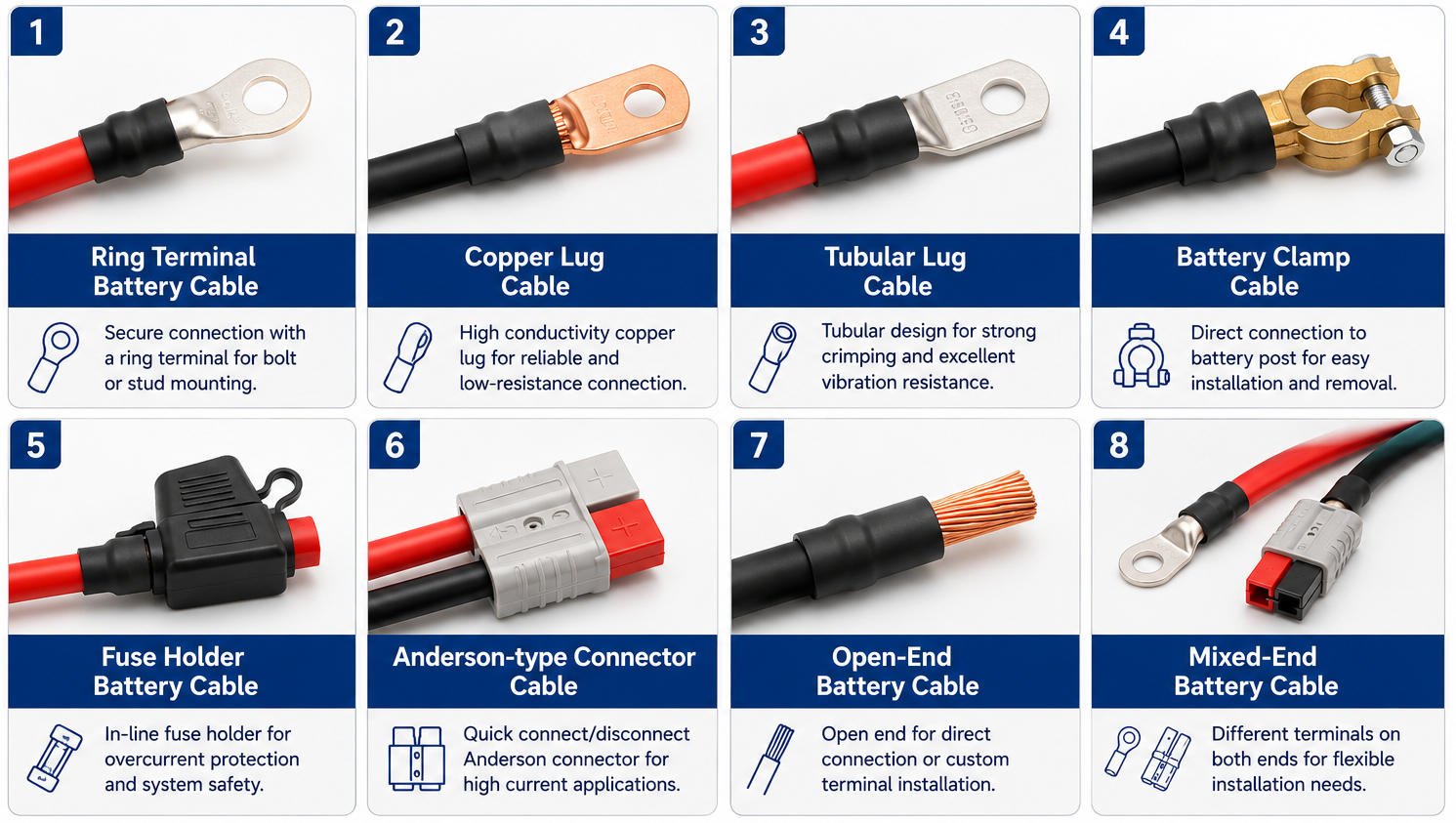
Battery cable assemblies can be terminated with different lugs, terminals, clamps and connectors according to the battery type, equipment interface and current requirement. Yihetai can manufacture custom battery cables based on drawings, samples, terminal datasheets or application requirements.

Terminal / Connector OptionCommon Use
Ring Terminal Battery CableBattery connection, grounding and power wiring
Copper Lug CableHigh-current cable termination and power distribution
Tubular Lug CableIndustrial equipment, energy storage and power systems
Battery Clamp CableAutomotive battery and backup power connection
Fuse Holder Battery CableProtected battery power connection
Anderson-Type Connector CableModular power connection and quick disconnect applications
Open-End Battery CableCustom installation, soldering or equipment-specific wiring
Mixed-End Battery CableLug to connector, clamp to lug, fuse holder to connector or custom structure


For high-current battery cables, terminal material, contact area and crimping quality should be confirmed together with cable size.

Battery Cable Assembly Structures We Manufacture

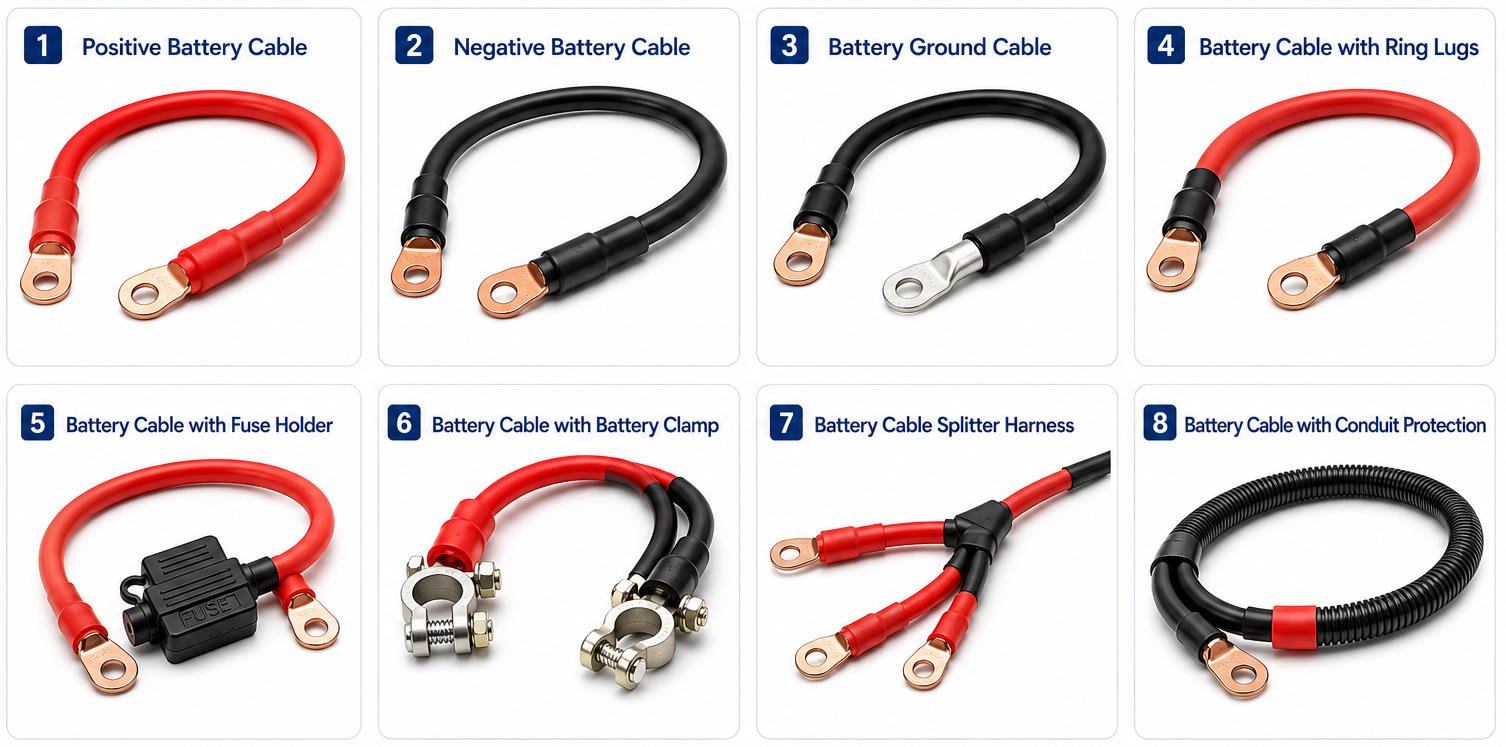
Yihetai can manufacture simple battery leads as well as complex battery power cable assemblies with lugs, fuse holders, connectors, branches and protective sleeves.

Cable StructureDescription
Positive Battery CableRed cable or marked positive cable for battery power output
Negative Battery CableBlack cable or marked negative cable for return path connection
Battery Ground CableUsed for chassis grounding, equipment grounding and safety connection
Battery Cable with Ring LugsRing terminals or copper lugs on one or both ends
Battery Cable with Fuse HolderIntegrated fuse protection for battery power circuits
Battery Cable with Battery ClampSuitable for automotive, UPS and backup power applications
Battery Cable with Anderson-Type ConnectorUsed for modular power connection and quick disconnect design
Battery Cable Splitter HarnessOne input to multiple outputs for power distribution
Battery Cable with Conduit ProtectionAdds abrasion protection and cable routing support
Custom Battery Power HarnessDesigned according to battery pack, equipment layout or drawing

Battery Cable Protection Options

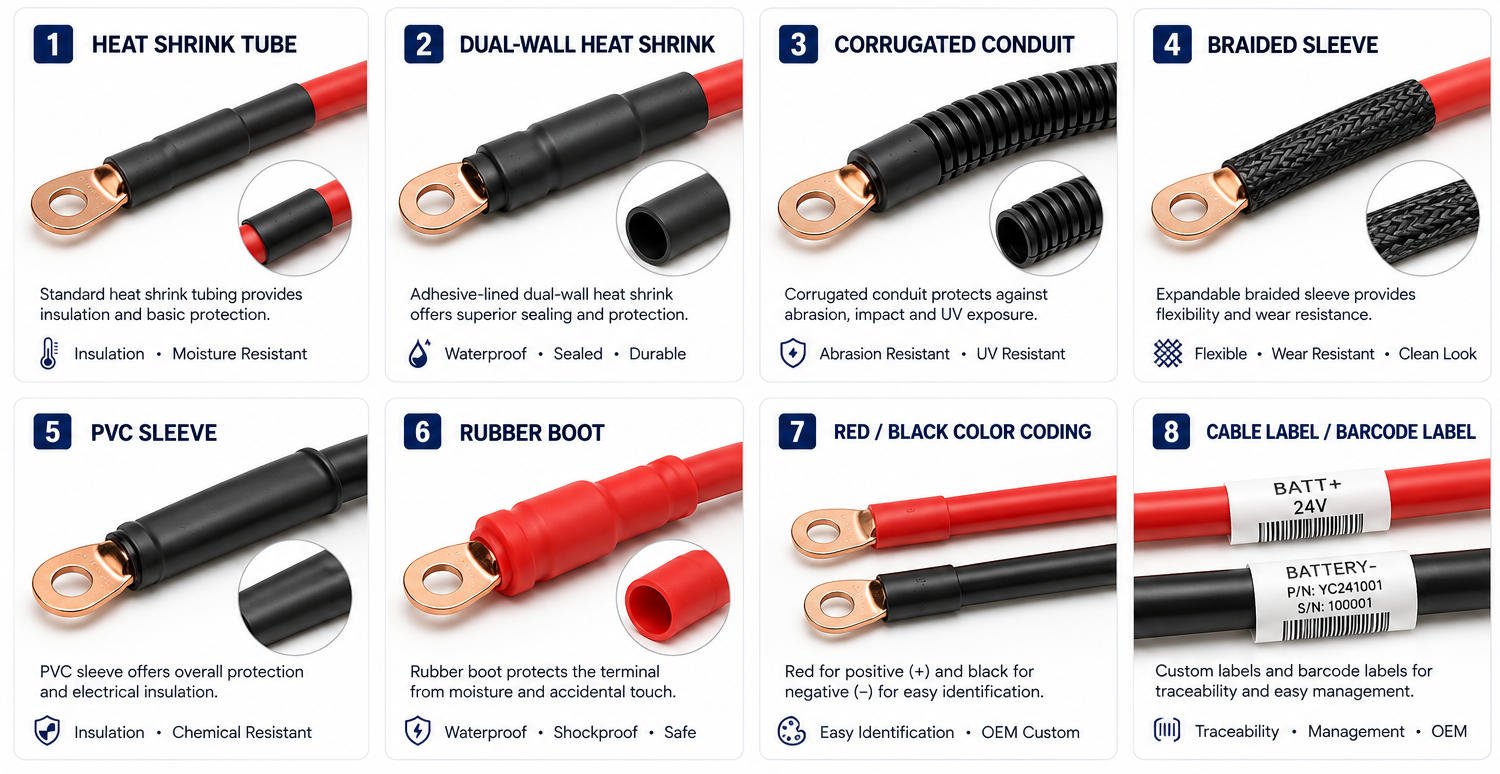
Battery cable assemblies often require additional protection because they are used in power, battery, automotive, energy storage and industrial environments. Yihetai can customize insulation, sleeve, conduit, boots and labels according to your application.

For battery cables, we recommend clearly marking polarity, cable function and installation direction when needed.

Crimping Quality Control for Battery Cable Assemblies

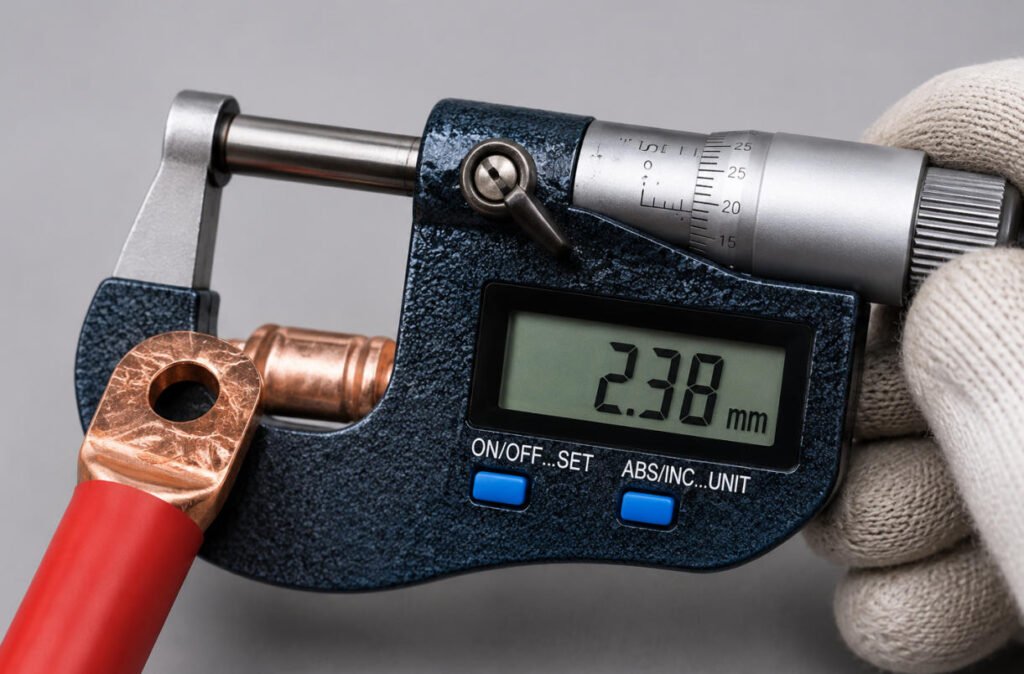
For battery cable assemblies, terminal crimping quality directly affects electrical conductivity, contact resistance, heat generation and mechanical strength. A poor crimp may cause voltage drop, overheating, loose connection or cable failure during long-term use.

Yihetai controls battery cable crimping through cable size verification, stripping length inspection, terminal matching, crimping process control, pull force testing, continuity testing and final visual inspection.

Inspection ItemPurpose
Cable Size VerificationEnsures conductor size matches the current requirement
Terminal / Lug MatchingConfirms cable and lug barrel compatibility
Stripping Length InspectionPrevents exposed conductor or insufficient crimping area
Crimping Appearance CheckChecks deformation, cracks and conductor position
Pull Force TestConfirms mechanical strength of the crimped terminal
Continuity TestConfirms stable electrical connection
Polarity CheckPrevents positive / negative wiring errors
Heat Shrink InspectionConfirms insulation coverage and appearance
Final Visual InspectionChecks labels, routing, terminals and packaging

Our goal is to ensure every battery cable assembly has correct polarity, stable crimping, reliable conductivity and consistent batch quality before shipment.

Where Battery Cable Assemblies Are Used

Battery cable assemblies are widely used in electrical systems that require stable power transmission between batteries, power modules, chargers, inverters and electrical equipment. Yihetai manufactures custom battery cables for energy storage, automotive, solar, industrial and backup power applications.

Energy Storage Systems

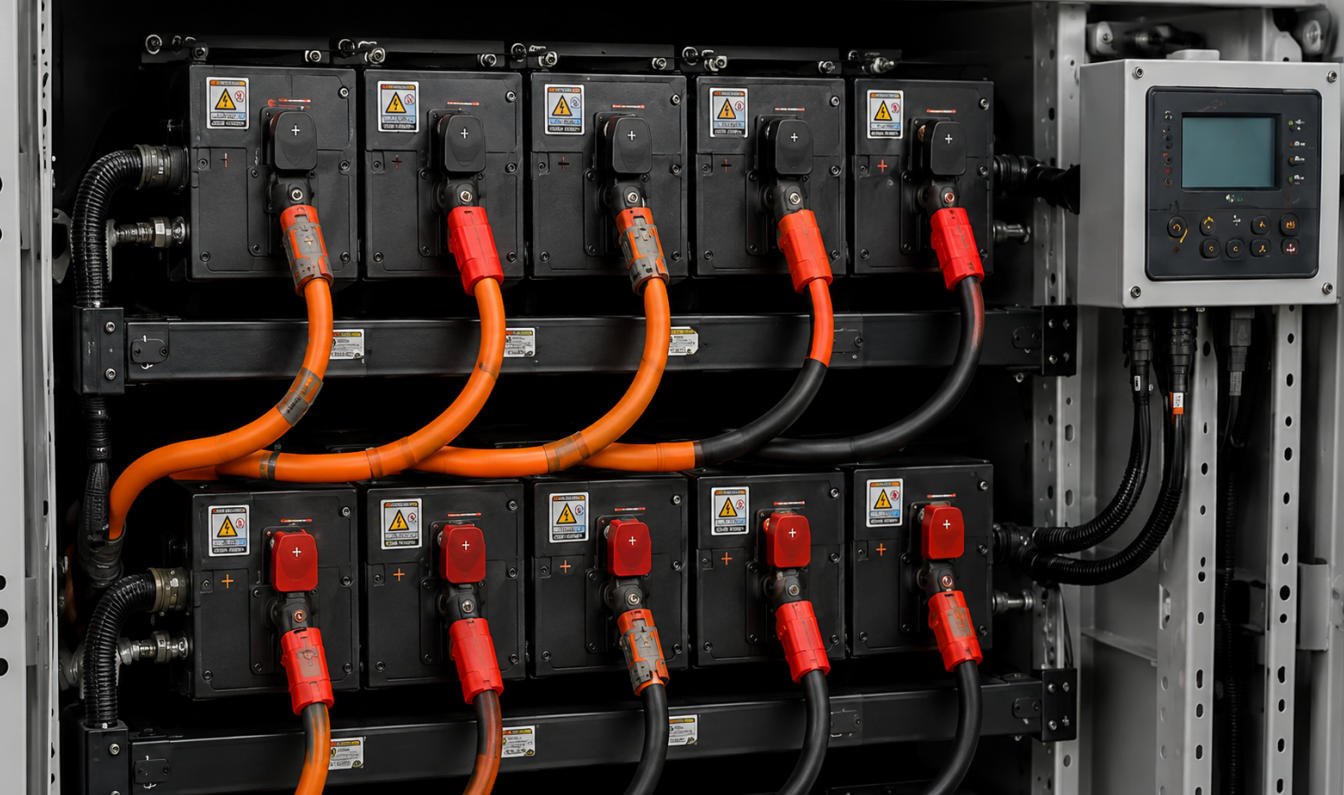
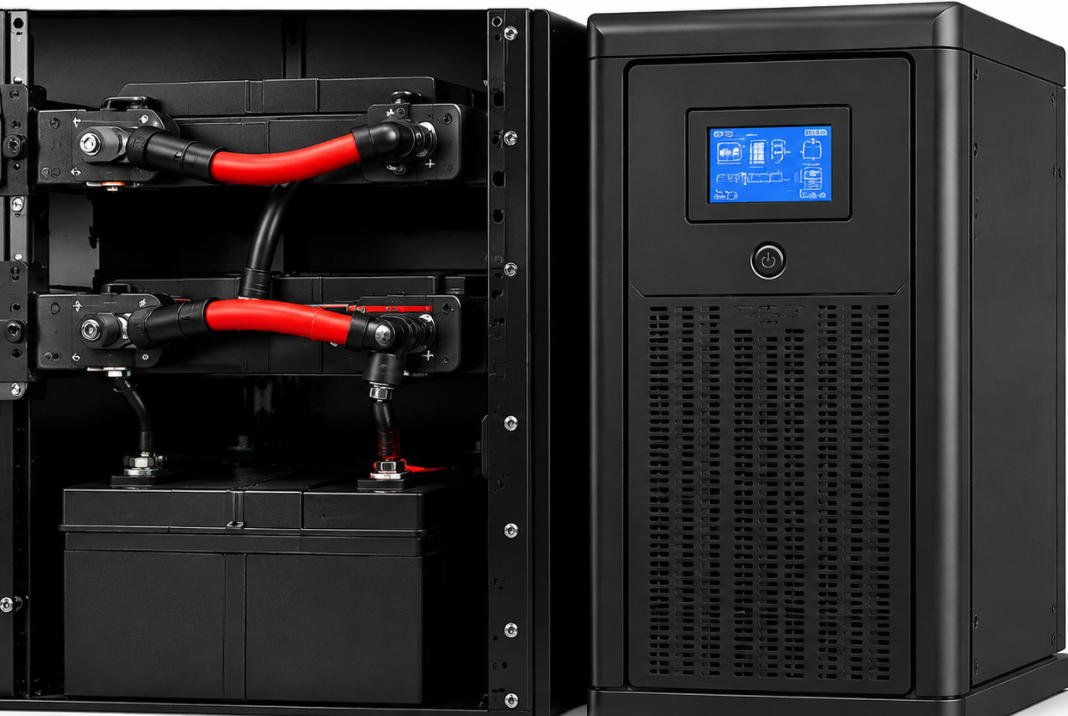
Battery cable assemblies are used in energy storage cabinets, battery racks, battery modules, power conversion systems and BMS-related power connections. They help connect battery packs, bus bars, fuses, breakers and power control units.

Automotive and Electric Vehicles

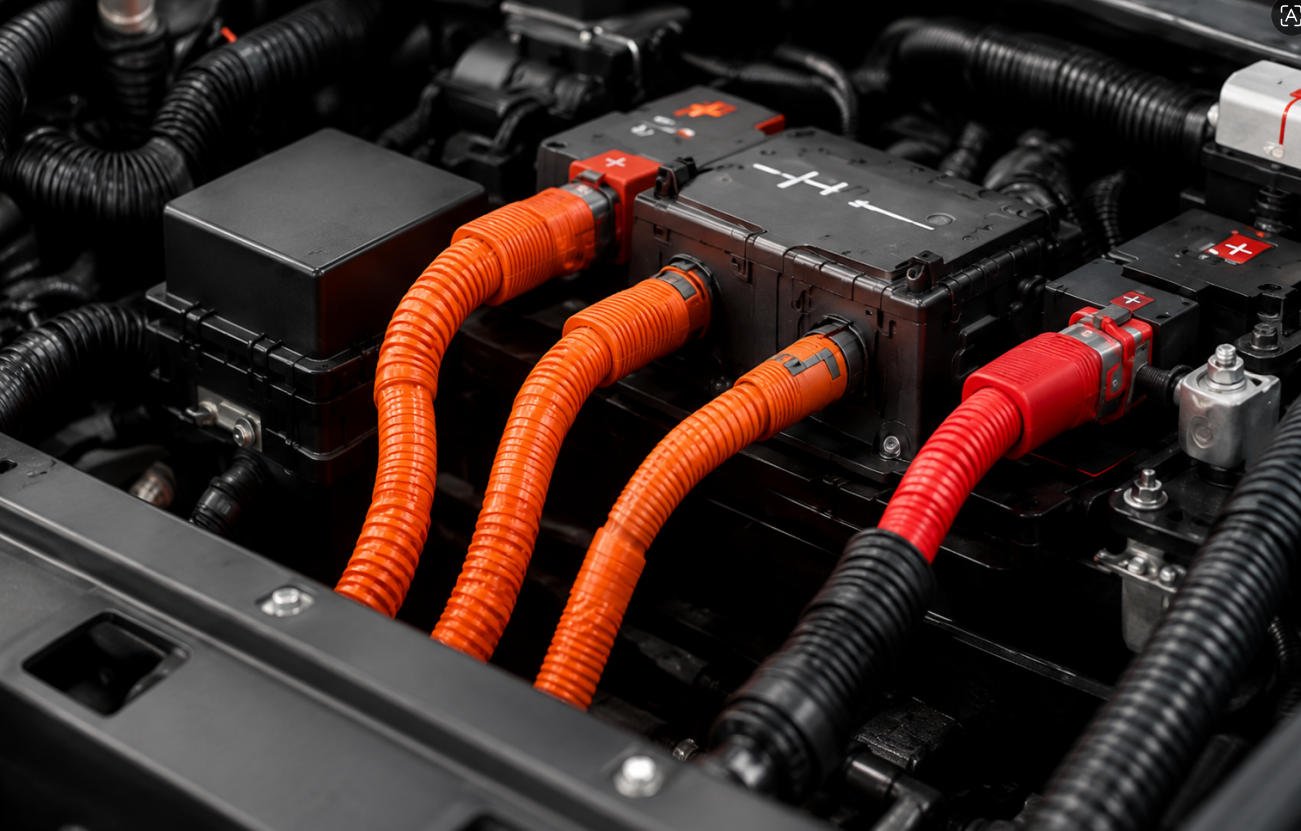
Battery cables are used for automotive battery connections, grounding cables, auxiliary power wiring, electric vehicle battery systems and low-voltage or high-voltage power connections depending on project requirements.

Solar and Photovoltaic Systems

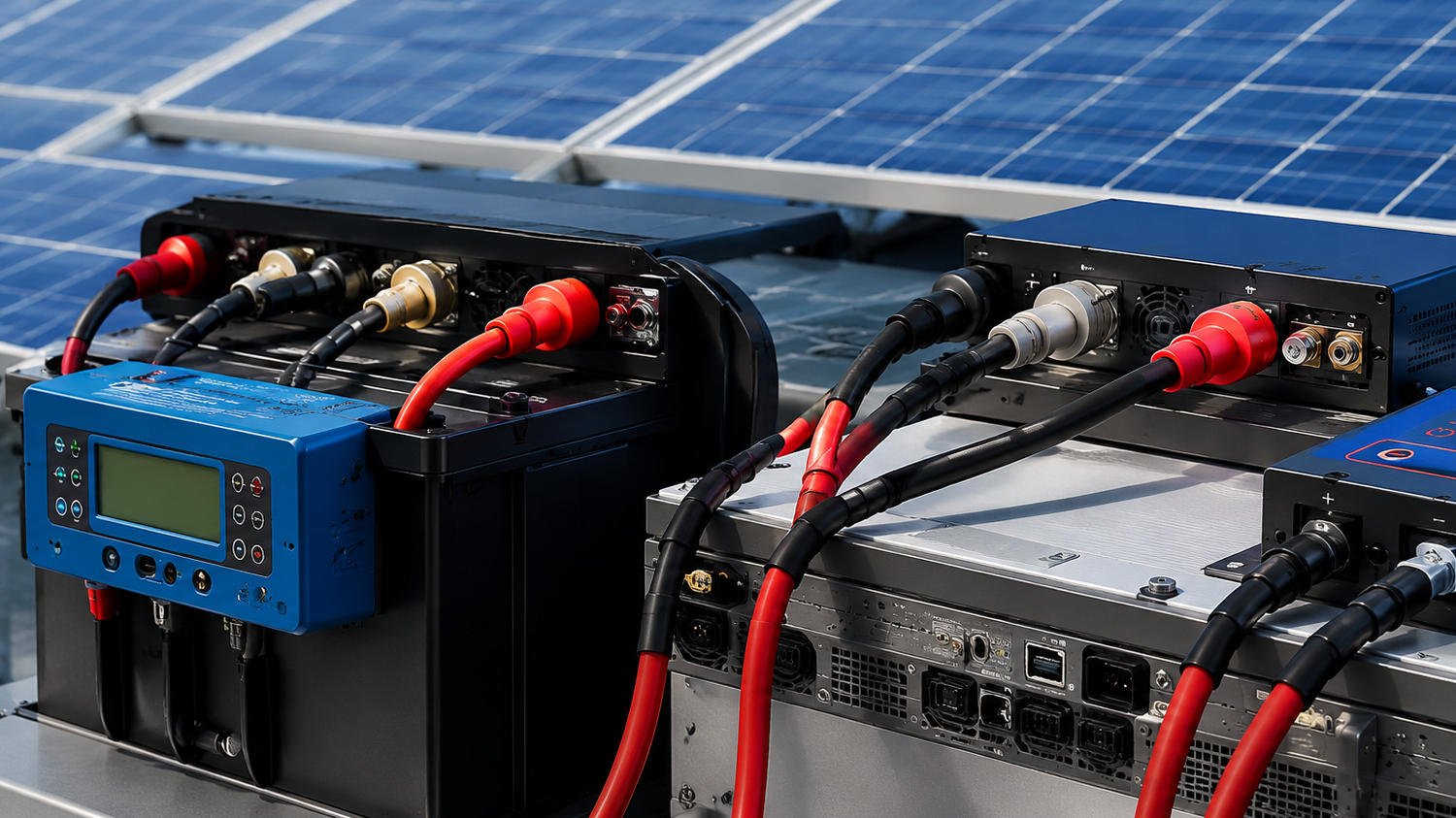
In solar power systems, battery cable assemblies can be used to connect batteries, charge controllers, inverters and power distribution units. Cable size, insulation material and terminal quality are important for stable long-term operation.

Industrial Equipment

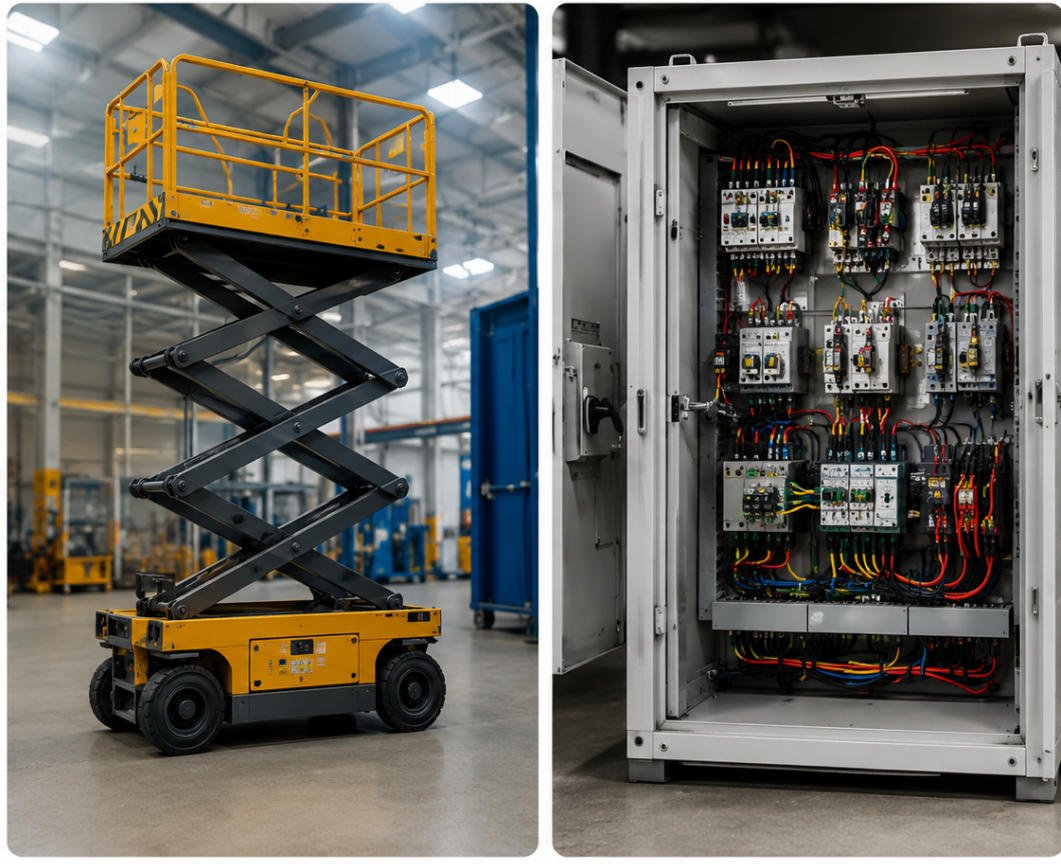
Industrial machines, mobile equipment, power tools, forklifts, lifting equipment and automation systems may require battery cable assemblies for power supply, motor connection, grounding and control cabinet power wiring.

Backup Power and UPS Systems

UPS systems and backup power equipment require dependable battery cables to connect battery banks, inverters, chargers and protection devices. Stable crimping and low-resistance connection are especially important in these applications.

Marine, RV and Outdoor Power Equipment

Battery cable assemblies are also used in marine equipment, RV power systems, outdoor power stations and portable energy devices. These applications may require flexible cables, corrosion-resistant terminals and protective sleeves.

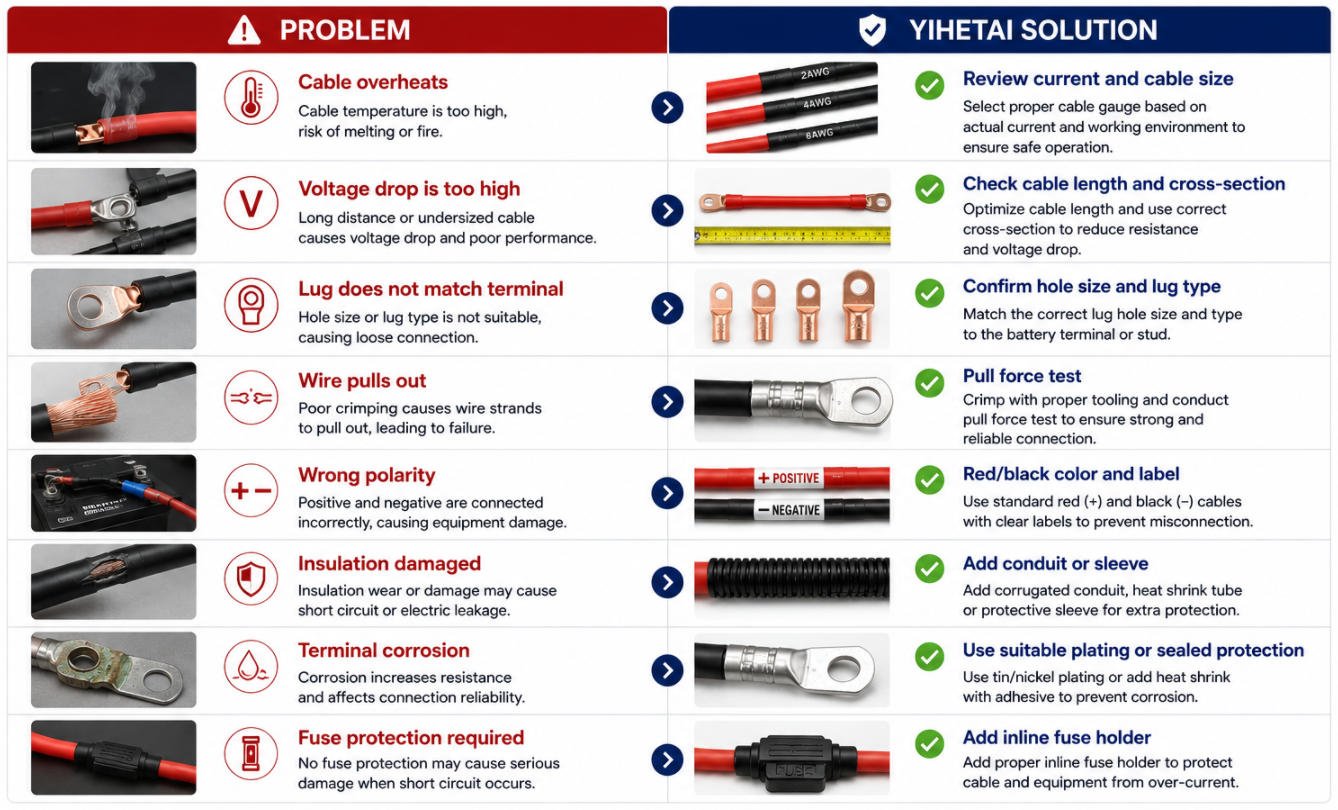
Common Battery Cable Problems We Help Customers Solve

Yihetai helps customers improve battery cable assembly reliability by reviewing cable size, terminal type, crimping method, polarity marking, protection design and application environment.

Customer Problem 1,Cable overheats during operation
Yihetai Solution:Review current, cable size, conductor material and terminal contact area

Customer Problem 2,Voltage drop is too high
Yihetai Solution:Check cable length, cross-section and power transmission requirement

Customer Problem 3,Lug does not match battery terminal
Yihetai Solution:Confirm terminal hole size, lug type and equipment connection point

Customer Problem4,Wire pulls out from lug
Yihetai Solution:Review lug barrel size, crimping method and pull force requirement

Customer Problem 5, Positive and negative cables are confused
Yihetai Solution: Use red/black color coding, polarity labels and wiring confirmation

Customer Problem6, Cable insulation is easily damaged
Yihetai Solution:Add conduit, braided sleeve, heat shrink or protective covering

Customer Problem 7,Moisture causes terminal corrosion
Yihetai Solution:Review terminal material, plating, sealed heat shrink or rubber boot

Customer Problem 8, Installation space is too tight
Yihetai Solution:Customize cable length, bending direction and routing structure

Customer Problem 9,Fuse protection is required
Yihetai Solution:Add inline fuse holder or protected power cable structure

Customer Problem 10, Batch quality is inconsistent
Yihetai Solution:Use confirmed drawing, approved sample and 100% electrical testing

How to Choose a Battery Cable Assembly

When choosing a battery cable assembly, engineers should confirm the current rating, voltage rating, cable length, wire gauge, conductor material, terminal hole size, insulation material, working temperature and installation environment.

For higher-current applications, cable size and terminal contact area are critical. If the wire gauge is too small or the terminal crimping is unstable, the cable may generate excessive heat or cause voltage drop during operation.

For outdoor, marine, RV or energy storage applications, insulation material, terminal plating, corrosion resistance and protective sleeving should also be considered.

Selection ItemWhat to Confirm
Current ratingContinuous current and peak current
Voltage ratingLow voltage, medium voltage or project-specific requirement
Cable sizeSelected according to current load and cable length
Conductor materialBare copper, tinned copper or customer-specified
Terminal typeRing terminal, copper lug, battery clamp, connector, fuse holder
Terminal hole sizeM5, M6, M8, M10 or customized
Insulation materialPVC, silicone, XLPE, TPE or project-specific material
Cable flexibilityStandard cable or high-flex cable
ProtectionHeat shrink, braided sleeve, corrugated tube, PVC sleeve
IdentificationRed/black color, labels, polarity marking, part number
TestingContinuity, pull force, insulation resistance, withstand voltage

Send us your drawing, sample or specification for a fast quotation

Manufacturing Capability

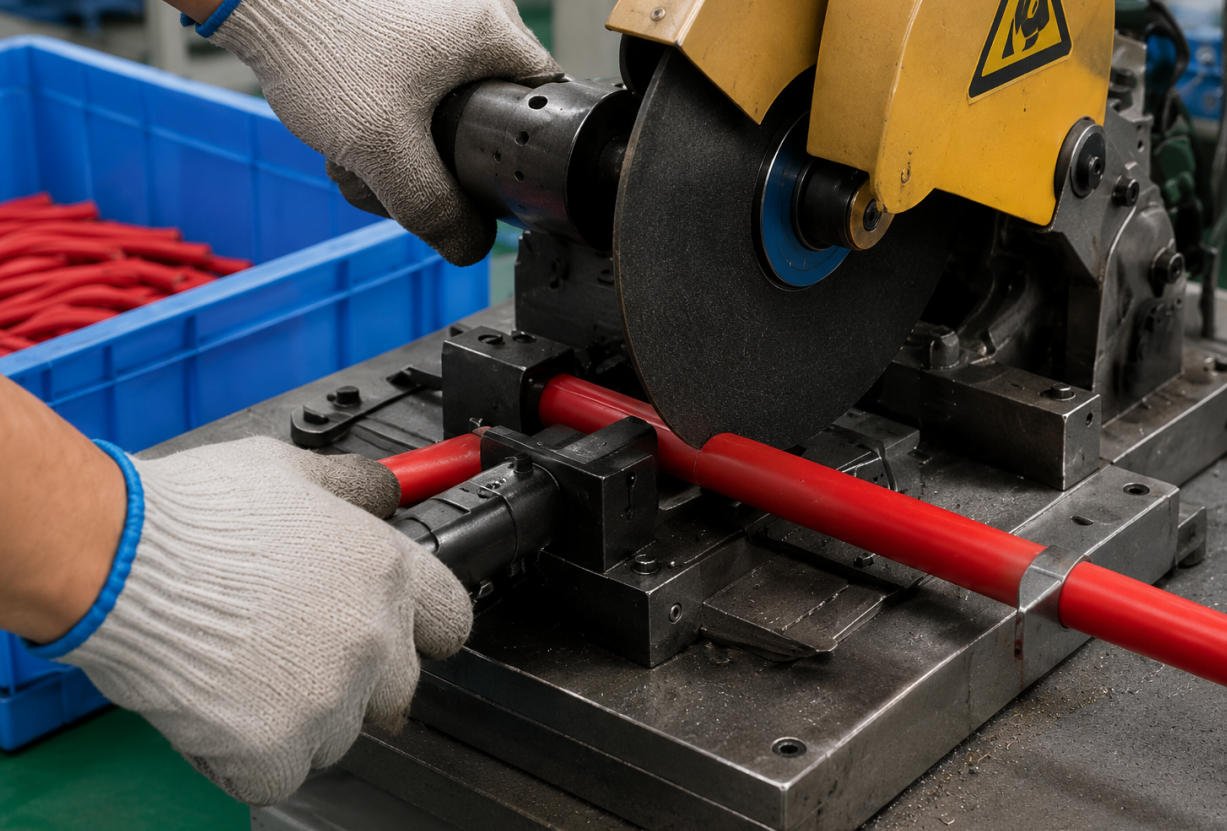
Yihetai has solid manufacturing capability for custom Battery Cable Assembly projects, from simple battery leads to complex multi-branch power cable harnesses. With in-house wire processing, cutting, stripping, terminal crimping, soldering, assembly, bundling and electrical testing, we are able to control key production steps and maintain stable quality across different order volumes. This allows us to support both prototype development and mass production for OEM customers.

As a professional cable assembly manufacturer and wire harness manufacturer, we can process different conductor sizes, cable structures and terminal types for high-current and power distribution applications. Our production capability covers custom cable preparation, terminal connection, protective sleeving, labeling and final inspection, helping customers receive battery cable assemblies that are ready for direct installation.

From material selection to final assembly and testing, all production processes are carried out under strict quality control to ensure consistent product performance and delivery reliability. Typical lead time for prototypes is 5-7 days, and mass production is usually within 3-4 weeks, depending on product complexity and material availability.

Manufacturing and Quality Control for Battery Cable Assemblies

Battery cable assemblies require stable crimping, correct cable size and reliable terminal contact. A poor crimp, incorrect terminal size or damaged conductor may cause high resistance, overheating, voltage drop or power failure.

Yihetai controls key production steps during manufacturing, including incoming material inspection, wire cutting, stripping, terminal crimping, assembly, bundling, electrical testing, appearance inspection, final inspection and packaging.

Why Choose Yihetai

25+ years of wire harness and cable assembly experience serving multiple industrial sectors

Strong engineering team for custom design and connector matching

Flexible support from prototype to mass production for OEM battery cable and power harness projects

In-house wire processing and assembly capability for better control of quality, lead time and customization

Certified quality system with ISO 9001:2015, UL and IATF 16949 for reliable manufacturing control

Application experience in energy storage, automotive, photovoltaic and industrial equipment, which fits battery cable assembly projects well

Frequently Asked Questions

Please send us your drawing, sample, cable size, length, terminal type, current requirement, application environment, quantity and any testing or packaging requirements. If you only have a sample or basic specification, we can also assist with engineering evaluation.

Yes. We can produce custom battery cable assemblies for different current levels by selecting suitable conductor size, cable type, terminal structure and protection method according to the application.

We can provide ring terminals, copper lugs, tubular terminals, battery clamps, fuse terminals, connector housings and mixed-end termination structures depending on your project needs.

Yes. We support custom battery and power cable assemblies used in energy storage systems, photovoltaic systems, new energy vehicles and other high-reliability electrical applications.

Yes. Depending on the product requirement, we provide continuity testing, polarity verification, crimp pull test, insulation resistance test, high-voltage test and final visual inspection before shipment.

Yes. Yihetai can manufacture battery cables with ring terminals, copper lugs, battery clamps, connectors, fuse holders and other customer-specified terminals.

Need a custom battery cable assembly for your application?

Contact Yihetai today for fast support on prototype development, technical evaluation and quotation

Ask For A Quick Quote

We will contact you within 24 hours, please pay attention to the email with the suffix “info@yihetai-cable.com”