
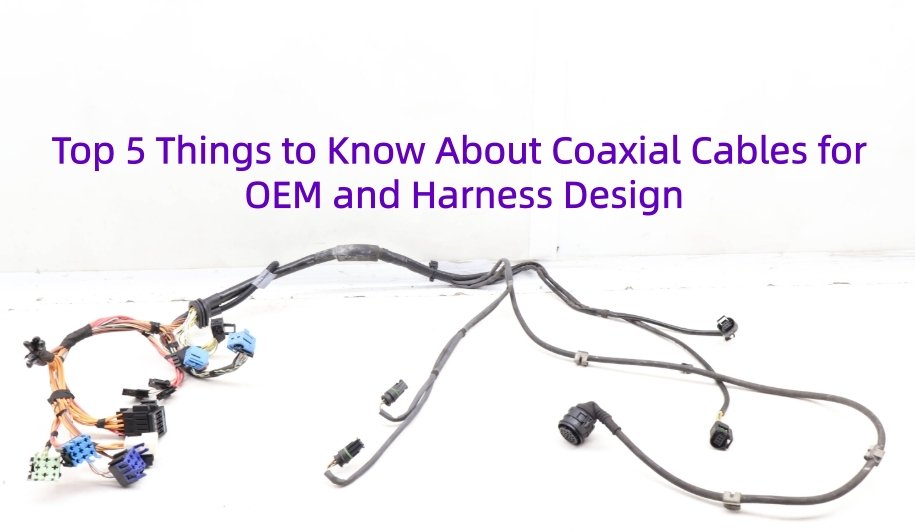
In OEM projects and wire harness design, small components can have a huge impact, and coaxial cables are a perfect example. I have seen many teams overlook cable selection, only to face signal problems, electromagnetic interference, or failed compliance checks during testing.
If you are an engineer, sourcing manager, or product developer, you already understand how important it is to get every detail right. But when it comes to coaxial cables, the wide range of types, specifications, and applications can make it difficult to choose the best option for your system.
That is exactly why I wrote this blog. I want to share the top five things you need to know about coaxial cables in the context of OEM and custom harness development. By the end, you will have the knowledge to make better design and purchasing decisions with confidence and avoid costly mistakes later in the process.
Over the years, I have seen how the performance and reliability of an OEM system can be directly impacted by the smallest cable decisions. Coaxial cables may look simple from the outside, but they carry complex signals and must meet precise requirements. Whether you are designing for automotive, medical, communication, or industrial systems, understanding the key factors behind coaxial cable selection is critical to achieving long-term performance and system stability.
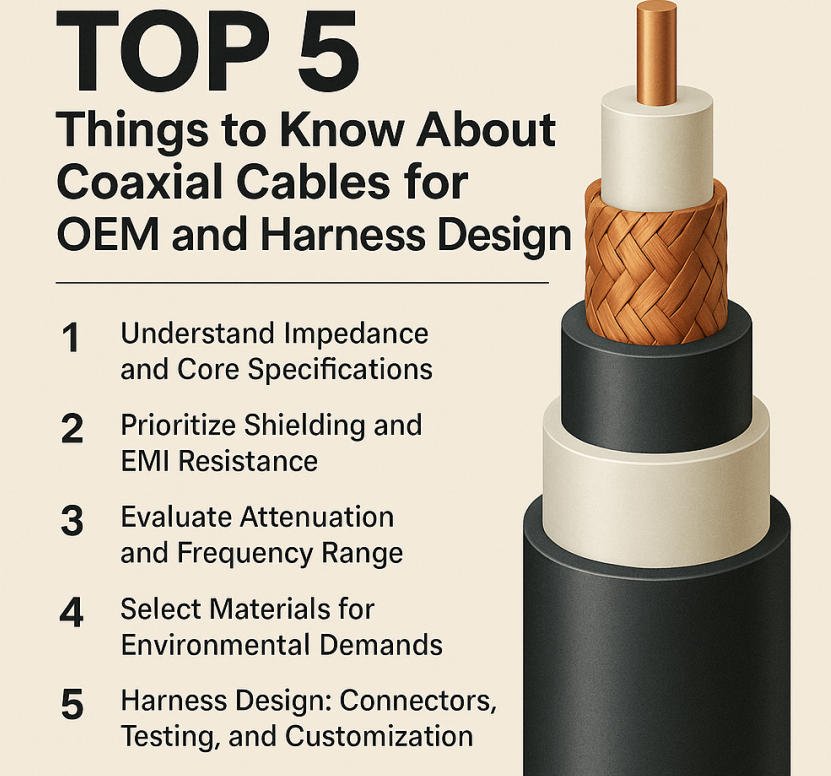
Below, I have outlined the five most important things you need to know when choosing and integrating coaxial cables into your wire harness design. These insights come from real project experience and are meant to help you make smarter, more confident decisions from the very beginning:
- Things1. Understand Impedance and Core Specifications
- Things2. Prioritize Shielding and EMI Resistance
- Things3. Evaluate Attenuation and Frequency Range
- Things4. Select Materials for Environmental Demands
- Things5. Harness Design: Connectors, Testing, and Customization
Things1. Understand Impedance and Core Specifications
Let me begin with one of the most important and sometimes overlooked aspects of coaxial cable design impedance. In every OEM project I support, matching the cable impedance to the system is absolutely critical. If the impedance is incorrect, it can lead to signal reflections, reduced performance, or even complete signal loss in high frequency applications.
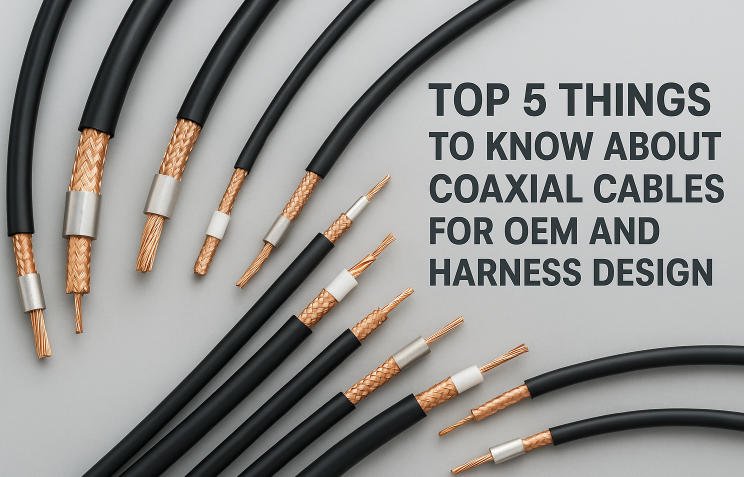
Coaxial cables are typically designed with either 50 ohm or 75 ohm impedance. The 50 ohm version is widely used in radio frequency and test equipment, while 75 ohm cables are standard in video and broadcast systems.
This impedance value depends on several key factors, including the diameter of the center conductor, the type of dielectric material used such as polyethylene, foam polyethylene, or PTFE, and the geometry of the shielding. For instance, RG6 cable, which is commonly used for video applications, has a 75 ohm impedance, a 1.02 millimeter copper clad steel core, and a 4.57 millimeter foam dielectric, making it ideal for low loss video transmission.
Other important specifications I always review in coaxial cable selection include:
- Capacitance, usually between 50 and 100 picofarads per meter, which affects how the signal behaves across long distances
- Velocity of propagation, typically between 66 and 88 percent, indicating how fast the signal travels through the cable compared to the speed of light
Understanding these parameters allows you to select a cable that not only fits the harness physically, but also meets the electrical and performance standards your system demands. Choosing the correct coaxial cable from the beginning helps ensure long term signal integrity and system stability.
Things2. Prioritize Shielding and EMI Resistance
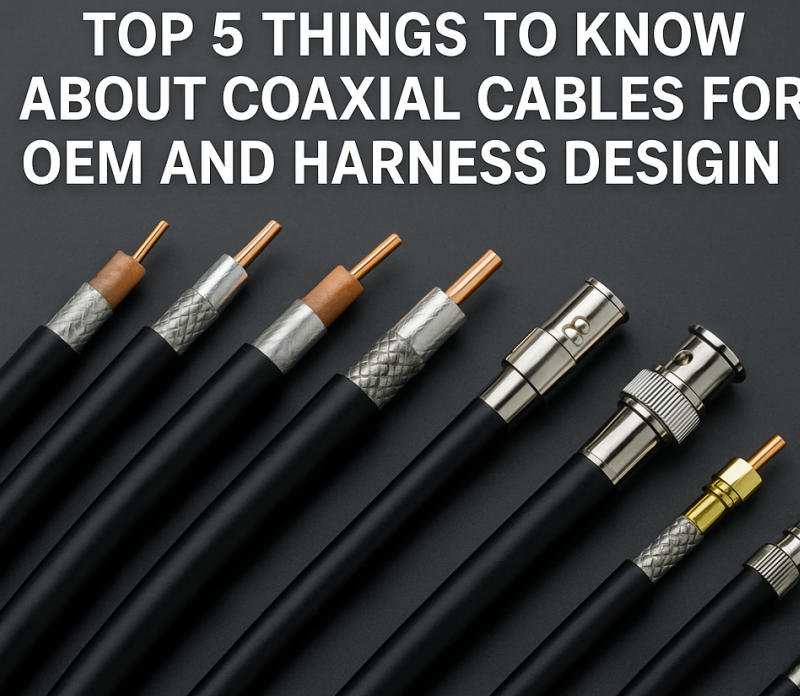
After impedance, one of the most overlooked but critical factors in coaxial cable design is shielding. In OEM environments, especially those involving motors, power electronics, or wireless systems, electromagnetic interference (EMI) can disrupt signal integrity and cause system instability.
That is why effective shielding is not optional, it is essential.
Depending on your application, you can choose from:
- Foil Shields – Lightweight and ideal for basic EMI protection
- Braided Shields – Provide stronger mechanical strength and better EMI resistance
- Double or Triaxial Shields – Used in high-interference environments where maximum protection is required
For example, double-braided coaxial cables are well suited for high-flex RF harnesses in automotive or industrial systems. In medical equipment like ultrasound or ECG probes, low-noise coax cables with carbon-loaded dielectric layers and insulation resistance above one teraohm per meter are often required for accurate performance.
Make sure your coaxial cables also meet relevant safety and quality standards. UL-certified cables with dielectric strength of at least 1600 volts ensure your harness is safe for integration into high-reliability systems.
Shielding ensures not just performance, but long-term reliability, compliance, and safety.
Things3. Evaluate Attenuation and Frequency Range
After considering impedance and shielding, the next key factor I always evaluate in coaxial cable selection is attenuation, especially when working with high-frequency OEM applications like 5G antennas, radar, or medical ultrasound systems. This is where understanding how signal loss behaves over distance becomes essential.
Attenuation increases as frequency rises and as cable length grows. For example, a compact cable like RG178 can support high-frequency signals but may experience attenuation close to 20 decibels per 100 feet at 750 megahertz. That level of loss might be acceptable in short runs, but it is unsuitable for long-distance transmission in high-performance systems.
For extended cable runs over 500 meters, I recommend using foam dielectric coaxial cables, such as CELLFLEX, which provide low signal loss and excellent return loss performance. These cables also maintain a low voltage standing wave ratio, making them ideal for applications that demand signal integrity across long distances.
Mechanical durability matters too. Always consider minimum bending radius, which for larger foam dielectric cables can be around 32 millimeters, and tensile strength, especially in harnesses that may experience movement, vibration, or strain during operation.
Lastly, to verify real-world performance, I always recommend testing attenuation and frequency response at a controlled temperature of 20 degrees Celsius. This gives a realistic measure of how the cable will perform in actual OEM conditions.
By carefully balancing frequency range, attenuation, and mechanical limits, you can select a coaxial cable that maintains high signal quality while meeting the physical demands of your harness design.
Things4. Select Materials for Environmental Demands
Choosing the right materials for your coaxial cable is just as important as the electrical specifications. In real-world OEM environments, cables are often exposed to extreme temperatures, vibration, moisture, and chemicals. If the material cannot handle these conditions, performance will suffer and failure rates may rise.
Start by selecting the right outer jacket for your application. Common choices include:
- Polyethylene (PE) for outdoor durability and moisture resistance
- Polyvinyl chloride (PVC) for general-purpose use and easy handling
- Polytetrafluoroethylene (PTFE) for high-temperature, chemical, or aerospace environments
Temperature tolerance is also key. A reliable coaxial cable for OEM use should perform consistently between minus 40 and plus 85 degrees Celsius, depending on the application.
For the conductor, balance cost and performance by choosing between pure copper for low resistance and high performance, or copper-clad steel (CCS) when budget and mechanical strength are priorities.
In specialized industries, material selection becomes even more critical. Aerospace and military systems often require low-smoke, halogen-free jackets that meet MIL-STD vibration standards. In automotive harnesses, look for materials that comply with IATF16949 quality certification and offer extended flex life for moving parts and tight routing paths.
By selecting the right materials from the start, you ensure long-term durability, regulatory compliance, and consistent performance in demanding OEM applications.
Things5. Harness Design: Connectors, Testing, and Customization
Even with the right cable and materials, poor integration can lead to performance issues. In OEM wire harness design, the way your coaxial cables are terminated, assembled, and tested matters just as much as the cable itself.
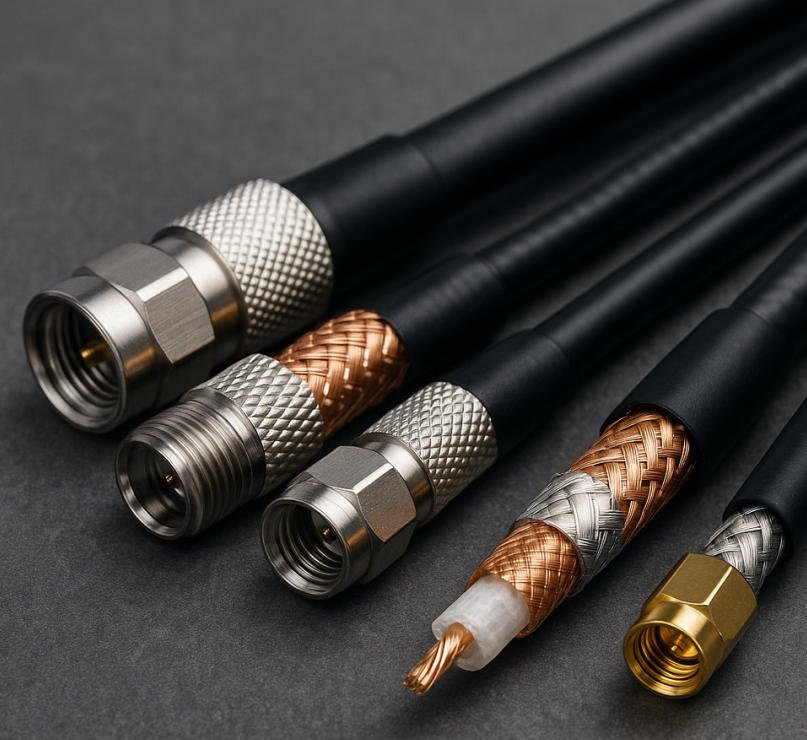
Start by selecting the appropriate connectors based on your system requirements. Common options include F-type, BNC, and SMA connectors, each suited for specific signal types and frequency ranges. These connectors should be integrated using precise crimping and molding processes to ensure stable connections, signal integrity, and mechanical durability.
Harness designs should also accommodate custom lengths, multi-conductor hybrid cables, and tight routing constraints based on the final application. This is especially important for OEMs in automotive, medical, or communications where space and signal clarity are critical.
Equally important is quality assurance. Every harness should undergo 100 percent in-house testing across all production stages. Key metrics include:
- Return loss of at least 20 decibels, to ensure minimal signal reflection
- Insulation resistance greater than 5000 megaohms per kilometer, to prevent leakage and short circuits
Finally, choose a manufacturing partner with experience in delivering scalable OEM solutions, from prototype support to full production. A reliable partner ensures consistent quality, faster lead times, and the flexibility to adapt as your design evolves.
Investing in smart harness design from the start saves time, reduces failure rates, and delivers better end performance.
Applications and Use Cases in OEM and Harness Design
After working with coaxial cables in OEM harness design for years, I’ve seen how versatile and essential they are across industries. Whether you’re building high-frequency systems, medical instruments, or automotive modules, coax cables often offer the perfect balance of signal integrity, EMI protection, and mechanical durability. Let’s take a closer look at where and why they’re used in OEM applications.
Applications and Use Cases in OEM and Harness Design
- RF Transmission Systems
Coaxial cables are the gold standard for RF signal transmission. Whether in test benches, 5G base stations, or antenna modules, their impedance consistency and low loss make them ideal for handling high-frequency signals with minimal interference. - Surveillance and CCTV Systems
In OEM security applications, coax cables—especially 75Ω types like RG59 or RG6—are commonly used for video signal transmission. They deliver clean, stable analog or HD video over long distances without signal degradation. - Medical Devices
I’ve supported clients in the medical field where precision is everything. Coaxial cables are often used in ultrasound probes, ECG equipment, and imaging devices because they offer high EMI immunity and excellent signal quality in low-noise environments. - Automotive Systems
In cars, coax cables are increasingly used for camera modules, radar sensors, and infotainment systems. Their shielding and compact form make them suitable for the EMI-heavy environment under the hood especially for ADAS (Advanced Driver Assistance Systems). - Aerospace and Military Equipment
Military-grade coax cables are used in everything from navigation systems to avionics and communication devices. These applications demand rugged, flame-resistant materials and ultra-stable performance under extreme conditions coax delivers both.
Why OEMs Prefer Coaxial Cables
Signal Stability: Maintains consistent performance over distance, especially for high-frequency data.
EMI Protection: Critical in environments with heavy electrical noise or RF interference.
Customizability: Easily adapted to specific lengths, connector types, and multi-core configurations in wire harness assemblies.
Certifiable Quality: Many coaxial cables meet strict certifications (UL, IATF16949, MIL-STD), which is a must for regulated industries.
Customization Options for OEM Harnesses
In real-world OEM projects, I’ve learned that standard, off-the-shelf coaxial cables rarely meet all design requirements. Maybe the cable needs to be a non-standard length, or maybe you need specific shielding, color coding, or bundled signal and power lines in a compact harness. That’s where custom coaxial harness design comes in and it’s one of the key areas where we help OEMs succeed.
Customization Options for OEM Harnesses
1.When Off-the-Shelf Isn’t Enough
Standard coaxial cables might work in basic setups, but OEM designs often demand more. I’ve helped customers customize:
- Cable lengths tailored to tight or oversized routing paths.
- Shielding configurations for challenging EMI environments (foil, braid, or dual-shield).
- Jacket colors for circuit identification or aesthetic consistency.
- Printed labels or heat shrink ID tags for easier assembly and field maintenance.
- These small details can make a huge difference in assembly speed, serviceability, and long-term reliability.
2.Coaxial Bundling in Multi-Cable Harnesses
Many OEM harnesses combine coaxial lines with signal, power, or data wires in a single, integrated assembly. We regularly bundle:
- Coax with twisted pair (for CAN, Ethernet, or control)
- Power lines with signal shielding
- Hybrid harnesses for automotive cameras, RF modules, and medical probes
Bundling saves space, reduces weight, and simplifies installation all critical for OEMs working with complex systems or space-constrained environments.
3.How Yihetai Supports OEMs
At Yihetai, we specialize in turning your concept into a fully functional, test-verified harness:
- Prototyping support for new product development or design validation
- Quick turnarounds on samples with full technical consultation
- Mass production capabilities with ISO 9001:2015, UL, and IATF 16949 certifications
- 100% in-house testing for continuity, return loss, impedance, and durability
From first drawings to final assembly, we help you build coaxial harnesses that fit your exact application not the other way around.
Conclusion
If there is one piece of advice I would give to any OEM team, it is this. Do not treat coaxial cables as an afterthought. Their performance, durability, and how they are integrated into your wire harness can strongly impact the success of your system. This is especially true in applications that involve high frequencies or require protection from electromagnetic interference. Making the right cable choice early in the design process can help avoid costly delays and unexpected failures later on.
If you are not sure which coaxial cable is best for your application, or how to include it in a custom harness, I am here to support you. At Yihetai, we provide expert guidance and full-service manufacturing based on over 23 years of experience. Contact us today to explore a custom coaxial cable solution that meets your exact needs with quality and confidence.