
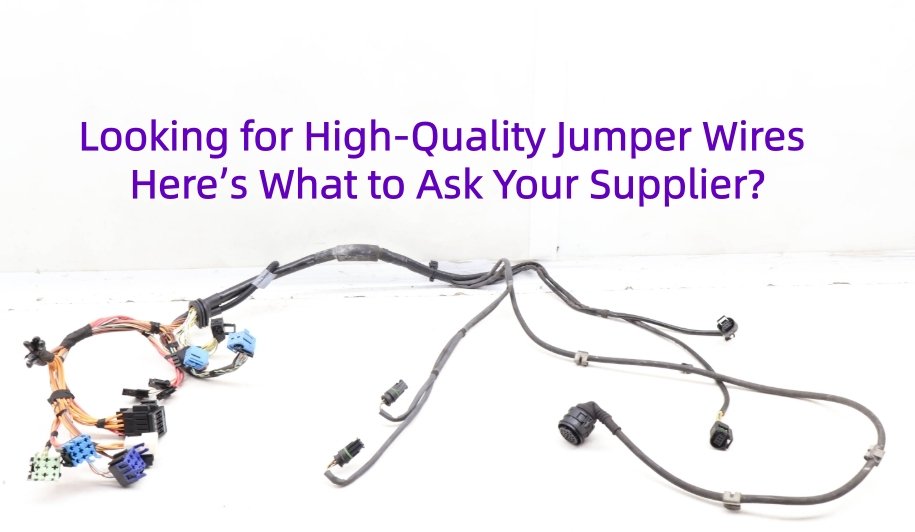
For a long time, I underestimated how much jumper wire quality really matters. They look simple, inexpensive, and easy to replace, so it’s tempting to treat them as a minor detail. But through real projects, I’ve learned that jumper wires often determine whether a system works reliably or fails unexpectedly.
Low-quality jumper wires can cause poor connections, unstable signals, unexpected failures, and even safety risks like overheating or short circuits. I’ve seen projects delayed, debug time doubled, and equipment damaged all because the wires did not meet basic quality standards. These problems rarely show up immediately, which makes them even more frustrating.
That’s exactly why I wrote this blog. My goal is to help buyers, engineers, and sourcing teams ask the right questions before choosing a supplier. By knowing what to look for and what to ask, you can avoid hidden risks and confidently choose a supplier that delivers safe, reliable, and high-quality jumper wires for your application.
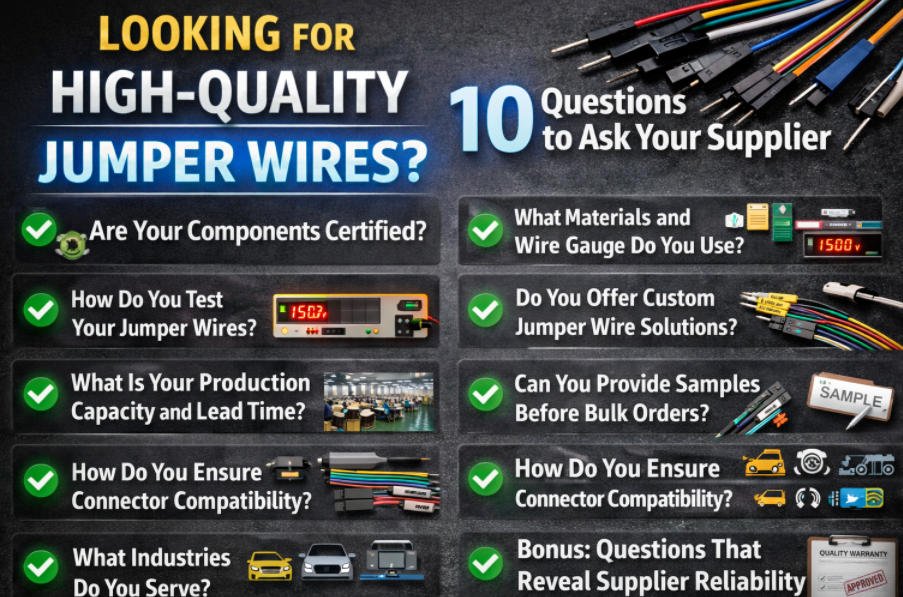
Before choosing a supplier for jumper wires, I’ve learned that asking the right questions makes all the difference. High-quality jumper wires impact performance, safety, and long-term reliability, so it’s important to evaluate a supplier carefully rather than simply comparing prices. To help buyers make smarter decisions and avoid common pitfalls, I’ve summarized the essential questions I always ask when sourcing jumper wires. These ten points will guide you through certifications, materials, testing, customization, production capabilities, and overall supplier reliability.
Here are 10 questions every buyer should start with:
Start With the Basics: What Are Your Project Requirements?
- Question 1: What Certifications Do Your Jumper Wires Meet?
- Question 2: What Materials Do You Use?
- Question 3: What Testing Do You Perform?
- Question 4: Do You Offer Custom Jumper Wire Solutions?
- Question 5: What Is Your Production Capacity and Lead Time?
- Question 6: Can You Provide Samples Before Bulk Orders?
- Question 7: How Do You Ensure Connector Compatibility?
- Question 8: What Industries Do You Serve?
- Question 9: Engineering Support and Communication
- Question 10: Bonus: Questions That Reveal Supplier Reliability
Start With the Basics: What Are Your Project Requirements?
Before I even start asking a supplier technical questions, I always take a step back and look at my own project requirements first. Understanding what the application truly needs makes it much easier to judge whether a supplier can deliver the right jumper wires. Without this foundation, even the best supplier answers may not help you make the right choice. That’s why I always begin by clarifying the electrical, mechanical, and environmental demands of the project before evaluating any supplier.
Start With the Basics: What Are Your Project Requirements?
When sourcing jumper wires, the first thing I do is determine the voltage, current, and application environment. High-current applications require thicker wire gauges and reliable insulation, while low-voltage signal lines may prioritize flexibility and stability over power capacity. Environmental factors like heat, moisture, vibration, or chemical exposure also influence which materials and constructions are appropriate.
Next, I identify the wire gauge, insulation material, and connector type the project requires. Whether I need silicone for high-temperature stability, PVC for cost-effective general use, or PTFE for harsh conditions, the material choice directly affects performance and lifespan. Connector types matter just as much: Dupont, JST, Molex, or IDC terminals each serve different purposes, so matching them to my device’s pin pitch and mounting design is essential.
Finally, I consider whether the project needs custom jumper wires or if off-the-shelf options are enough. In simple prototypes, standard jumper wires may work perfectly. However, for production runs or mission-critical applications, I often need precise lengths, specific terminal combinations, labeling, or heat-shrink protection. This is where custom manufacturing becomes a significant advantage.
Question 1: What Certifications Do Your Jumper Wires Meet?
Certifications such as UL, ISO 9001:2015, and IATF 16949 are essential indicators of a supplier’s commitment to quality and consistency. UL certification ensures the materials and components meet strict safety requirements, which is especially important for anything involving power or heat. ISO 9001:2015 confirms that the supplier follows a rigorous quality management system, helping ensure every batch of jumper wires is produced to the same standard. For automotive or high-reliability applications, I always look for IATF 16949, which sets the bar even higher for manufacturing processes and traceability.
Using certified materials is not just about meeting industry expectations; it directly affects safety, reliability, and compliance. Certified wires are less prone to failures, insulation breakdowns, or inconsistent electrical performance. In industries such as medical, automotive, or industrial automation, using uncertified wires could mean non-compliance, project delays, or regulatory problems.
A major red flag for me is when a supplier cannot provide documentation for their certifications upon request. Reliable manufacturers maintain complete records and share them openly. If a supplier hesitates, avoids the question, or provides vague answers, it usually signals poor quality control or non-compliant materials which is a risk I never take.
Question 2: What Materials Do You Use?
After confirming certifications, the next question I always ask is about materials. The materials used in jumper wires directly affect performance, safety, and lifespan. Even if two jumper wires look the same on the outside, what’s inside can make a huge difference in how they perform over time.
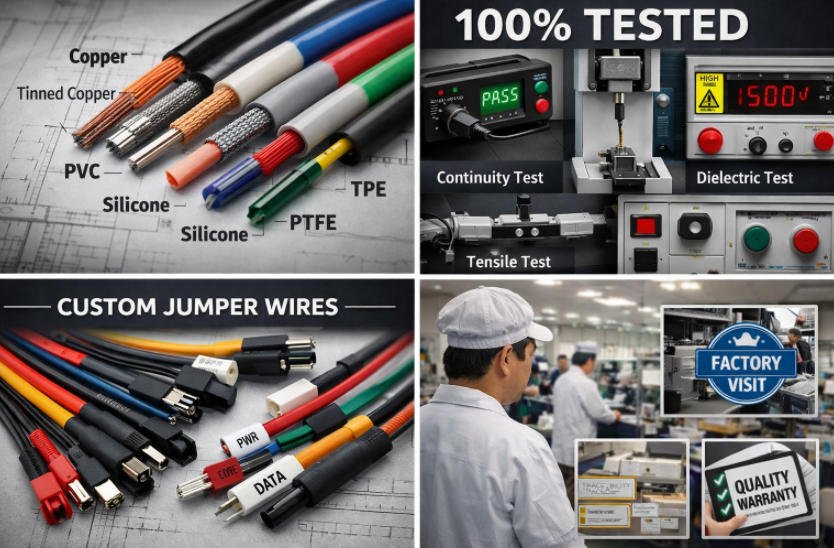
The first thing I look at is the conductor quality. High-quality jumper wires typically use pure copper because it provides excellent conductivity and low resistance. For applications requiring corrosion resistance or long-term stability, I prefer tinned copper, which has a thin protective layer that prevents oxidation. Whenever a supplier uses CCA (copper-clad aluminum), that’s a red flag for me because it reduces current capacity and breaks more easily.
Next, I ask about insulation options, since the outer jacket plays a big role in durability and safety.
- PVC is common and affordable, suitable for basic, low-temperature applications.
- Silicone offers exceptional flexibility and high temperature resistance, making it ideal for dynamic or heat-intensive environments.
- PTFE provides the highest chemical and thermal resistance, often used in medical, aerospace, or harsh industrial settings.
- TPE is a great middle ground with better flexibility than PVC while still being cost-effective.
Material choice directly affects flexibility, temperature rating, and durability. For example, silicone jumper wires are perfect when I need frequent bending or movement, while PTFE is my go-to for demanding applications where reliability under stress is essential. By asking for clear material specifications, I can be confident the jumper wires will perform the way my project requires.
Question 3: What Testing Do You Perform?
Whenever I source jumper wires, I make it a point to ask suppliers about their testing procedures. Proper testing is what separates reliable, high-quality wires from ones that may fail in critical applications.
Essential Tests
I focus on a few key tests:
- Continuity Testing ensures that electricity flows properly through the wire from end to end.
- Tensile Strength Testing checks that connectors and crimps can withstand mechanical stress without breaking.
- Dielectric Withstand Testing verifies that insulation can handle high voltage without breakdown.
- Impedance Testing is important for certain signal applications where consistent electrical characteristics are crucial.
Why 100% Testing Matters
I always prefer suppliers who test every single wire rather than relying on sampling. This guarantees that each piece meets the specified standards and avoids surprises during assembly or in the field.
Problems Prevented
Proper testing prevents a wide range of issues, including intermittent connections, signal loss, short circuits, or wire failure under mechanical or electrical stress. By asking about testing protocols upfront, I ensure the jumper wires I use are safe, reliable, and ready for consistent performance in every application.
Question 4: Do You Offer Custom Jumper Wire Solutions?
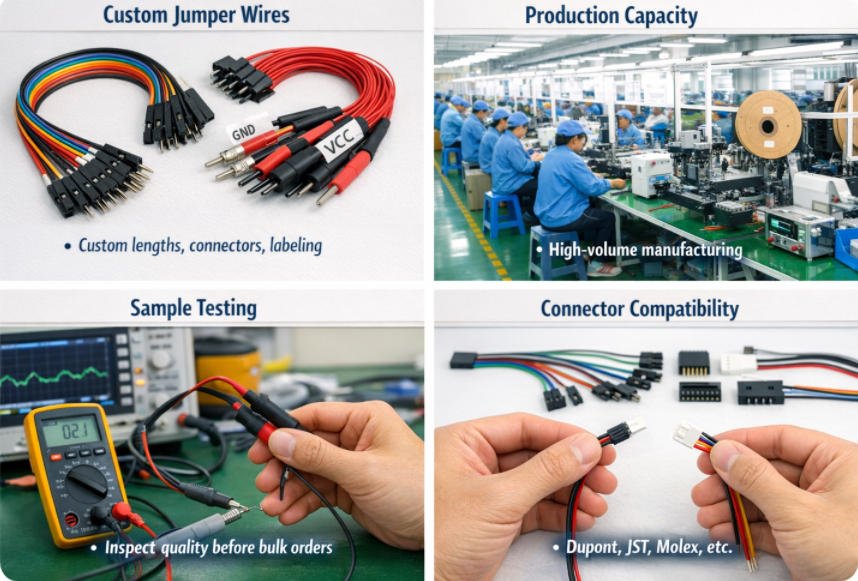
When I’m working on a project, I often find that standard jumper wire kits don’t meet all my needs. That’s why I always ask suppliers if they provide custom jumper wire solutions. Customization allows me to specify exact lengths, color coding, connector types, heat-shrink sleeves, and labeling, ensuring that the wires fit perfectly into my design.
Custom solutions are particularly important when projects involve complex assemblies or high-density layouts. Instead of spending extra time trimming, bundling, or labeling standard wires, I can get wires that are ready to install right out of the box.
Using customized jumper wires also improves assembly efficiency and reliability. Every wire is precisely matched to the application, which reduces errors, prevents connection issues, and simplifies maintenance. For me, working with a supplier that offers tailored solutions is essential for both professional-grade results and time savings.
Custom Lengths, Color Coding, Connectors, Heat-Shrink, and Labeling
A strong supplier should be able to tailor jumper wires to your exact specifications, including:
- Custom lengths to eliminate clutter and improve cable management
- Color coding for easier identification and faster troubleshooting
- Custom connectors such as Dupont, JST, Molex, IDC, or specialized terminals
- Heat-shrink tubing for insulation, strain relief, or environmental protection
- Labeling or numbering for traceability, assembly efficiency, and maintenance
- These customization options make a big difference in both usability and long-term reliability.
When Custom Solutions Are Better Than Standard Kits
Standard jumper wire kits are fine for basic experiments, but they fall short in professional or production environments. You should choose custom jumper wires when:
- Your layout requires specific lengths to avoid excess slack
- You need consistent quality across hundreds or thousands of units
- Your connectors must match specific PCB headers, modules, or sensors
- The wires operate in harsh environments (high temp, vibration, chemicals)
- You want to reduce manual assembly time and wiring errors
Question 5: What Is Your Production Capacity and Lead Time?
Production capacity matters differently depending on the project. For large-volume orders or OEM manufacturing, I need a supplier who can scale up without delays or quality issues. For fast prototyping, I look for suppliers who can turn around samples quickly so I can continue development without interruptions. Lead time is a major factor in keeping both R&D and production schedules on track.
To evaluate supplier stability and scalability, I always ask about their workforce size, equipment, facility capacity, and workflow management. A stable supplier should be able to maintain consistent output, support repeat orders, and handle growth without compromising quality. If their capacity fluctuates or they cannot give clear timelines, it’s usually a sign to be cautious.
Another key question I ask is whether the manufacturer handles production in-house or outsources parts of the process. In-house manufacturing typically means better quality control, faster communication, and more reliable delivery times. Outsourcing, especially without transparency, can lead to inconsistencies, delays, or unclear accountability.
Question 6: Can You Provide Samples Before Bulk Orders?
Before committing to a large order, I always ask suppliers if they can provide sample units. Sampling is a simple but essential step that protects me from potential quality issues. By testing a few wires upfront, I can verify that the materials, connectors, insulation, and overall construction meet my project’s specifications.
When evaluating sample units, I check several key factors. I examine conductor quality, ensuring continuity and proper resistance. I inspect insulation and connectors for durability, fit, and flexibility. I also test the wires under the expected voltage, current, and environmental conditions to ensure they will perform reliably in the actual application.
A supplier who is willing to provide prototype support demonstrates confidence in their quality and flexibility. For me, this step is invaluable it helps catch potential problems early and ensures that the full production run will meet expectations without costly surprises.
Question 7: How Do You Ensure Connector Compatibility?
Even if your jumper wires use high-quality materials and pass strict testing, they still will not perform well if the connectors do not match your devices. Connector compatibility is one of the most important questions to ask your supplier. A mismatch in pin pitch, terminal type, or housing style can lead to poor connections, equipment failures, or unnecessary redesigns. These problems are completely avoidable when you verify compatibility from the start.How Do You Ensure Connector Compatibility?
How Do You Ensure Connector Compatibility?
1.Matching Pin Pitch (2.54 mm, 2.0 mm, 1.27 mm)
The first detail to confirm with your supplier is the pin pitch. This is the spacing between pins or holes on a PCB or module.
Common standards include:
- 2.54 mm: the standard pitch for breadboards, Arduino, Raspberry Pi, and many electronic modules
- 2.0 mm: often used in compact consumer products and battery connectors
- 1.27 mm: used for high-density and miniaturized electronic designs
If the supplier does not verify the pitch, the jumper wire connectors may not fit your hardware correctly, which can cause loose connections or force changes to your design.
2.Choosing the Right Terminal Type (Dupont, JST, Molex, IDC, etc.)
The next step is to confirm the correct terminal and connector style. Different applications require different standards.
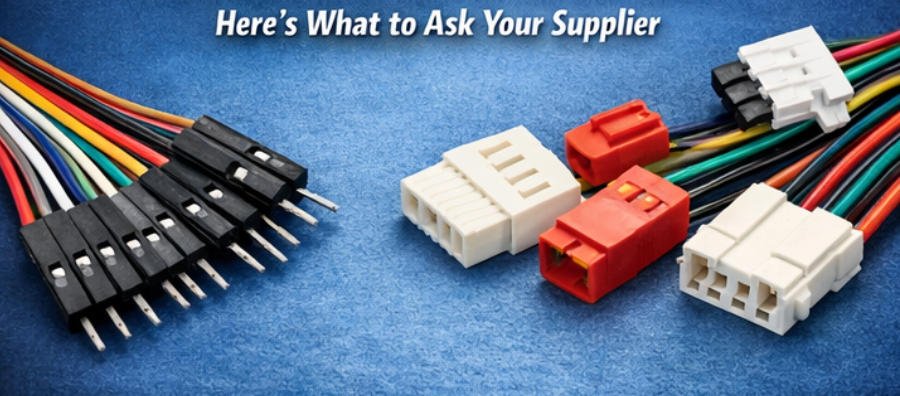
- Dupont connectors: suitable for prototyping and low-current signals
- JST connectors: popular for sensors, batteries, and compact electronics
- Molex connectors: strong and reliable for industrial or automotive use
- IDC connectors: ideal for multi-pin ribbon cable connections
- Custom crimp terminals: required for many OEM or specialized modules
A knowledgeable supplier should help you select the correct terminal based on your current load, voltage, locking mechanism, and environmental requirements.
3.Problems Caused by Incompatible Connectors
Using the wrong connector type can create multiple issues, including:
- Intermittent or unstable electrical contact
- Difficulty inserting or removing connectors
- Incorrect wiring or polarity errors
- Overheating caused by poor contact resistance
- Mechanical stress that damages pins or housings
- Delays in assembly because connectors must be modified or replaced
These problems can weaken your final product and increase failure rates. A reliable supplier ensures connector compatibility in the design stage, preventing issues before they happen.
Question 8: What Industries Do You Serve?
Industry experience matters because each sector has strict expectations for reliability, durability, and safety. For example, in the automotive industry, jumper wires must withstand vibration, temperature swings, and long-term mechanical stress. In the medical field, the focus shifts to precision, clean manufacturing, and stable, interference-free performance. For industrial equipment, I look for suppliers who understand high-current loads, harsh environments, and the need for consistent quality. Even in consumer electronics, experience ensures the wires fit compact designs and maintain stable connectivity.
A supplier with proven experience in these industries brings industry-specific knowledge that improves overall product reliability. They understand which materials perform best under certain conditions, which connectors are industry standards, and which certifications are mandatory. This expertise reduces risk during development and ensures the final jumper wire solution is both compliant and dependable.
That’s why I always check their industry background. The more aligned they are with my application, the more confidence I have in the quality of their jumper wires.
Question 9: Engineering Support and Communication
Once I’ve narrowed down potential suppliers based on certifications, materials, and testing, the next thing I evaluate is their engineering support and communication. Even high-quality wires can run into problems if design issues, technical questions, or last-minute changes aren’t handled effectively. Strong technical support from a supplier can save time, reduce risk, and make the entire development process much smoother.
When I assess a supplier, I ask questions like:
- “Do you have an engineering team that can review my drawings and suggest improvements?”
- “How do you handle design changes or technical issues during the project?”
- “Will I have a dedicated contact person for my account?”
Suppliers who provide clear, proactive support make a big difference. In my experience, having direct access to an engineering team and a dedicated contact ensures that any potential problems are caught early. This level of technical communication reduces mistakes, speeds up development, and ensures that the jumper wires meet the project’s specifications without surprises.
Question 10: Bonus: Questions That Reveal Supplier Reliability
After covering certifications, materials, testing, and engineering support, I always like to ask a few bonus questions to gauge the supplier’s reliability. Even high-quality products can fall short if the supplier lacks transparency, traceability, or accountability.
Some of the questions I ask include:
- “Can I visit your factory or see production photos?” Seeing the production process firsthand, or at least through verified images, gives me confidence in the manufacturing setup, equipment, and quality control practices.
- “Do you maintain traceability for materials and batches?” Traceability ensures that if any issue arises, I can track and verify the source of each component, which is essential for safety and regulatory compliance.
- “What is your quality warranty policy?” A clear warranty policy shows that the supplier stands behind their products and is committed to resolving defects or failures.
By asking these questions, I can distinguish suppliers who are genuinely reliable from those who may cut corners. This step helps me select a partner that I can trust for consistent, high-quality jumper wires for all my projects.
Conclusion
Over the years, I’ve learned that smart buyers ask smart questions. Jumper wires may seem like a small component, but their quality has a direct impact on performance, safety, and long-term reliability. Asking the right questions upfront helps avoid hidden risks and costly problems later.
That’s why I always encourage readers to evaluate suppliers carefully, not just based on price, but on materials, certifications, testing processes, and real manufacturing capability. A reliable supplier should be transparent, experienced, and able to support both standard and custom requirements.
If you’re looking for high-quality, certified, and custom jumper wires, I strongly recommend reaching out to Yihetai. With over 23 years of experience, full certifications including ISO 9001, UL, and IATF 16949, and strong OEM and ODM capabilities, Yihetai is well equipped to support your project from concept to production.
Read more: Looking for High-Quality Jumper Wires Here’s What to Ask Your Supplier?Related Blog:
- Choosing the Right JST Cable Assembly for Your Application: A Complete Guide
- How to Prevent Common JST Cable Assembly Failures in Your Product Design
- JST vs. Other Connector Types: What Makes JST Cable Assemblies So Popular?
- What Are JST Cable Assemblies and Why Are They Essential in Modern Electronics?
- How to Design a Custom Wire Harness for Harsh Environments?