
Finding a reliable LCD display cable manufacturer sounds simple at first, but I quickly realize it is much harder than it looks. Many suppliers appear professional on the surface, with similar websites, product photos, and promises. However, once I begin comparing them, it becomes difficult to tell who truly has manufacturing capability and who may create risks for my project.
The real concern appears when things go wrong. Choosing the wrong LCD display cable manufacturer can result in unstable signal performance, inconsistent quality, delayed deliveries, and repeated design changes. Relying on price alone often leads to even bigger problems, such as hidden costs, poor reliability, and long term supply issues. As an OEM, I also face challenges with limited customization options, unclear quality standards, and weak technical communication.
That is why this guide is important. It will help me find, evaluate, and select the right manufacturing partner with confidence.
To find a truly reliable LCD display cable manufacturer, I’ve learned that random searching and price comparisons simply don’t work. What does work is following a clear, step-by-step process that reduces risk and leads to better decisions. In this article, I break the entire sourcing journey into five practical stages. First, it starts with clearly defining your technical and application requirements before you search. Second, it’s about knowing where to find qualified manufacturers and how to quickly screen them. Third, you need proven methods to verify reliability through audits, questions, samples, and trial orders. Fourth, careful comparison helps you avoid common buyer mistakes and choose based on long-term value, not just cost. Finally, the goal is to build a stable, long-term partnership with a manufacturer who understands your application, communicates well, and grows with your business. The following 10 steps will walk you through this process in detail, from first search to final decision.
- Step One: Clearly Define What You Need Before You Start Searching
- Step Two: Where to Find Reliable LCD Display Cable Manufacturers
- Step Three: How to Quickly Screen Manufacturers You Find
- Step Four: How to Verify a Manufacturer Is Truly Reliable
- Step Five: How to Compare Shortlisted LCD Cable Manufacturers
- Step Six: How to Communicate With Potential Manufacturers
- Step Seven: Questions You Should Always Ask Before Making a Decision
- Step Eight: Sample, Prototype, and Trial Order Evaluation With Potential Manufacturers
- Step Nine: Common Mistakes Buyers Make When Looking for LCD Cable Manufacturers
- Step Ten: How to Build a Long-Term Partnership With the Right Manufacturer
Step One: Clearly Define What You Need Before You Start Searching
Before I start contacting any LCD display cable manufacturer, I have learned that the most important work happens internally. Many sourcing problems do not come from poor suppliers, but from unclear requirements at the beginning. If I cannot clearly explain what I need, even the best manufacturer will struggle to provide the right solution. Defining my requirements upfront allows me to communicate efficiently, avoid misunderstandings, and quickly identify manufacturers who are truly capable of supporting my project.
What Type of LCD Display Cable Do I Need?
The first question I ask myself is what type of LCD display cable my application requires. Common options include LVDS cables for stable signal transmission, eDP cables for higher data rates, IPEX or micro-coax assemblies for compact designs, FPC cables for space-constrained layouts, or fully customized wire harnesses for complex systems. Knowing the exact cable type immediately narrows my supplier search to manufacturers with relevant experience.
Key Specifications I Need to Prepare
Next, I prepare detailed technical specifications. This includes connector type and brand, pin count, pitch, cable length, shielding requirements, and any locking or strain relief features. I also consider the application environment, such as operating temperature, vibration levels, and EMI sensitivity. These details help manufacturers evaluate feasibility and provide accurate quotations instead of assumptions.
Why Clear Requirements Save Time and Cost
When my requirements are clear, manufacturers can respond faster, quote more accurately, and propose better technical solutions. This reduces back-and-forth communication, avoids costly redesigns, and prevents delays later in production. Most importantly, it helps me quickly eliminate unsuitable suppliers and focus only on manufacturers who truly match my needs.
Step Two: Where to Find Reliable LCD Display Cable Manufacturers
Once I clearly understand what I need, the next challenge is knowing where to look. Not all suppliers appear in the same places, and not every channel offers the same level of reliability. From my experience, finding a trustworthy LCD display cable manufacturer requires using the right sourcing channels and knowing how to evaluate what I see. This step is critical because it determines the quality of suppliers that enter my shortlist from the very beginning.
1.Search Engines (Google and Bing)
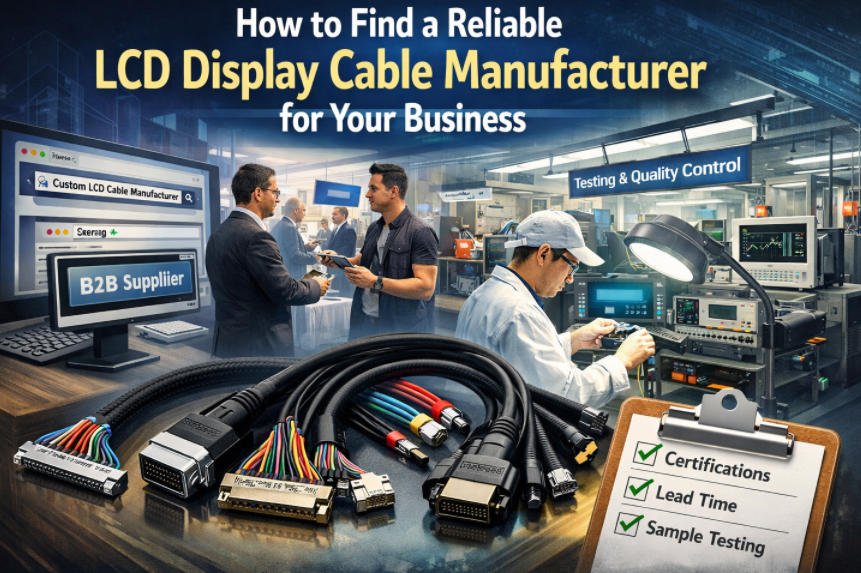
Search engines are often my first stop, but the key is using specific keywords instead of generic terms. Searching for phrases like “custom LCD display cable manufacturer,” “LVDS cable assembly factory,” or “OEM LCD cable supplier” helps me reach manufacturers with real production capabilities rather than resellers. When reviewing results, I look for detailed technical content, real product photos, factory information, and evidence of customization. Manufacturers usually show depth, while traders focus on broad product listings with little technical detail.
2.B2B Platforms (With Caution)
Platforms such as Alibaba, Made in China, and Global Sources can be useful, but I approach them carefully. I pay close attention to factory verification, business licenses, years of operation, and whether the supplier shows real production equipment and testing processes. Warning signs include vague company profiles, overly broad product categories, and an inability to answer technical questions clearly. These are often indicators of trading companies rather than true manufacturers.
3.Industry Exhibitions and Trade Shows
Industry exhibitions are extremely valuable because they allow me to meet manufacturers face to face. In a short conversation, I can ask about cable types, customization experience, testing methods, and production capacity. By discussing technical details directly, I can quickly judge whether a supplier truly understands LCD display cable applications or is simply repeating sales language.
4.Referrals From Existing Suppliers or Engineers
Referrals from engineers, system integrators, or existing suppliers are one of the most reliable sourcing methods. These recommendations usually come from real project experience, which significantly reduces supplier risk. Referrals also save evaluation time because the manufacturer has already proven its capability in a similar application.
Using these channels together gives me a stronger, more reliable starting point for selecting the right LCD display cable manufacturing partner.
Step Three: How to Quickly Screen Manufacturers You Find
After identifying several potential LCD display cable manufacturers, I know that not all of them deserve a formal RFQ. Sending drawings and specifications to the wrong suppliers wastes time and often leads to misleading quotations. That is why I always perform a quick screening first. This step helps me eliminate unsuitable manufacturers early and focus only on those who are worth deeper evaluation.
Check the Depth of the Company Website
The first thing I review is the company website. I look for technical content rather than pure marketing language. A reliable manufacturer usually provides clear product categories, cable types, connector details, application examples, and quality or testing information. Websites that are overly generic, vague, or focused only on low prices often indicate limited technical capability.
Look for Real Products and Production Evidence
Next, I check whether the manufacturer shows real product photos, production lines, and testing equipment. Images of wire processing, crimping, assembly, and electrical testing give me confidence that the factory is actually producing LCD display cables in house rather than outsourcing or trading.
Verify Experience and Industries Served
I also verify how long the company has been in business and which industries they serve. Experience in industrial, medical, automotive, or display related applications usually means higher quality standards and better process control.
Confirm Custom Design Capability
Finally, I confirm whether the manufacturer supports custom designs. A reliable partner should be able to handle custom connectors, pinouts, lengths, shielding, and special requirements, not just standard off the shelf cables.
Step Four: How to Verify a Manufacturer Is Truly Reliable
1.Manufacturing Capabilities
The first thing I verify is whether the manufacturer has real in house cable processing capabilities or relies heavily on outsourcing. In house production usually means better quality control, shorter lead times, and faster problem solving. I also evaluate whether they can handle complex LCD cable assemblies, including fine pitch connectors, shielding, and customized layouts. Flexibility is critical, so I look for engineering support and a willingness to adapt designs when requirements change.
2.Quality Systems and Certifications
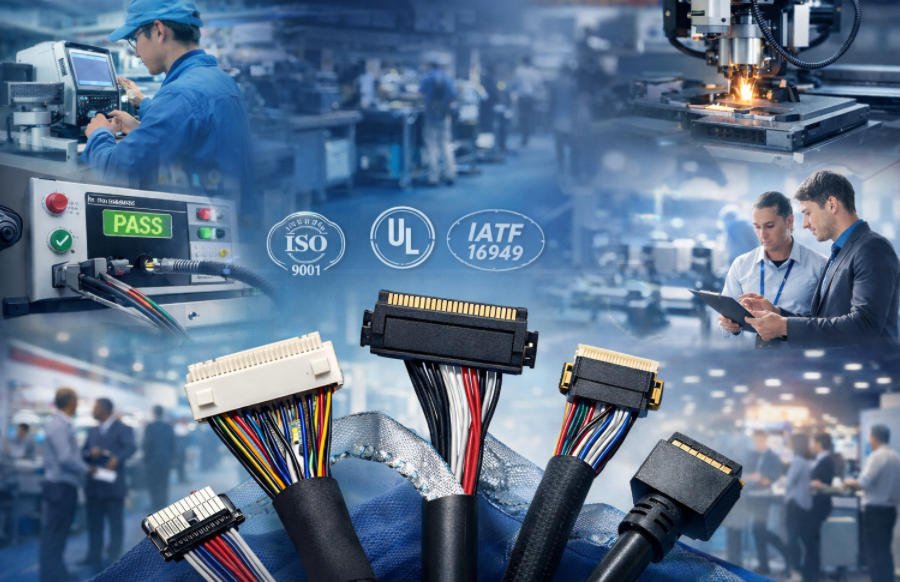
Next, I review quality systems and certifications such as ISO 9001, IATF 16949, UL, or other relevant approvals. These certifications matter because they reflect standardized processes, traceability, and continuous improvement. Missing, outdated, or unclear certifications are major warning signs and often indicate inconsistent quality management.
3.Testing and Quality Control Processes
Finally, I examine testing and inspection procedures. Reliable manufacturers perform electrical testing such as continuity, impedance, and high voltage tests, along with visual and mechanical inspections. Full testing on every cable provides far more confidence than sample only testing, especially for critical LCD display applications.
Step Five: How to Compare Shortlisted LCD Cable Manufacturers
Once I have a shortlist of qualified LCD display cable manufacturers, the real decision making begins. At this stage, the goal is not to find the cheapest option, but to identify the supplier that offers the best overall value and long term reliability. A structured comparison helps me avoid emotional decisions and ensures I choose a partner that truly fits my business needs.
Compare More Than Just Unit Price
Price is important, but I never evaluate manufacturers based on unit cost alone. I look at total cost, including quality consistency, risk of rework, and potential delays. A slightly higher price often delivers better stability and fewer problems over time.
Lead Time, MOQ, and Response Speed
I carefully compare lead times, minimum order quantities, and how quickly each manufacturer responds to questions. Fast and clear responses usually indicate good internal coordination and strong customer focus, which are critical during development and production.
Engineering Communication and Technical Understanding
I pay close attention to how well the engineering team understands my application. Manufacturers who ask relevant technical questions and offer suggestions show real expertise and problem solving ability.
Willingness to Support Long Term Cooperation
Finally, I evaluate whether the manufacturer is interested in long term cooperation or only a single order. A reliable partner is willing to grow with my business and support future needs, not just today’s requirement.
Step Six: How to Communicate With Potential Manufacturers
Once I have narrowed down my shortlist, communication becomes a critical test. The way a manufacturer responds to my first inquiry often tells me more than any website or brochure. Clear, professional communication helps prevent misunderstandings, speeds up evaluation, and reveals whether a supplier has the technical depth to support my project.
What Information to Send in My First Inquiry
In my first inquiry, I make sure to share clear and structured information. This usually includes the cable type, basic drawings or specifications, connector details, expected quantity, application environment, and target timeline. Providing complete information allows the manufacturer to evaluate feasibility quickly and respond with meaningful technical feedback rather than generic answers.
Professional Responses vs Unreliable Ones
A professional manufacturer responds with specific questions, technical confirmation, and realistic lead times. They acknowledge requirements clearly and explain what is possible or needs clarification. In contrast, unreliable suppliers often reply with vague promises, immediate pricing without review, or limited technical discussion, which raises concerns about their capability.
Signs of Strong Engineering and Technical Support
Strong manufacturers involve engineering early. I look for responses that include technical suggestions, potential risks, and alternative solutions. This level of engagement shows real understanding and a willingness to support my application, not just process an order.
Step Seven: Questions You Should Always Ask Before Making a Decision
Before I make a final decision, I always remind myself that asking the right questions is just as important as reviewing prices and samples. These questions help me confirm whether a manufacturer can truly support my project over the long term, not just deliver an initial order. Clear answers reveal real capability, transparency, and reliability.
Can You Support Custom LCD Cable Designs From Drawing to Production?
I always ask whether the manufacturer can support custom LCD cable designs from the drawing stage through mass production. A reliable partner should be able to review drawings, suggest design improvements, and manage tooling, prototyping, and production internally. This shows strong engineering capability and reduces development risk.
What Testing Is Performed on Every Cable?
Testing is critical for LCD display cables, so I ask exactly what tests are performed on every cable. This may include continuity testing, impedance checks, high voltage testing, and visual inspection. Full testing provides far more confidence than sample only checks.
How Do You Handle Quality Issues and Corrective Actions?
No supplier is perfect, so I want to understand how quality issues are handled. A trustworthy manufacturer should have a clear corrective action process, root cause analysis, and preventive measures to avoid repeat problems.
Can You Scale Production if Demand Increases?
Finally, I ask whether the manufacturer can scale production as my business grows. The ability to increase capacity without sacrificing quality is essential for long term cooperation and supply stability.
Step Eight: Sample, Prototype, and Trial Order Evaluation With Potential Manufacturers
Before committing to mass production, I rely heavily on samples, prototypes, and trial orders. This stage is where a manufacturer’s real capabilities become visible. A supplier may sound professional during discussions, but only a physical sample can confirm whether their LCD display cable truly meets my technical and quality requirements. Skipping this step often leads to costly mistakes later.
Why Samples Are Critical for LCD Display Cables
LCD display cables are sensitive components where small issues can cause serious performance problems. Samples allow me to verify signal stability, compatibility, and overall build quality before moving forward. They also help confirm that the manufacturer fully understands my design intent.
What I Check During Sample Testing
During testing, I focus first on signal performance to ensure stable data transmission without noise or interference. I then examine assembly quality, including crimping consistency, shielding, and cable routing. Connector fit is also critical, so I check mating accuracy, locking strength, and strain relief to ensure long term durability.
Moving From Sample Approval to Trial Production
Once samples are approved, I move to a small trial order. This step helps validate production consistency, lead time, and quality control processes before scaling up to full production.
Step Nine: Common Mistakes Buyers Make When Looking for LCD Cable Manufacturers
As I go through the sourcing process, I realize that many problems are not caused by suppliers themselves, but by common mistakes buyers make early on. Learning from these mistakes helps me avoid unnecessary risks and make smarter, more confident decisions when choosing an LCD cable manufacturer.
Choosing the Cheapest Supplier Without Technical Evaluation
One of the most common mistakes is selecting the lowest priced supplier without proper technical evaluation. A low price often hides poor signal performance, weak assembly quality, or inconsistent materials. These issues usually lead to higher costs later through rework, delays, or product failures.
Relying Only on Online Platforms
Another mistake is relying solely on online platforms to judge a manufacturer. While these platforms are useful for initial sourcing, they rarely provide a complete picture of real manufacturing capability. Without deeper verification, it is easy to mistake traders for true manufacturers.
Ignoring Communication Efficiency and After Sales Support
Poor communication is often overlooked at the beginning, but it becomes a serious problem during development and production. Slow responses, unclear answers, and weak after sales support can quickly disrupt a project.
Not Verifying Factory Capability Early
Finally, failing to verify factory capability early can result in major surprises later. Confirming production processes, testing methods, and engineering support upfront saves time, cost, and frustration in the long run.
Step Ten: How to Build a Long-Term Partnership With the Right Manufacturer
After evaluating samples, trial orders, and performance, I realize that the real value begins after the supplier selection. The goal is not just to place orders, but to build a long term partnership with a manufacturer I can rely on as my business grows. A strong partnership creates stability, efficiency, and competitive advantage over time.
Benefits of Working With One Reliable Cable Partner
By working with one reliable LCD display cable manufacturer, I reduce sourcing risk, simplify communication, and maintain consistent quality. A long term partner understands my standards, processes, and expectations, which leads to fewer errors and faster execution.
Continuous Improvement and Cost Optimization
A trusted manufacturer actively supports continuous improvement. Through design optimization, process refinement, and material selection, I can achieve cost reductions without sacrificing performance or reliability.
Support for Future Product Upgrades and New Projects
Most importantly, a long term partner supports future product upgrades and new developments. With shared knowledge and proven collaboration, new projects move faster and with greater confidence, creating sustainable growth for both sides.
Conclusion
In the end, finding a reliable LCD display cable manufacturer requires a smarter and more intentional approach. I have learned that the best results come from knowing where to look and how to evaluate manufacturers beyond surface level promises. Search engines, industry platforms, trade shows, and referrals all play a role, but real confidence comes from carefully reviewing manufacturing capability, quality systems, customization support, and communication.
By focusing on these factors, I can make sourcing decisions with clarity instead of uncertainty. My final advice is to avoid rushing and never rely on price alone. A dependable manufacturer should support my application requirements, long term plans, and quality expectations, not just deliver a single batch of cables.
That is why I choose to work with a manufacturer like Yihetai, who understands real applications, engineering challenges, and long term partnership value, not just the order itself.