
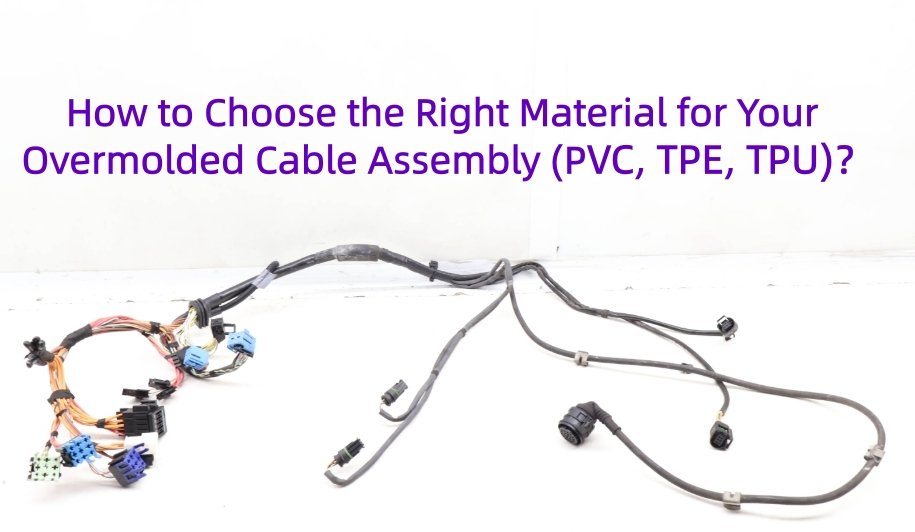
Overmolded cable assemblies look simple from the outside, just a cable with a clean molded “boot” at the connector, but in our factory I’ve seen they’re often the first place a product fails. The overmold is the interface between your connector and cable. It provides strain relief, improves handling, and can add sealing against dust or moisture.
The problem is this: many teams treat the overmold material as a cosmetic choice. Then cables start cracking in cold warehouses, turning sticky after months in a handheld device, or slipping because the resin doesn’t bond well with the jacket. That’s when field returns get expensive and troubleshooting becomes painful.
The good news is you can prevent most of these issues by choosing the right material from the start. In this article, I’ll break down the three most common options, PVC, TPE, and TPU, and show you how to match them to your environment, flex life, chemical exposure, and durability requirements.
What is Overmolding in Cable Assemblies?
Before we dive into choosing the right material like PVC, TPE, or TPU for your overmolded cable assembly, it’s important to understand what overmolding is and why it’s a critical part of cable design. Overmolding isn’t just for appearance. It serves key engineering functions that protect the integrity and performance of the cable, especially in demanding environments. Let me explain what overmolding does and why it matters.
What is Overmolding in Cable Assemblies?
Overmolding is the process of applying a thermoplastic material, such as PVC, TPE, or TPU, over a cable and connector junction using injection molding. This molded layer enhances the mechanical strength, durability, and environmental resistance of the assembly. Here’s how it works in practical terms:
1.Strain Relief and Bend Radius Control
The overmold reinforces the area where the cable exits the connector. This prevents sharp bends and supports a controlled bend radius, which reduces stress on internal conductors. It is essential for applications where cables experience frequent movement, helping to prevent wire fatigue and breakage over time.
2.Sealing Against Dust and Moisture
Overmolding provides a physical seal that protects the connector from environmental exposure. While not always fully waterproof, it offers splash resistance and blocks dust, which is crucial in automotive, industrial, and outdoor applications.
3.Connector and Cable Reinforcement
The overmold adds mechanical support around the connector, reducing the risk of latch breakage or cracks in the housing. This is especially important for connectors that are frequently plugged and unplugged or exposed to impact.
4.EMI and ESD Design Considerations
For cables that require shielding, the geometry of the overmold can affect how well the shielding terminates. Poorly designed overmolds may interfere with grounding or cause unwanted interference. In some cases, overmolding can be optimized to improve electrostatic discharge protection as well.
Factory Insight: Experience is Key
From my experience on the production side, I’ve seen that the success of overmolding depends not just on materials, but on design, tooling, and process control. Even the right material can fail if not applied correctly. That’s why working with an experienced manufacturer like Yihetai makes a big difference in long-term reliability.
7 Key Factors That Should Drive Material Selection For Your Overmolded Cable Assembly
Once you understand what overmolding does, the next critical step is choosing the right material to ensure your cable assembly performs as expected in its real-world environment. The truth is, there’s no one-size-fits-all solution. Whether you’re considering PVC for its cost-efficiency, TPE for flexibility, or TPU for rugged durability, your decision should be based on a clear understanding of performance requirements. Here are 7 essential engineering factors I always recommend evaluating before making that choice:
1.Temperature Range (Operating and Storage)
Material behavior changes drastically at extreme temperatures. In cold environments, cold flexibility is key since some materials stiffen or crack, especially PVC. In hot zones such as near motors or power supplies, heat aging and softening can compromise mechanical stability. TPE and TPU often outperform PVC in both low and high temperature extremes.
2.Flex Life and Strain Relief Performance
If your cable is subject to repeated motion, such as in robotics, wearables, or medical equipment, flex life matters. TPU typically offers excellent flex fatigue resistance. However, geometry is just as important as material. Taper length, wall thickness, and molding design can greatly influence how well the overmold absorbs stress and protects the cable.
3.Chemical and Oil Resistance
Exposure to oils, fuels, cleaning agents, or even skin oils can degrade some materials over time. PVC is particularly vulnerable to plasticizer migration and swelling in oily or harsh environments. For applications involving solvents, disinfectants, or lubricants, TPU is usually the safest choice, followed by TPE.
4.Abrasion, Cut, and Tear Resistance
In environments where cables are dragged, flexed, or exposed to sharp edges such as drag chains, robotics arms, or floor contact, you will need high mechanical toughness. TPU is highly recommended for these applications because of its superior abrasion and tear resistance.
5.Required Hardness, Grip, and Feel (Shore A or D)
Ergonomic considerations matter, especially in handheld or consumer products. TPE provides a soft-touch feel for better grip, while harder materials like rigid PVC or TPU offer more structure and support. If texture, anti-slip features, or logo imprinting are needed, the moldability and hardness of the material become key factors.
6.Compliance Needs (Industry and Region)
From UL flammability ratings to RoHS and REACH environmental regulations, compliance can vary widely depending on the market. In automotive applications, PPAP documentation may be required. In medical products, biocompatibility and sterilization compatibility are critical. TPE and medical-grade TPU are often better suited than PVC for regulated environments.
7.Adhesion Compatibility (The Number One Hidden Risk)
This is one of the most overlooked factors. The overmold must bond or mechanically lock to both the cable jacket (such as PVC, TPE, TPU, or PE) and the connector housing (such as Nylon, PBT, PC, or ABS). I’ve seen many assemblies that look perfect but fail basic pull tests simply because adhesion compatibility was not tested during development. Always verify adhesion through testing early in the design process.
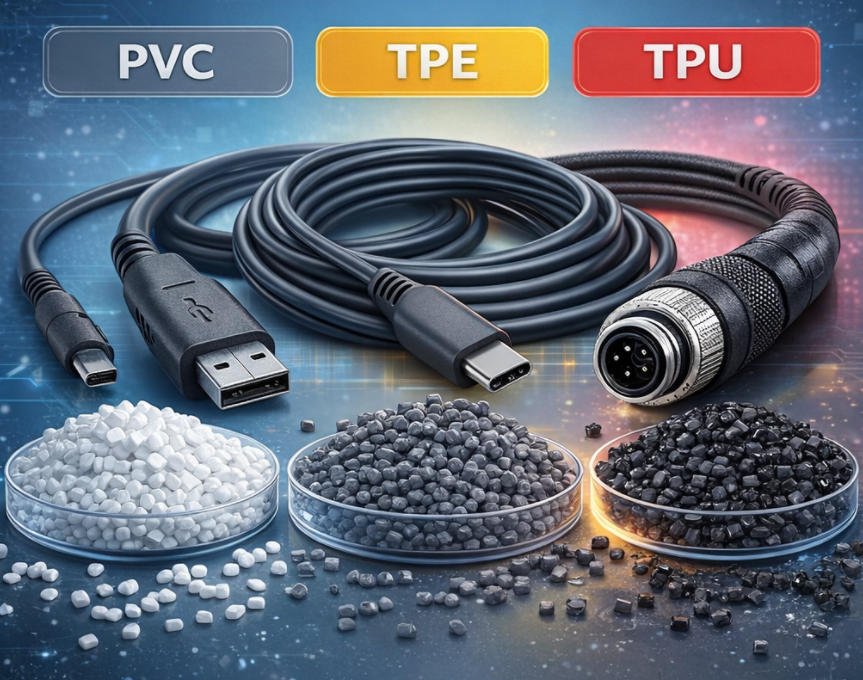
PVC vs TPE vs TPU Material Comparison
With so many performance variables to consider, it’s helpful to see how PVC, TPE, and TPU stack up side-by-side. Each material has its own strengths and trade-offs, and the best choice depends on your cable’s application, operating environment, and cost targets. Below is a quick comparison based on the most critical selection factors I use when helping customers at Yihetai design custom overmolded assemblies.
| Property | PVC | TPE | TPU |
| Temperature Flexibility (Especially Cold) | Poor to fair (stiff in cold, risk of cracking) | Good cold flexibility | Excellent low-temp flexibility, no cracking |
| Abrasion / Tear Resistance | Low | Moderate | High (ideal for rugged use) |
| Oil / Chemical Resistance | Poor to fair (prone to swelling or tackiness) | Moderate (better than PVC) | Excellent (resists oils, fuels, disinfectants) |
| UV / Weathering Resistance | Poor (indoor use preferred) | Good (some grades for outdoor) | Excellent (best for outdoor, harsh conditions) |
| Processing Window & Cosmetic Stability | Easy to mold, low cost | Moderate, soft-touch finish | More complex molding, highly stable finish |
| Adhesion to Jackets / Housings | Limited (needs primers or mechanical lock) | Moderate (depends on substrate) | Good chemical bonding with many plastics |
| Typical Cost Trend (Relative) | Lowest | Mid-range | Highest |
| Typical Applications | Low-cost USB cables, basic DC cords, indoor consumer products | Handheld devices, soft-grip connectors, light industrial | Robotics, M12 connectors, automotive sensors, scanner cables, outdoor & high-abuse environments |
What Applications Do We Recommend?
Now that we’ve explored how different materials perform across technical and environmental factors, the final step is to match the right material to the right application. Whether you’re developing a high-volume consumer cable or a rugged industrial assembly, aligning your overmold material with your usage environment ensures better reliability, compliance, and product lifespan. Here are the material choices I typically recommend based on industry and application type:
1.Consumer Electronics (USB / Type-C / DC Cords)
Typical recommendation: PVC or TPE
In consumer electronics, the priority is usually appearance + cost + decent strain relief, not extreme chemical or abrasion resistance.
Why PVC often works
- Cost-effective for high-volume programs
- Stable processing and consistent cosmetics (gloss, color matching, clean edges)
- Good for basic pull strength and everyday indoor use
Why TPE is often chosen instead
- Better “soft-touch” feel and flexibility for handheld use
- Often performs better when users constantly bend the cable near the connector
What I watch for: connector exit cracking from short strain relief geometry, and surface tackiness if the product sits in warm storage (material grade matters).
2.Industrial Automation / Drag Chain / Robotics
Typical recommendation: TPU (or engineered TPE grades in some cases)
This is where overmolds get punished: continuous flex cycles, abrasion, oil mist, vibration, and sharp routing.
Why TPU is usually my first choice
- Excellent abrasion and tear resistance
- Strong toughness under repeated bending
- Generally good performance in oily environments (verify exact chemicals)
When engineered TPE can work
- When the application needs a softer feel but still requires durability
- When processing or bonding requirements favor a specific TPE grade
What I watch for: knit lines and stress points at the cable exit (design + gate location matter), and adhesion/retention after flex + oil exposure.
3.Medical Devices & Patient-Contact Cables
Typical recommendation: Medical-grade PVC or medical-grade TPE (depending on cleaning/sterilization)
Medical cables fail less from “pull strength” and more from cleaning protocols and user handling.
Why medical-grade PVC is still common
- Proven history in medical environments (grade selection is critical)
- Can balance flexibility, appearance, and cost
- Consistent molding and stable production control
Why medical-grade TPE is attractive
- Comfortable skin feel and flexibility
- Often better user experience for patient-contact or handheld devices
What I watch for: resistance to disinfectants/alcohol wipes, color stability, and maintaining a consistent surface that doesn’t become sticky or micro-crack over time.
4.Automotive / E-Mobility / Charging Related Assemblies
Typical recommendation: TPU or carefully specified TPE/PVC (application-dependent)
Automotive and e-mobility introduce the hardest mix: temperature cycling, fluids, vibration, long service life, and higher documentation expectations.
Key focus areas:
- Temperature range (including cold start and hot soak)
- Fluid exposure (oils, coolants, road chemicals)
- Vibration + long-term fatigue at the connector exit
- Consistency and traceability during mass production
What I watch for: not just the resin choice, but long-term retention pull/torque after heat aging, and flex testing at temperature extremes.
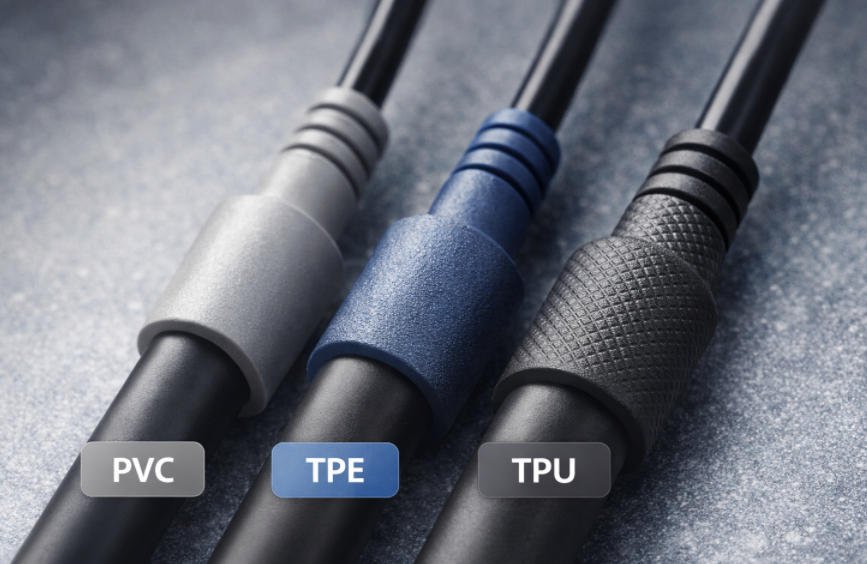
A Real Case Where We Chose the Wrong Material
- Failure #1 — Overmold cracking in cold environments
- Root causes: wrong polymer choice, too high hardness, sharp transition geometry
- Failure #2 — Sticky surface or discoloration after aging
- Typical with some PVC formulations (plasticizer migration) + heat exposure
- Failure #3 — Tear at the cable exit after repeated bending
- Often TPU/TPE geometry issue (strain relief too short), or poor gate design causing knit lines
- Failure #4 — Overmold slipping/rotating on the cable
- Adhesion not validated; jacket material mismatch; missing mechanical locks
- Failure #5 — Seal failure (customers assumed “waterproof”)
- Overmold alone isn’t IP-rated without design features + validation
How to Design the Overmold So the Material Can Succeed
Even with access to quality materials like PVC, TPE, and TPU, I’ve seen firsthand that using the wrong one can lead to serious product issues. Many failures happen not because of poor material, but because the chosen material did not match the application, environment, or design. To help you avoid these costly mistakes, here are some real cases where material selection or design choices led to failure, and what we learned from each one.
A Real Case Where We Chose the Wrong Material
Failure 1: Overmold Cracking in Cold Environments
We once selected a hard material for an outdoor cable without fully considering cold weather conditions. As temperatures dropped, the overmold cracked near the connector. The polymer was too rigid in cold environments, and the design had a sharp transition that caused stress concentration.
Lesson learned: Always verify low-temperature performance. For cold environments, flexible materials like TPE or TPU combined with a smooth transition design are more reliable.
Failure 2: Sticky Surface or Discoloration After Aging
A project used cost-sensitive PVC near a power source. After a few months, the surface became sticky and discolored. This was caused by plasticizer migration and long-term heat exposure, which are common with certain PVC grades.
Lesson learned: Use high-quality, heat-resistant PVC or consider switching to TPE or TPU when cosmetic stability and longevity are important.
Failure 3: Tear at the Cable Exit After Repeated Bending
In a scanner cable application, the overmold began tearing where the cable exited after repeated bending. The issue was not the material itself, but the overmold design. The strain relief was too short, and poor gate placement created weak knit lines.
Lesson learned: Combine the right material with proper geometry. Longer taper lengths and well-placed gates help distribute stress more effectively.
Failure 4: Overmold Slipping or Rotating on the Cable
A customer reported that the overmold was rotating on the cable after use. Testing revealed that the material had poor adhesion to the cable jacket, and the design lacked mechanical locking features.
Lesson learned: Always test adhesion between the overmold and jacket. If bonding is weak, mechanical interlocks like ribs or grooves are essential.
Failure 5: Seal Failure (Customer Assumed Waterproof)
In one case, a customer expected their overmolded product to be waterproof. However, it failed during splash testing. The overmold did not include dedicated sealing features and was never tested to an IP rating.
Lesson learned: Overmolding does not automatically make a product waterproof. To achieve proper sealing, the design must include features for environmental protection and go through validation testing.
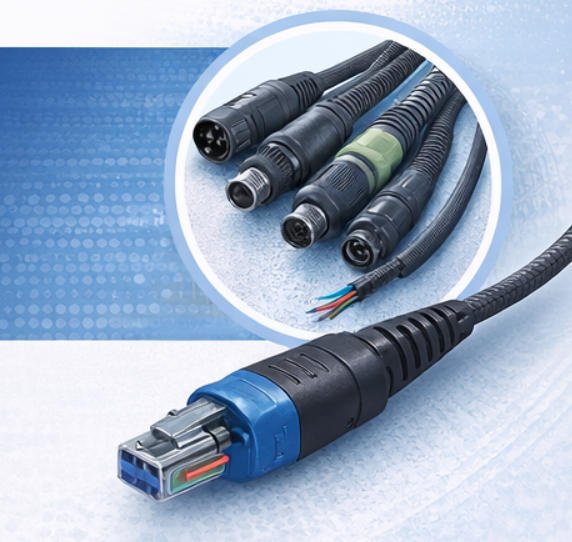
How to Make the Final Decision?
Before I “lock” a material on any overmolded cable assembly, I stop looking at resin price and start looking at total riskmanufacturing risk and field-failure risk. In my experience, the wrong choice usually doesn’t fail in the first sample; it fails after temperature cycling, chemical exposure, or repeated bending in real use. So the final decision should be a mix of performance fit + process stability + validation proof, not just a line item cost.
1.Total Cost Isn’t Just Material Price
Material price is the smallest number on the spreadsheet
What really moves your total cost is what happens after you choose the polymer:
A) Scrap rate risk (narrow processing windows)
- Some materials/grades are less forgiving in molding: tighter temperature control, moisture sensitivity, and more sensitivity to flow/venting.
- Higher scrap doesn’t just waste resin—it wastes connectors, cable, labor, and machine time.
- In production, a “slightly unstable” process turns into lot-to-lot appearance variation, voids, weak knit lines, or inconsistent adhesion.
B) Rework risk (appearance defects, flash, sink, flow marks)
- Overmold is customer-visible. Cosmetic issues often trigger 100% screening or rework.
- Flash removal can damage the boot edge and create future tearing points.
- Color shift or surface tackiness becomes a customer complaint even if electrical performance is fine.
C) Warranty risk (field failures cost more than resin)
- A field return costs far more than the material delta between PVC/TPE/TPU.
- Typical “expensive” failures: cold cracking, sticky surface after aging, boot tear after flex cycles, overmold rotation/slip from poor adhesion, and sealing assumptions.
My rule: If the application is harsh (abrasion/oil/high flex), I’d rather pay more for the right material and stable design than pay repeatedly for RMAs.
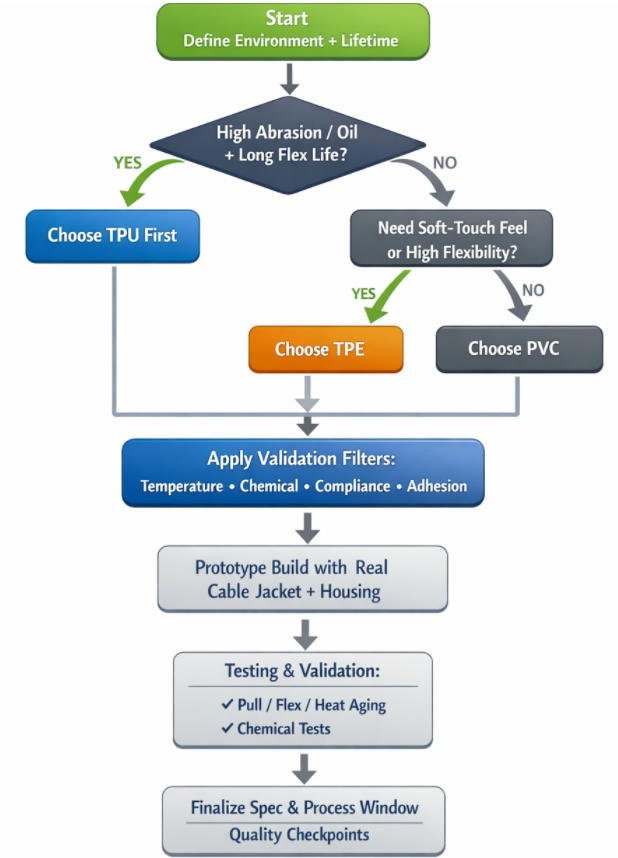
2.A Simple Decision Flow (use as a graphic)
Here’s a clean flow you can paste into your blog. I use this logic as the first pass, then I narrow down by temperature/chemicals/compliance/adhesion proof.
FAQ:
Q1. Is TPU always better than TPE?
A:Not always. While TPU generally offers superior abrasion resistance, chemical durability, and toughness, TPE is often more cost-effective, easier to process, and provides a softer feel. The “better” choice depends on your application. For harsh environments with high mechanical demands, TPU is often preferred. For ergonomic, indoor, or consumer products, TPE may be the smarter option.
Q2. Can overmold be waterproof?
A:Overmolding alone does not automatically make a cable assembly waterproof. While it can provide splash resistance and basic environmental sealing, achieving full waterproofing (such as IP67 or IP68) requires dedicated sealing features, proper mold design, and validation testing. If true waterproof performance is required, the overmold must be part of a fully engineered sealing system.
Q3. What matters more: material or mold design?
A:Both are critical, and one cannot succeed without the other. A high-quality material can still fail if the mold design is poorsuch as having thin walls, short strain reliefs, or sharp transitions. Similarly, even a great design will not perform well if the wrong material is used for the environment or load. In short, optimal performance comes from the right combination of both material and tooling design.
Q4. Do I need special surface prep for adhesion?
A:Yes, in many cases, especially when bonding overmolded material to low-surface-energy jackets or hard plastic housings. Some materials, like TPU, may require a primer or mechanical locking features to ensure proper adhesion. Without surface preparation or testing, there’s a risk the overmold could slip, rotate, or fail under tension. Always validate adhesion during development to avoid field issues later.
Conclusion
Choosing the right overmolding material isn’t just a technical decision it directly impacts your cable’s performance, lifespan, and cost-efficiency. As I’ve learned through hands-on experience, each material serves a specific purpose: PVC is perfect when budget matters most, TPE offers excellent flexibility and comfort for everyday use, and TPU delivers unmatched toughness for demanding, rugged environments.
If you’re unsure which material is the best fit for your application, don’t guess ask the experts. At Yihetai Cable, we’ve spent over 23 years helping clients around the world design and manufacture high-performance, custom cable assemblies that meet the toughest standards.
Related Blog:
- What Is Overmolding Cable Assemblies and How to Know When to Use It Effectively?
- How to Design a Custom Wire Harness for Harsh Environments?
- How to Choose Between Metal and Plastic Connector Housings for Your Cable Assembly Needs?
- How to Prevent Common JST Cable Assembly Failures in Your Product Design
- Flat Cable vs Round Cable in Consumer Electronics Which Is Better for Your Needs?